

In recent months, a sophisticated Android malware campaign has emerged, targeting banking users in India under the disguise of a “KYC verification” application. Distributed primarily through WhatsApp, this malware leverages social engineering and advanced evasion techniques to compromise devices and harvest highly sensitive financial data.
This article breaks down the architecture, behavior, and risks associated with this campaign, offering a clear, technical understanding suitable for cybersecurity professionals, researchers, and informed users.
Introduction to the Threat
The malware masquerades as a legitimate banking compliance application, tricking users into believing they must complete a mandatory KYC update. Once installed, it initiates a multi-stage infection chain designed to maintain persistence, evade detection, and exfiltrate financial data.
At its core, the attack combines:
- Social engineering (fake update prompts)
- Multi-stage payload delivery
- Native code obfuscation
- Real-time command-and-control (C2) communication
- WebView-based phishing interfaces
This layered approach significantly increases its effectiveness and resilience.
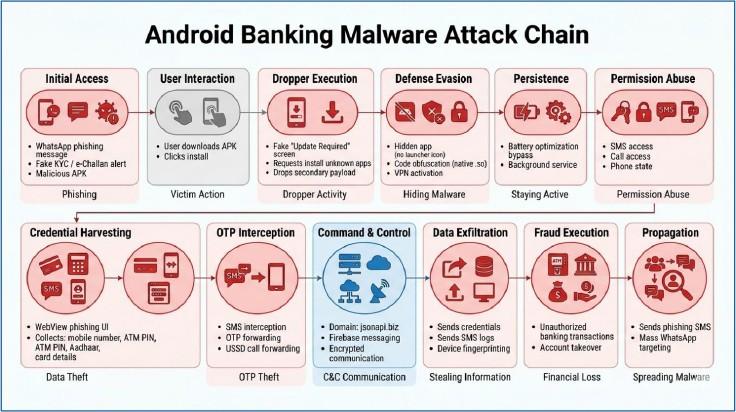
Multi-Stage Dropper Architecture
The malware operates using a two-stage design:
Stage 1: Dropper Application
- Disguised as a banking app
- Requests permission to install unknown apps
- Decrypts an embedded payload using XOR-based logic
- Installs a hidden secondary APK silently
Stage 2: Payload Execution
- Runs without appearing in the app launcher
- Gains access to SMS, calls, and system-level functions
- Establishes persistent communication with a remote server
This architecture allows the initial app to appear relatively benign while the real malicious activity is handled by the hidden payload.
Advanced Obfuscation Using Native Code
One of the most notable aspects of this malware is its use of native libraries (.so files) to conceal critical components such as:
- C2 endpoint:
https://jsonapi[.]biz - Encryption keys
- Agent identifiers
By moving these elements into native code, attackers significantly reduce visibility during static analysis, making reverse engineering more complex.
Command-and-Control via Firebase
Instead of relying solely on traditional HTTP communication, the malware integrates Firebase Cloud Messaging (FCM) for remote command execution.
Capabilities include:
- Sending SMS messages
- Intercepting incoming SMS (including OTPs)
- Initiating phone calls
- Executing USSD commands
This hybrid communication model (Firebase + HTTP backend) improves reliability and reduces detection risk.
Telephony and SMS Exploitation
The malware heavily abuses Android telephony features:
- SMS interception: Captures OTPs and forwards them to attackers
- Bulk SMS extraction: Dumps entire inbox data
- Call control: Initiates calls remotely
- USSD execution: Enables call forwarding and network queries
This functionality directly supports financial fraud operations.
VPN-Based Traffic Manipulation
A particularly dangerous feature is the built-in VPN service:
- Routes all device traffic through a controlled tunnel (
10.0.0.2) - Enables real-time traffic monitoring and filtering
- Can disrupt security services like Google Play Protect
This effectively turns the infected device into a monitored endpoint under attacker control.
WebView Phishing Framework
The malware includes a Next.js-based phishing interface rendered inside a WebView.
Phishing Flow:
- Mobile number + ATM PIN
- Aadhaar + date of birth
- Card details (number, CVV, expiry, PIN)
- Fake “verification in progress” screen
This staged approach increases user trust and completion rates, maximizing data theft.
Data Exfiltration Pipeline
All collected data is:
- Structured into JSON format
- Encrypted locally
- Sent via HTTP POST requests to the C2 server
Each transmission includes:
- Device ID
- Timestamp
- Event metadata
This indicates a well-organized backend capable of managing large-scale fraud operations.
Persistence Mechanisms
To remain active and undetected, the malware:
- Requests battery optimization exemption
- Uses
WAKE_LOCKfor continuous execution - Hides its launcher icon
- Operates independently of the original dropper
These techniques ensure long-term persistence on infected devices.
Threat Actor Insights
Evidence suggests a connection to previous e-Challan fraud campaigns, based on:
- Similar domain patterns (
jsonserv,jsonapi) - Shared phishing themes
- Identical attack techniques
The infrastructure evolution—from basic obfuscation to native code concealment—indicates increasing sophistication and adaptation.
Security Implications
This campaign highlights several critical risks:
- Large-scale credential harvesting
- Real-time OTP interception
- Full device surveillance via VPN
- Stealthy persistence mechanisms
It represents a mature, financially motivated cybercrime operation targeting mobile users.
Our Opinion on This Case
This malware campaign is not just another phishing attempt—it represents a significant evolution in mobile financial threats. What stands out is the level of operational maturity. The attackers are no longer relying on simple fake apps; instead, they are deploying multi-stage architectures, native code obfuscation, and hybrid communication systems that rival advanced persistent threats.
The use of Firebase for command delivery is particularly clever. It blends malicious traffic with legitimate services, making detection far more difficult. Combined with VPN-based traffic control, this creates a highly controlled environment where the attacker can monitor, manipulate, and exploit user activity with minimal interference.
However, the most concerning aspect is the psychological precision of the attack. The staged KYC workflow mirrors real banking processes closely enough to deceive even cautious users. This indicates a deep understanding of user behavior, not just technical capability.
From a defensive standpoint, traditional antivirus solutions alone are no longer sufficient. Behavioral detection, user awareness, and strict app installation policies are now essential.
Ultimately, this campaign reinforces a critical reality: mobile devices have become primary financial targets, and attackers are investing heavily in making their tools more stealthy, scalable, and convincing than ever before.
INDICATORS OF COMPROMISE
| Indicator | Type | Remarks |
| 34479b18597f1a0deb5d55b8450bc21af1d1f638c4ceca1ee19e6f5ac89d6be2 | Sha256 | Dropper |
| 1d261b45e73b5b712becb12ed182ec89d3dd0d73143a2dd8ff5512da489a50eb | Sha256 | Dropped apk |
| Jsonapi[.]biz | Domain | C2 |
| jsonserv[.]biz | Domain | C2 |
| jsonserv[.]xyz | Domain | C2 |
MITRE ATTACK FRAMEWORK For Mobile
| S.N | Tactic | Technique |
| 1. | Initial Access (TA0027) | T1660: Phishing |
| 2. | Persistence (TA0028) | T1541: Foreground Persistence T1603: Scheduled Task/Job |
| 3. | Defense Evasion (TA0030) | T1628: Hide Artifacts T1628.002: Hide Artifacts: User Evasion T1406: Obfuscated Files or Information |
| 4. | Credential Access (TA0031) | T1417: Input capture |
| 5. | Discovery (TA0032) | T1418: Software Discovery T1426: System Information Discovery T1422: Internet Connection Discovery |
| 6. | Collection (TA0035) | T1414: Input capture T1636.004: Protected User Data: SMS Messages T1636.002: Protected User Data: Call log T1616: Call Control |
| 7. | Command and Control (TA0037) | T1437: Application Layer Protocol T1437.001: Application Layer Protocol: Web Protocols T1521: Encrypted Channel T1481: Web Services |
| 8. | Exfiltration (TA0036) | T1646: Exfiltration Over C2 Channel |
