

The cyber threat landscape in 2026 has entered a new phase where artificial intelligence is no longer an experimental enhancement for attackers but a core operational capability. According to findings from Google Threat Intelligence Group (GTIG), threat actors are now integrating generative AI into every stage of the cyber attack lifecycle, from vulnerability discovery and malware development to reconnaissance, social engineering, autonomous malware execution, and supply chain compromise. The report highlights a dangerous shift where AI simultaneously acts as a force multiplier for adversaries and a highly valuable attack surface for cybercriminals and nation-state groups alike.
AI-Driven Vulnerability Discovery and Zero-Day Exploitation
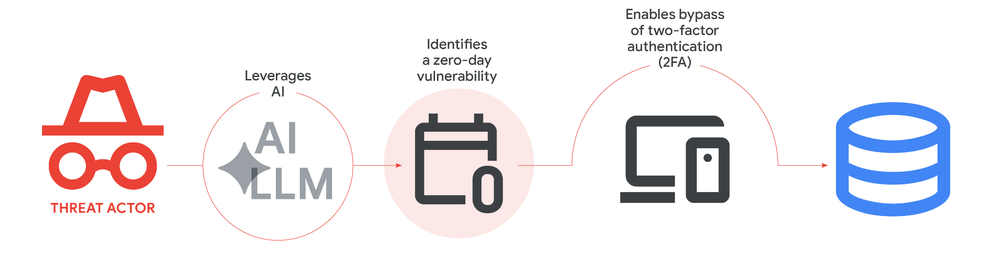
One of the most alarming developments identified by GTIG is the first observed case of a threat actor likely using AI to develop a zero-day exploit. Cybercriminals reportedly created a Python-based exploit capable of bypassing two-factor authentication on a widely used web-based administration platform. Investigators discovered that the exploit displayed several characteristics strongly associated with AI-generated code, including highly structured formatting, educational-style docstrings, hallucinated vulnerability scoring, and polished coding conventions often produced by large language models.
The significance of this event extends far beyond a single vulnerability. Traditional vulnerability discovery methods rely heavily on fuzzing tools and static analysis engines that identify memory corruption or unsafe input handling. However, modern frontier AI models excel at understanding contextual logic flaws hidden inside complex application workflows. These systems can detect semantic inconsistencies, hardcoded trust assumptions, and authorization weaknesses that conventional scanners may overlook. Nation-state groups linked to the People’s Republic of China (PRC) and North Korea have reportedly leveraged AI-enhanced vulnerability datasets and specialized repositories containing tens of thousands of historical vulnerability records to train and refine their exploit development workflows.
AI-Augmented Malware and Defense Evasion
Threat actors are increasingly using AI to accelerate malware development and improve defense evasion techniques. GTIG documented malware families that employ AI-generated decoy code, dynamic payload generation, and automated obfuscation strategies designed to bypass static security controls. Malware variants such as CANFAIL and LONGSTREAM reportedly contain massive amounts of inactive but legitimate-looking code inserted specifically to confuse analysts and evade detection systems.
This evolution demonstrates how generative AI is enabling adversaries to industrialize malware production. AI-assisted coding allows attackers to rapidly generate polymorphic malware variants capable of altering their structure dynamically. Russia-linked threat actors targeting Ukrainian organizations have used these techniques to deploy malware that appears operationally legitimate while hiding malicious functionality beneath layers of filler content. Additionally, PRC-linked groups have leveraged AI to develop operational relay box (ORB) management infrastructure that obscures attacker origins by routing malicious traffic through residential mobile networks and anonymized relay chains.
Autonomous Malware Operations and PROMPTSPY
The emergence of autonomous malware frameworks marks one of the most technically advanced shifts in cyber operations. GTIG’s analysis of the Android malware PROMPTSPY revealed how attackers are integrating large language models directly into malware orchestration systems. Unlike traditional malware that relies heavily on manual operator commands, PROMPTSPY can autonomously interpret device states, analyze user interface layouts, and execute actions such as clicks, swipes, and navigation decisions using AI-generated instructions.
PROMPTSPY leverages Google Gemini APIs to serialize device interface structures into machine-readable formats before sending them to an AI model for analysis. The model returns structured command responses that the malware converts into physical interactions on the compromised device. Researchers also identified capabilities for biometric replay attacks, persistence mechanisms using overlay-based uninstall prevention, and runtime infrastructure rotation that enables operators to update command-and-control endpoints without redeploying malware payloads. This level of operational resilience demonstrates how AI is fundamentally changing malware behavior from static automation to adaptive decision-making systems.
AI-Powered Reconnaissance and Information Operations
Beyond malware and exploits, threat actors are heavily using AI as a reconnaissance and operational research assistant. Adversaries now employ large language models to map enterprise organizational structures, identify third-party vendor relationships, and generate highly personalized phishing campaigns. These AI-assisted workflows significantly reduce the manual effort required for intelligence gathering and social engineering preparation.
GTIG also documented sophisticated information operations leveraging synthetic media, AI voice cloning, and deepfake content. The pro-Russia campaign known as “Operation Overload” reportedly used AI-generated voice synthesis to impersonate journalists and manipulate authentic video footage into disinformation campaigns. These tactics represent a substantial escalation in influence operations because AI dramatically lowers the cost and time required to create convincing fabricated media at scale.
Supply Chain Attacks Targeting AI Ecosystems
As enterprises increasingly integrate AI platforms into production environments, attackers have shifted focus toward the broader AI software supply chain. GTIG identified several incidents involving compromised AI libraries, malicious plugins, trojanized configuration files, and vulnerable open-source dependencies. Threat actors associated with “TeamPCP” reportedly compromised repositories connected to widely used security and AI integration platforms including LiteLLM, Trivy, and Checkmarx.
These attacks highlight how AI ecosystems introduce entirely new categories of enterprise risk. Compromised AI integration layers can expose API keys, cloud credentials, authentication tokens, and internal AI models. Once attackers gain access, they can pivot deeper into enterprise networks, exfiltrate sensitive information, or weaponize internal AI systems for reconnaissance and lateral movement. The increasing popularity of AI agents, autonomous plugins, and third-party integrations significantly expands the modern attack surface.
Our Opinion on the Future of AI-Driven Cybersecurity Threats
The findings presented by GTIG clearly indicate that the cybersecurity industry is entering an era where artificial intelligence will become deeply embedded in offensive cyber operations. What makes this transformation particularly dangerous is not simply the automation of existing attacks, but the emergence of adaptive and autonomous cyber systems capable of reasoning, decision-making, and dynamic interaction with victim environments. Traditional defensive models built around static detection, signature analysis, and rule-based monitoring may struggle to keep pace with malware capable of evolving behavior in real time.
At the same time, this report demonstrates that AI itself has become a critical component of enterprise infrastructure and therefore an attractive target for adversaries. Organizations adopting AI technologies must recognize that securing the core model alone is insufficient. The surrounding ecosystem, including APIs, plugins, orchestration layers, cloud connectors, training pipelines, and third-party dependencies, represents a rapidly expanding attack surface that requires comprehensive governance and security controls.
In our view, the future of cybersecurity will increasingly depend on AI-versus-AI dynamics. Defensive teams will need to deploy equally advanced AI systems capable of autonomous detection, behavioral analysis, and rapid response to counter highly adaptive adversarial operations. Enterprises that fail to modernize their security posture for this new AI-driven threat environment may face unprecedented operational and financial risks in the coming years.
| Tactic | Technique | Procedure(s) |
| Reconnaissance | T1592.001: Gather Victim Host Information: Hardware | A threat actor attempted to identify the exact make and model of a computer used by a high-value target and prompted an LLM to provide photos showing the targeted individual using the device. |
| Reconnaissance | T1591.002: Gather Victim Org Information: Business Relationships | Threat actors prompted AI models to generate detailed third-party relationships of large enterprises. |
| Reconnaissance | T1591.004: Gather Victim Org Information: Identify Roles | Threat actors prompted AI models to generate detailed organizational hierarchies for specific departments, focusing on high-value functions such as finance, internal security, and human resources. |
| Resource Development | T1587.001: Develop Capabilities: Malware | Adversaries leveraged AI-augmented research to develop malware, such as CANFAIL and LONGSTREAM. |
| Resource Development | T1587.004: Develop Capabilities: Exploits | Adversaries leveraged AI-augmented research to develop exploits, such as the identification of 2FA bypass vulnerability in a server administration tool and development of an exploit. |
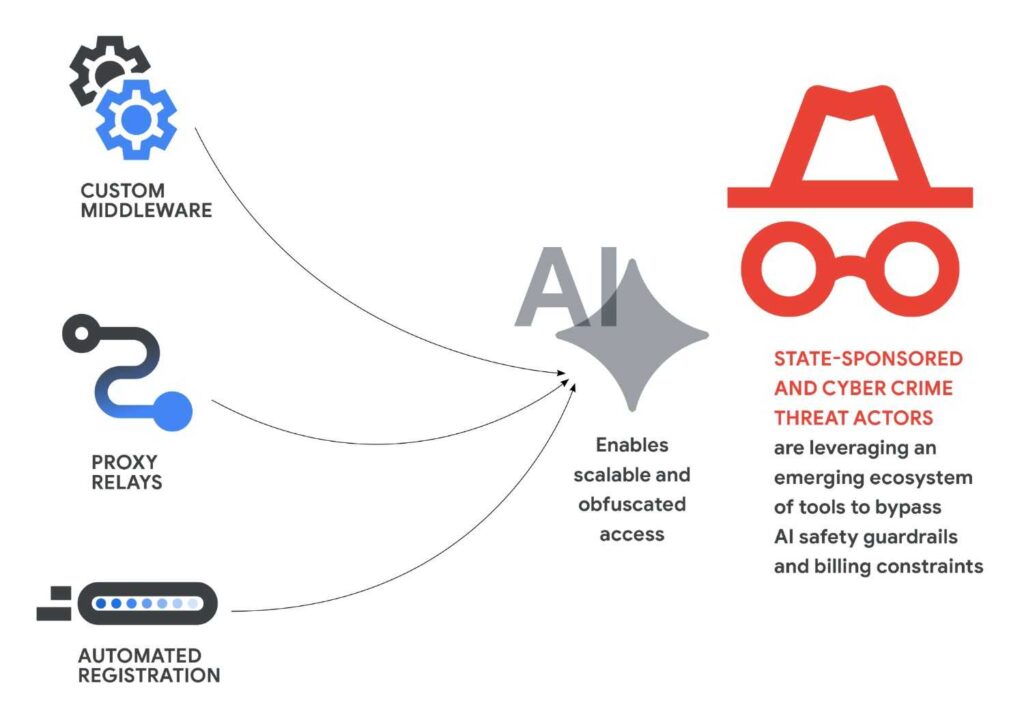
| Resource Development | T1588.002: Obtain Capabilities: Tools | Threat actors identified and downloaded specialized, community-developed middleware projects from GitHub, such as CLIProxyAPI, which were then configured to serve as a persistent aggregation layer for managing API keys. |
| Resource Development | T1588.005: Obtain Capabilities: Exploits | Threat actors leveraged AI to obtain known exploits of vulnerabilities against targeted systems. |
| Resource Development | T1588.006: Obtain Capabilities: Vulnerabilities | Threat actors leverage AI to research known vulnerabilities of targeted systems. |
| Resource Development | T1588.007: Obtain Capabilities: Artificial Intelligence | Adversaries utilize automated pipelines, such as the ChatGPT Account Auto-Registration Tool, to programmatically exploit the registration flows of legitimate providers. |
| Initial Access | T1566: Phishing | Threat actors leverage LLMs to research targeted victims and craft higher-fidelity phishing lures. |
| Defense Evasion | T1027.014: Obfuscated Files or Information: Polymorphic Code | Malware families such as PROMPTFLUX employ automated code modification to vary file signatures and bypass legacy security controls. |
| Defense Evasion | T1027.016: Obfuscated Files or Information: Junk Code Insertion | Malware families such as CANFAIL and LONGSTREAM contain decoy code to help disguise the malicious nature of the code family. |
| Command and Control | T1090.003: Proxy: Multi-hop Proxy | We observed APT27 leverage AI models to accelerate the development of a fleet management application to support the network management for an ORB network using multi-hop configurations. |
