
The cybersecurity landscape is continuously evolving as threat actors adopt emerging technologies to improve stealth, resilience, and operational effectiveness. One of the most significant developments in recent years is the misuse of blockchain technology and smart contracts as components of malicious command-and-control (C2) infrastructure. Traditionally, cybercriminals relied on centralized servers, compromised websites, or fast-flux networks to host payloads and maintain communication with infected systems. However, the increasing sophistication of security tools and threat intelligence platforms has made traditional infrastructure easier to identify, block, and dismantle.
A recent investigation by Trend Micro revealed how the ClearFake threat campaign leveraged smart contracts and blockchain technologies to conceal malicious operations, creating a decentralized and highly resilient delivery mechanism for malware payloads. This technique demonstrates how attackers are adapting modern decentralized technologies to overcome traditional cybersecurity defenses and maintain persistence in increasingly monitored environments.
Understanding Smart Contracts and Their Security Implications
Smart contracts are self-executing programs deployed on blockchain networks that automatically execute predefined actions when specific conditions are met. Unlike traditional applications that operate on centralized servers, smart contracts exist across distributed blockchain nodes, making them highly resistant to tampering and removal.
The primary purpose of smart contracts was to facilitate decentralized finance (DeFi), automate digital agreements, and eliminate the need for intermediaries. However, the same characteristics that make smart contracts attractive for legitimate applications—immutability, transparency, decentralization, and global accessibility—also make them appealing to cybercriminals. Because smart contracts cannot be easily altered or removed after deployment, attackers can store configuration data, malicious scripts, payload locations, and operational instructions within blockchain networks. Security teams cannot simply take down a blockchain-hosted resource the same way they would disable a malicious web server or seize a command-and-control domain. This fundamental shift creates significant challenges for defenders attempting to disrupt malicious infrastructure.
The Evolution of Command-and-Control Infrastructure
Command-and-control infrastructure represents the communication channel between compromised systems and threat actors. Once malware infects a device, it requires a mechanism to receive instructions, download additional payloads, exfiltrate data, and maintain persistence.
Historically, attackers utilized dedicated servers, domain generation algorithms (DGAs), proxy networks, cloud storage services, and social media platforms to establish command-and-control channels. The MITRE ATT&CK framework categorizes these methods under Command and Control (TA0011), highlighting techniques such as web services, dynamic resolution, encrypted channels, proxy usage, and multi-stage communication architectures. As cybersecurity vendors became more effective at identifying malicious domains and infrastructure, attackers increasingly sought decentralized alternatives. Blockchain-based command-and-control systems represent the next phase of this evolution, providing adversaries with infrastructure that is difficult to seize, monitor, or disrupt.
ClearFake Campaign: A New Generation of Blockchain-Enabled Threats
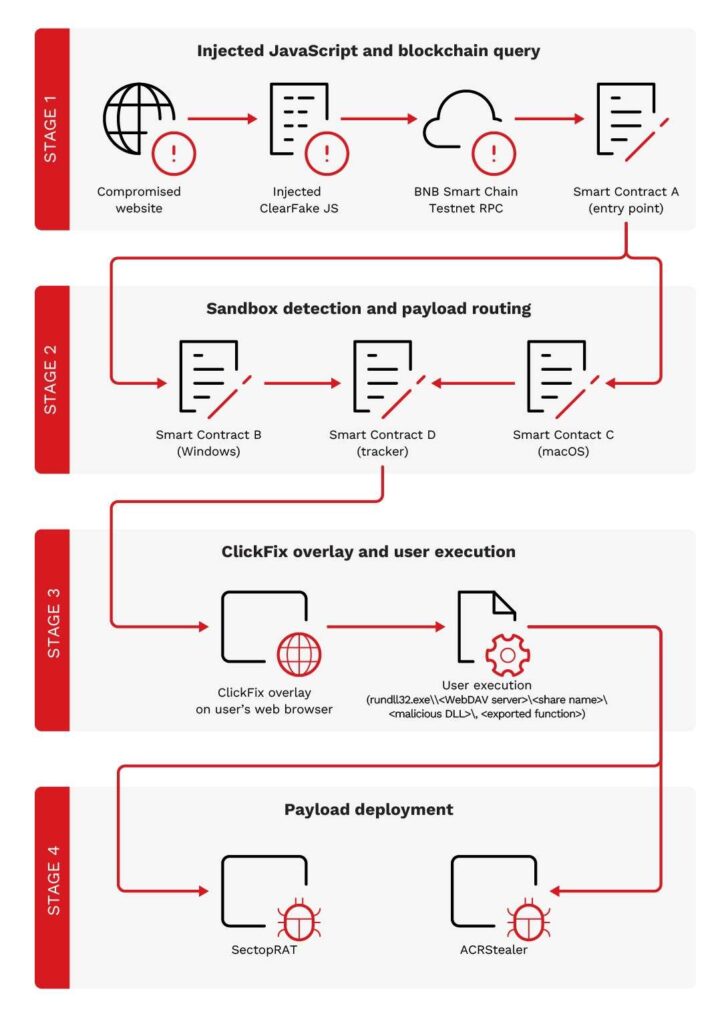
Trend Micro researchers observed the ClearFake threat campaign adopting an innovative technique known as EtherHiding. Instead of relying on traditional command-and-control servers, the attackers used smart contracts hosted on blockchain platforms to facilitate malware delivery and operational control. The attack chain begins when a victim visits a compromised website. Embedded malicious JavaScript initiates communication with blockchain-hosted smart contracts through public blockchain interfaces. These contracts contain encoded information that points infected systems toward additional malicious resources, payloads, or commands.
Because the blockchain interaction occurs through legitimate public infrastructure, security products often struggle to distinguish malicious activity from legitimate blockchain usage. The communication appears as normal traffic directed toward blockchain nodes or public RPC endpoints, significantly reducing the likelihood of detection. Additionally, blockchain transactions are globally distributed and replicated across thousands of nodes, making infrastructure takedowns exceptionally difficult. Even if defenders identify a malicious smart contract, removing it from the blockchain is effectively impossible due to the immutable nature of distributed ledger technology.
EtherHiding: Leveraging Blockchain Immutability for Malware Operations
EtherHiding represents a significant advancement in attacker tradecraft because it weaponizes one of blockchain’s most celebrated features: immutability.
In traditional attacks, defenders often neutralize threats by taking down malicious domains, blocking hosting providers, or seizing command-and-control servers. EtherHiding fundamentally changes this dynamic. Instead of storing malicious infrastructure on conventional hosting environments, threat actors embed operational data within smart contracts that reside permanently on public blockchains.
This approach offers several advantages to attackers:
- Resistance to takedown operations
- High availability through distributed blockchain nodes
- Reduced dependence on centralized infrastructure
- Increased operational anonymity
- Greater difficulty for threat intelligence tracking
By distributing critical components of their infrastructure across decentralized networks, attackers create a command-and-control architecture that remains accessible even when portions of the campaign are exposed or disrupted. This increases operational resilience and extends campaign lifespans compared to traditional malware infrastructure.
Detection Challenges for Security Teams
The use of blockchain technology introduces several challenges for cybersecurity professionals and incident response teams. First, blockchain communications often appear legitimate because organizations increasingly interact with decentralized applications, cryptocurrency platforms, and blockchain services as part of normal business operations. Blanket blocking of blockchain traffic may not be feasible for many enterprises.
Second, threat intelligence platforms typically focus on identifying suspicious domains, IP addresses, and hosting providers. Smart contracts operate outside these traditional indicators of compromise, requiring defenders to develop entirely new visibility and monitoring strategies.
Third, the decentralized nature of blockchain networks complicates attribution efforts. Threat actors can deploy contracts through anonymous wallets, interact through multiple blockchain ecosystems, and route communications through public infrastructure that spans numerous jurisdictions.
As blockchain adoption continues to increase globally, distinguishing legitimate blockchain activity from malicious command-and-control communications will become increasingly complex. Security teams must therefore expand their monitoring capabilities beyond conventional network indicators and incorporate blockchain analytics into their defensive frameworks.
The Growing Trend of Blockchain Abuse in Cybercrime
The ClearFake campaign is not an isolated incident. Researchers across the cybersecurity industry have documented a growing number of cases where blockchain technologies are being abused for malicious purposes. Recent investigations have highlighted threat groups embedding malicious code, payload references, and operational instructions directly into blockchain networks. Nation-state actors and financially motivated cybercriminals are increasingly experimenting with decentralized technologies to enhance persistence and evade detection. This trend aligns with a broader pattern in cybercrime where attackers continuously adopt legitimate technologies before defenders fully understand the associated risks. Just as cloud platforms, social media services, and content delivery networks were eventually weaponized by threat actors, blockchain ecosystems are now becoming part of the modern cybercriminal toolkit.
Defensive Strategies Against Blockchain-Based Command-and-Control
- Organizations must begin preparing for a future where blockchain-hosted infrastructure becomes a standard component of advanced cyberattacks.
- Security teams should establish visibility into blockchain-related traffic patterns, including interactions with public RPC endpoints and decentralized application services.
- Rather than focusing solely on indicators of compromise, organizations should prioritize behavioral analytics capable of identifying unusual script execution, browser-based exploitation, and anomalous network communications.
- Modern threat intelligence programs should incorporate blockchain analytics, wallet tracking, and smart contract monitoring alongside traditional infrastructure analysis.
- Advanced EDR solutions can help identify malicious processes, script execution chains, and suspicious browser activity before blockchain-hosted payloads are fully deployed.
- Many blockchain-enabled attacks still rely on compromised websites, phishing campaigns, and social engineering techniques. Educating users remains a critical component of organizational defense.
Our Opinion: Why This Development Signals a New Era of Cyber Threats
The ClearFake campaign demonstrates a fundamental shift in how cybercriminals approach infrastructure resilience and operational security. While blockchain technology was originally designed to create trustless, decentralized systems for legitimate innovation, attackers are now exploiting those same principles to build infrastructure that is significantly harder to detect, disrupt, and investigate. From our perspective, this development represents one of the most important warning signs for the cybersecurity industry. Traditional security models have been built around the assumption that malicious infrastructure can eventually be identified and removed. Blockchain-based command-and-control challenges that assumption by introducing infrastructure that is effectively permanent once deployed. This forces defenders to move away from reactive takedown strategies and toward proactive detection methodologies.
The broader concern is not merely the use of smart contracts themselves, but the growing convergence between emerging technologies and cybercrime operations. As artificial intelligence, decentralized applications, Web3 ecosystems, and autonomous systems mature, attackers will continue finding creative ways to weaponize these technologies faster than organizations can adapt. Security leaders should view the ClearFake case as an early indicator of a larger trend rather than an isolated incident. Organizations that begin investing today in blockchain visibility, behavioral analytics, and advanced threat hunting capabilities will be significantly better positioned to defend against the next generation of decentralized cyber threats.
Conclusion
The adoption of smart contracts for command-and-control operations marks a significant evolution in cybercriminal tactics. By leveraging blockchain technology and techniques such as EtherHiding, threat actors are creating decentralized infrastructures that challenge traditional security assumptions and defensive approaches. The ClearFake campaign highlights how blockchain immutability, decentralization, and resilience can be repurposed for malicious objectives, forcing defenders to rethink existing security strategies. As blockchain adoption continues to expand worldwide, cybersecurity teams must prepare for a future where decentralized infrastructure becomes a common component of advanced threat campaigns. Organizations that proactively adapt their detection, monitoring, and threat intelligence capabilities will be better equipped to identify and mitigate these emerging threats before they become mainstream attack methodologies.
