

Windows Interprocess Communication (IPC) remains one of the most intricate components of the Windows operating system. At the center of this ecosystem lies Remote Procedure Call (RPC), a mechanism that allows processes to communicate across different execution contexts. While RPC powers many essential Windows services, its complexity has historically made it a fertile ground for security vulnerabilities—ranging from local privilege escalation to remote code execution.
This article explores a newly identified architectural weakness in Windows RPC that enables a novel local privilege escalation technique. The issue is particularly concerning because it is likely present across multiple Windows versions and remains unpatched despite responsible disclosure.
Understanding RPC and ALPC in Windows
RPC follows a client-server model where one process (client) invokes functions exposed by another process (server). Each RPC interface is identified by a UUID and accessed via endpoints such as TCP ports, named pipes, or ALPC (Advanced Local Procedure Call) ports.
ALPC is especially important for local communication. It acts as a high-performance messaging channel between processes on the same machine. When a client initiates an RPC call, it constructs a request containing metadata like interface UUID, endpoint, and operation number (OPNUM).
The Role of Impersonation
A critical feature in Windows security is impersonation, which allows a server process to temporarily adopt the identity of a client. This is controlled by:
- Impersonation levels (Anonymous → Delegate)
- Security Quality of Service (SQOS)
- SeImpersonatePrivilege
Only processes with this privilege can impersonate others, typically services like Local Service or Network Service. While this mechanism is essential for legitimate operations, it becomes dangerous when misused.
The Core Vulnerability
The vulnerability stems from how RPC handles connections to unavailable servers. When a legitimate RPC server is not running, Windows does not adequately verify the authenticity of a replacement server exposing the same endpoint.
Key Insight:
An attacker can:
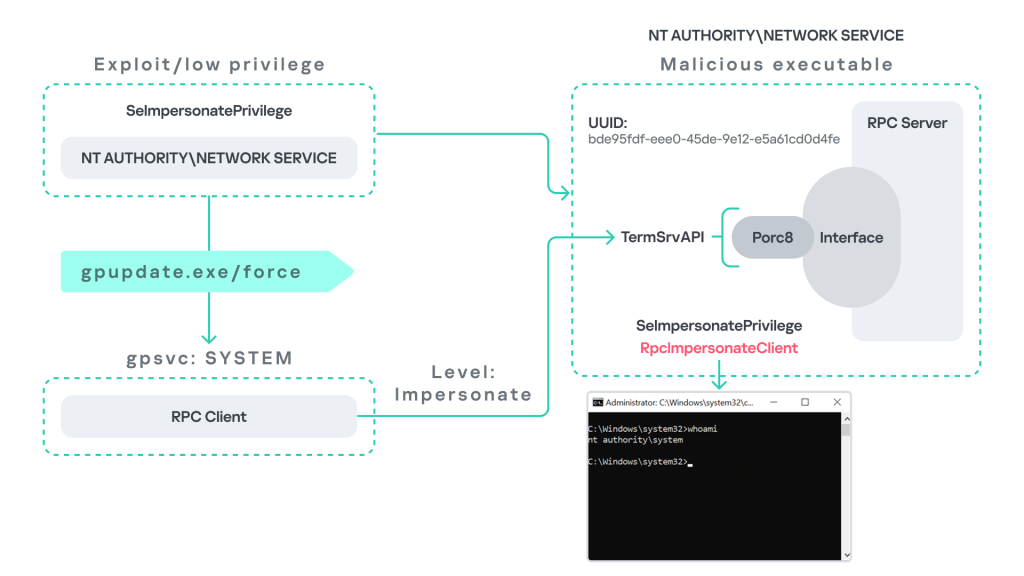
- Compromise a low-privileged service (e.g., Network Service)
- Deploy a fake RPC server mimicking a legitimate one
- Wait for a privileged client (e.g., SYSTEM process) to connect
- Use
RpcImpersonateClientto elevate privileges
This allows escalation from Network Service → SYSTEM or Local Service → Administrator.
Real-World Exploitation Scenarios
The research demonstrates multiple attack paths:
1. Group Policy Abuse
Triggering gpupdate /force causes SYSTEM-level RPC calls to a disabled service (TermService). A malicious server can intercept and impersonate SYSTEM.
2. User Interaction (Microsoft Edge)
Launching Edge triggers RPC calls. If intercepted, attackers can escalate to Administrator without coercion.
3. Background Services (WDI)
The Diagnostic Service periodically makes RPC calls, enabling passive privilege escalation without user interaction.
4. DHCP Client Abuse
If DHCP service is disabled, tools like ipconfig trigger exploitable RPC calls.
5. Windows Time Service Trick
A non-existent endpoint (\PIPE\W32TIME) can be spoofed, allowing privilege escalation even when the legitimate service is running.
Why This Is Dangerous
- Architectural flaw: Not a single bug, but a systemic design issue
- Unlimited attack surface: Any RPC-dependent service can become a vector
- Stealthy exploitation: Some attacks require no user interaction
- Wide impact: Likely affects multiple Windows versions
Despite these risks, Microsoft classified the issue as moderate severity due to the requirement of SeImpersonatePrivilege, and no patch or CVE has been issued.
Detection and Mitigation Strategies
Although a full fix requires architectural changes, organizations can reduce risk:
Detection
- Use Event Tracing for Windows (ETW) to monitor:
- RPC failures (
RPC_S_SERVER_UNAVAILABLE) - High impersonation levels
- High-privilege client processes
- RPC failures (
Mitigation
- Ensure critical services (e.g., TermService) are enabled when expected
- Minimize use of SeImpersonatePrivilege
- Monitor unusual RPC endpoints and bindings
- Audit services exposing RPC interfaces
These steps can significantly reduce the attack surface.
Our Opinion on This Case
This research highlights a recurring theme in operating system security: architectural trust assumptions often outlive their safety. The Windows RPC model implicitly trusts that a service exposing a known endpoint is legitimate, but modern threat models make this assumption increasingly fragile.
Microsoft’s decision to classify the issue as moderate severity is understandable from a traditional risk perspective—since the attacker already needs SeImpersonatePrivilege. However, in practice, this privilege is widely available across service accounts, making the barrier to exploitation relatively low. In real-world environments, attackers frequently gain such footholds through misconfigurations or initial access vectors.
What makes this vulnerability particularly concerning is its composability. It does not rely on a single exploit chain but instead enables countless variations depending on system configuration. This dramatically increases long-term risk, especially in enterprise environments with diverse service landscapes.
In our view, this should be treated as a design-level security gap rather than a moderate bug. Even if a full patch is complex, introducing stronger RPC server validation or endpoint authentication would significantly improve security posture.
Ultimately, this case reinforces the need for proactive defense—monitoring, least privilege enforcement, and architectural scrutiny—rather than relying solely on vendor patch cycles.
