

Modern threat actors are continuously shifting away from primitive phishing templates in favor of high-fidelity behavioral deception. In a massive distribution infrastructure uncovered by Check Point Research, malicious operators engineered a campaign designed to capture highly targeted search engine traffic by building professional-looking clones of open-source projects and developer utilities. This operation specifically singles out high-value technical profiles—such as security analysts, software developers, and DevOps engineers—by hosting lookalike portals for essential utilities, including Ghidra, dnSpy, ILSpy, grpcurl, MQTT Explorer, MFCMAPI, WinSetupFromUSB, CrystalDiskMark, and GUIFormat.
By manipulating search engine optimization (SEO) mechanics, these fraudulent domains successfully position themselves at the top of organic search engine results pages (SERPs). While early iterations of this domain cluster documented in late 2025 by threat intelligence teams appeared to be passively collecting traffic without delivering active payloads, telemetry from early 2026 indicates a dangerous evolutionary shift. The operators have fully integrated a gated, multi-stage routing infrastructure. This architecture weaponizes the initial user traffic, shifting from a gray-hat traffic acquisition scheme into an active launchpad for severe malware strains, including RemusStealer, AnimateClipper, and a highly sophisticated loader framework dubbed SessionGate.
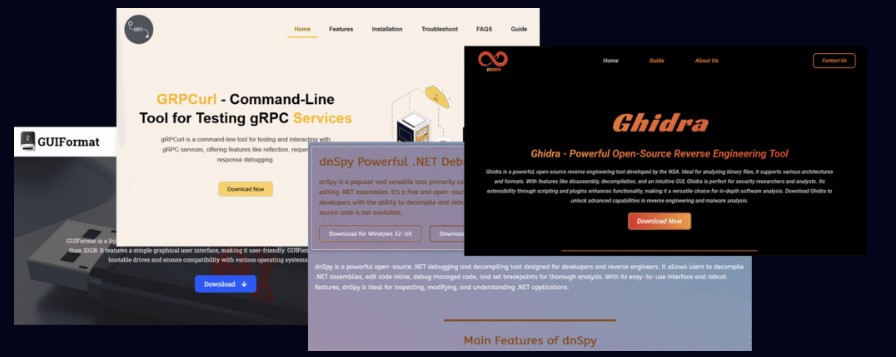
Under the Hood of Click Hijacking: JavaScript CDN Staging and Event Manipulation
The operational core of this ecosystem relies on evasive, client-side browser manipulation designed to bypass traditional user scrutiny. When a user lands on one of these fraudulent portals, such as ghidralite[.]com or dnspy[.]org, hovering over the prominent “Download” button reveals a completely authentic upstream destination, typically pointing directly to the official project release on GitHub. Because the DOM href attribute remains unchanged, standard browser user interface (UI) cues and preliminary URL checks fail to alert the victim.
The real deception is executed by a JavaScript staging layer hosted on legitimate Amazon CloudFront Content Delivery Network (CDN) nodes. The script actively hooks the webpage’s user interactions using localized event capture frameworks. It specifically utilizes the capture-phase mousedown event for desktop Google Chrome and the standard click event for Mozilla Firefox.
As soon as a user interacts with the button, the script executes preventDefault() to halt the browser’s native navigation to GitHub and calls stopImmediatePropagation() to neutralize any secondary security extensions or browser handlers. It then dynamically generates a runtime URL and hands off the browser session to a Traffic Distribution System (TDS). This transition is completed via specialized browser-side serving methods, such as utilizing cached references to window.open or generating synthetic, detached DOM anchor tags whose javascript: URLs quietly manipulate the active window context.

Dynamic Routing and TDS Gating Infrastructure
Once the client-side interaction is hijacked, the user’s browser is funneled into a sophisticated backend Traffic Distribution System (TDS) that serves as a highly selective conditional gateway. The browser is initially pushed to a temporary post-click redirector domain, such as oundhertobeconsist[.]org. This redirection point is not statically defined; rather, it is delivered dynamically via an obfuscated JSON configuration block served directly from the CloudFront infrastructure. The configuration block maps tracking parameters that tightly control the redirection workflow:
JSON
{
  "tagId": 1230479,
  "redirectorDomain": "oundhertobeconsist.org",
  "pixelDomain": "ukentaspectsofc.org",
  "capPerDomain": 2,
  "capPerUri": 1,
  "intervalBetweenPops_ms": 60000,
  "resetInterval_sec": 43200,
  "namespace": "xcvmsbcmxa"
}
The TDS infrastructure uses this metadata to enforce strict client gating and profiling. By collecting browser fingerprints, evaluation states, cookie values, geographic data, and checking for the presence of virtual private networks (VPNs) or datacenter IP blocks, the system builds an effective reproducibility trap. If the backend profiles the incoming request as a security analyst, a threat intelligence automated sandbox, or a return visitor (tracked via local storage frequency caps), the TDS immediately switches the branching outcome. The session is safely diverted away from malicious payloads, downloading benign applications like the Opera browser or forwarding the user to affiliate-tagged browser extension landing pages.
However, if the client matches a clean, vulnerable victim profile, the system passes them through a secondary multi-gate chain (featuring intermediate gates like trkscope[.]xyz and file-enter-web[.]com) before delivering the target malicious payload.
Dissecting SessionGate: A Multi-Stage Anti-Analysis Loader
Among the malware variants distributed at the end of the TDS routing chains, the SessionGate framework stands out due to its heavy obfuscation and anti-analysis design. Frequently bundled alongside Potentially Unwanted Applications (PUAs), SessionGate arrives on the victim’s machine inside a 20 MB self-extracting (SFX) archive. To deceive endpoint detection and response (EDR) platforms, 15 MB of the package consists of an entirely legitimate software installer that executes as a decoy, while the remaining 5 MB hosts the malicious loader code.

The inner functions of the loader are systematically bloated to expand individual function code sizes past 500 KB, a technique specifically chosen to break the graph views, decompilers, and intermediate representation engines of reverse-engineering utilities like IDA Pro. The developers achieve this by intertwining junk code instructions, opaque predicates, and inserting encrypted string blocks directly inside function bodies right after conditional branch splits. This structural manipulation tricks static disassemblers into misinterpreting raw data tables as valid executable code sequences, effectively causing function boundary detection algorithms to fail.
[Decoy Application (15MB)] <--- Embedded inside SFX Archive ---> [Obfuscated Loader (5MB)]
                                                                           |
                                              +----------------------------+----------------------------+
                                              |                                                         |
                                    [Environment Verification]                                [C2 Stage Gating]
                                              |                                                         |
                              - Adler-32 Hashing (npcap, sysmondrv)                     - Domain: appfreshstart[.]com
                              - SHA1 Process Verification                               - UA: NSIS_InetLoad (Mozilla)
                              - Registry Check (PUAProtection)                          - Keyed One-Time Payload
Furthermore, the malware avoids plaintext string storage during environmental checks. When enumerating system services to spot virtualization or capture utilities (such as npf, npcap, sysmondrv, epfw, or ehdrv), it runs Adler-32 checksum calculations on active service handles and compares the output against pre-computed constants. Running processes are audited via Toolhelp API loops using an internal SHA-1 hashing matrix.
The loader also queries specific Windows Registry values associated with Windows Defender security configurations, checking keys like PUAProtection and MpEnablePus. If the environment checks out clean, the loader initiates a multi-step check-in sequence with its command-and-control (C2) architecture—communicating with domains like appfreshstart[.]com, appgetonline[.]com, webinnosetup[.]com, or appmakingcenter[.]com—using a unique NSIS_InetLoad (Mozilla) User-Agent string. The final payload modules are dynamically generated, encrypted server-side, and uniquely keyed for a single execution per client session, leaving analysts with zero capability to decrypt payloads out of band.
Our Opinion on This Case
This campaign represents a critical point of convergence between automated digital advertising exploitation and highly targeted cyber espionage infrastructure. What makes this ecosystem particularly concerning is its deliberate shift toward targeting technically advanced user bases. By building high-fidelity replicas of platforms like Ghidra and dnSpy, these threat actors are no longer casting a generic wide net to entrap non-technical users; they are actively hunting security professionals, system administrators, and developers. Compromising an engineer’s endpoint grants an adversary an initial foothold with elevated privileges, which serves as the ultimate staging ground for lateral movement, source code theft, and enterprise-wide ransomware deployment.
Furthermore, the integration of commercial-grade Traffic Distribution Systems (TDS) demonstrates how modern threat rings are applying legitimate web-monetization engineering to isolate their delivery chains from security telemetry. By leveraging server-side fingerprint gating and client-side frequency caps, they ensure that malicious payloads are only exposed under optimal conditions. This effectively blurs the line between traditional ad-tech fraud and high-level malware staging.
For enterprise defense operations, this case emphasizes that visual trust metrics—such as professional web layouts or valid download hover links—are entirely obsolete. Organizations must transition to strict application control policies, enforce cryptographically validated software provenance, and maintain constant behavioral endpoint monitoring, independent of how authentic a download portal appears on the surface.
