

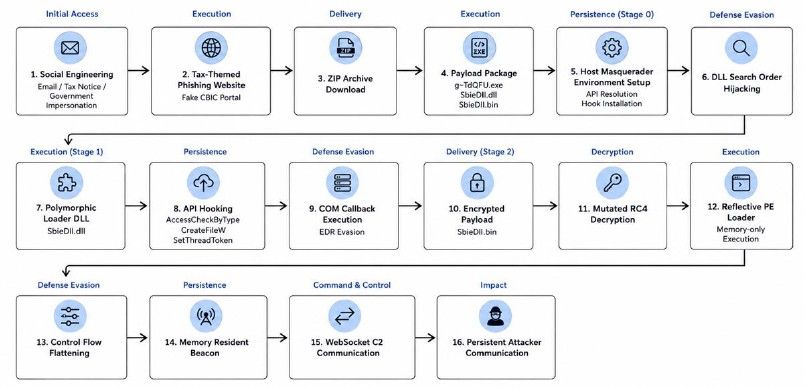
Government impersonation campaigns are among the oldest tricks in the book, but they continue to succeed because they exploit a fundamental human vulnerability: compliance anxiety. Discovered in late May 2026, Operation TaxShadow represents a highly dangerous evolution of this tactic. Far from a simple credential-harvesting scam, this campaign leverages sophisticated initial access infrastructure to drop a modular, multi-stage, in-memory malware framework that aggressively evades modern endpoint detection platforms. The attack chain transitions seamlessly from highly targeted social engineering to advanced evasion mechanisms, including DLL search order hijacking, token manipulation, custom virtualized execution, and memory-resident execution. By keeping its final payload entirely within volatile memory (RAM), the malware strips traditional forensics teams of their standard on-disk artifacts, making early detection incredibly difficult.
Technical Indicators: File Metadata Breakdown
To understand how this attack functions, we must examine the specific elements packed into the malicious ZIP archive downloaded by the victim. The archive contains three primary components designed to work in tandem to establish the infection lifecycle:
| Filename | File Type | MD5 Hash | Functional Role |
कर विवरण.exe | Portable Executable (EXE) | 3a8f6454927b8993aded75de0de2bd00 | Initial Execution Vector / Environment Validator |
SbieDll.dll | Dynamic Link Library (DLL) | e83ff54e58f0b295a392c7fc39a7d0de | Polymorphic Loader / Anti-Analysis Engine |
SbieDll.bin | Binary Data Component (BIN) | b498256cb086a6962077cdd6d2f65327 | Encrypted Shellcode & Core C2 Payload |
Anatomy of Initial Access and Infrastructure Reuse
The campaign begins with a fraudulent tax notification email masquerading as an official compliance notice from the Indian Income Tax enforcement authority. The attackers use a display name spoofing technique, sending emails from ac.enforcementincometax[.]gov.in@mnb-ny[.]com. By inserting a trusted government subdomain right before the actual attacker-controlled domain (mnb-ny[.]com), they trick hurried targets into trusting the sender identity. Interestingly, because the emails are routed through SendGrid’s legitimate outbound delivery servers, authentication checks like SPF (Sender Policy Framework), DKIM (DomainKeys Identified Mail), and DMARC pass validation seamlessly. The security systems evaluate the sender authority against mnb-ny.com rather than the official government domain, granting the malicious communication a clear pathway directly into corporate inboxes.
Once a user clicks the embedded link, they are redirected to a highly polished, bilingual (English and Hindi) phishing portal designed to mirror an official government tax portal. Threat actors use aggressive, urgency-driven messaging, threatening severe financial penalties if compliance documents are not provided within 48 hours. Infrastructure analysis reveals that this group operates a broad, multi-region phishing ring. The same underlying command-and-control server hosting the Indian tax lure was observed seamlessly rotating to host localized Japanese government tax portals. This rapid rotation allowed the group to maximize their operational investments while casting a wider global net.
The Execution Flow: Exploiting DLL Search Order Hijacking
Once the victim extracts the downloaded ZIP file and runs the initial loader, कर विवरण.exe, the malware initiates an environmental validation sequence. It establishes unique mutexes to prevent duplicate execution instances, evaluates basic operating system configurations, and resolves crucial Windows APIs dynamically via an algorithm that walks the Process Environment Block (PEB) using a ROR13 hashing technique. This allows the binary to avoid using static import tables that could flag signature-based endpoint scanners.
Immediately after completing these checks, the executable exploits a native Windows behavior known as DLL Search Order Hijacking. Because the application doesn’t specify a secure, absolute path for its required system libraries, Windows defaults to searching the local directory from which the application was launched. The folder contains a malicious file named SbieDll.dll, which mimics a legitimate security binary name but actually contains the core polymorphic loading engine. The executable unwittingly loads the malicious DLL into its own process space, granting the attacker unauthorized code execution privileges under a legitimate process banner.
Advanced Defense Evasion and the Mersenne Twister VM Engine
Once active within the host process, SbieDll.dll acts as an aggressive defense-evasion framework designed to blind local monitoring agents. It intercepts and modifies system behavior by installing targeted API hooks on critical functions, including AccessCheckByType, CreateFileW, DuplicateHandle, SetThreadToken, and GetTokenInformation. By hijacking these specific low-level APIs, the malware manipulates process reporting structures, hides file-system access events, and performs thread impersonation to bypass local Access Control Lists (ACLs).
To throw off security researchers, the loader routes its inner logic through a custom virtual machine (VM) interpreter built on a Mersenne Twister pseudo-random number generator algorithm. Instead of running its core code blocks sequentially, the malware uses the random generator to shuffle its runtime properties dynamically, meaning its execution footprint changes with every run. Furthermore, instead of initiating threads through highly monitored APIs like CreateThread or NtCreateThreadEx, the malware triggers its malicious code using COM IContextCallback handlers. Because security products track standard thread-creation routines much more closely than legacy Component Object Model (COM) calls, this choice allows the execution logic to slip right beneath behavioral detection layers.
In-Memory Residency via Mutated RC4 and Reflective PE Loading
The third file in the package, SbieDll.bin, holds the final stage payload. The binary contains raw shellcode protected by a modified RC4 stream cipher, where the standard key scheduling algorithm is altered to break automatic decryption utilities. Once the Mersenne Twister VM engine decrypts this binary data in memory, the underlying shellcode executes a custom Reflective PE Loader. This loader mimics the native Windows image-loading engine entirely within volatile memory (RAM).
Instead of relying on standard operating system APIs like LoadLibrary or MapViewOfFile—which generate clear forensic trails—the Reflective PE Loader manually maps the raw decrypted binary into its allocated memory spaces. It parses the payload’s internal headers, balances its relocation tables, fixes import addresses manually, and applies the appropriate memory execution permissions.
To make static reverse engineering even more difficult, the payload code is compiled using an LLVM compiler optimization known as Control Flow Flattening (CFF). CFF strips code of its natural structural loops and conditional structures, forcing all basic code blocks into a massive, centralized state machine switch block. An analyst looking at the binary in a disassembler sees an unreadable web of intersecting control lines, completely stalling manual analysis.
Command-and-Control (C2) and Network Layer Architecture
With the primary payload fully unpacked in memory, the malware shifts its focus toward network persistence. It establishes communication back to its command-and-control infrastructure by initiating an HTTP connection and requesting an immediate protocol upgrade. This process transitions the connection seamlessly into a long-lived, bi-directional WebSocket channel.
[In-Memory Payload] ──► HTTP Request (Protocol Upgrade) ──► WebSocket C2 ChannelThis structural shift provides two clear operational advantages for the attacker:
- Blends with Normal Traffic: WebSocket traffic maps cleanly over standard ports 80 and 443, helping the malware blend in with everyday corporate web application traffic.
- Corporate Proxy Awareness: The network module includes native support for
HTTP CONNECTcommands, ensuring the malware can successfully negotiate and route through strict corporate proxy servers to reach external servers.
During forensic investigation of the campaign’s code modules, analysts identified multiple Chinese-language metadata strings and visual artifacts buried inside the staging components. While these elements point to specific language profiles, they do not provide enough definitive proof to make a final attribution claim, leaving threat intelligence indicators at a moderate level of confidence.
Technical Opinion: Evaluating the Tactical Shifts in Operation TaxShadow
Operation TaxShadow underscores an ongoing shift in the current threat landscape, where commodity delivery vectors are paired with highly advanced, evasive post-exploitation tooling. Historically, broad phishing campaigns targeting public financial compliance rely on low-cost, loud infostealers or standard remote access trojans (RATs). TaxShadow shatters this pattern by introducing a custom-engineered virtualized dispatcher alongside runtime token abuse.
The architectural decision to bypass basic thread creation by routing calls through the IContextCallback COM interface reveals a deep familiarity with how modern endpoint detection engineering works. Most security monitoring frameworks focus their telemetry detection rules around explicit system call interventions and thread tracking. By relying on native COM handler infrastructures, the threat actors effectively mute behavioral analytics tools, turning what should be a highly visible execution step into completely silent background noise.
Similarly, deploying LLVM-driven Control Flow Flattening against standard corporate targets demonstrates a clear focus on defeating rapid incident response teams. The combination of an altered RC4 decryption scheme and flattened, virtualized execution loops means automated sandbox tools fail to generate clean behavioral patterns. Security teams are forced to rely on slow, manual reverse engineering to extract indicators of compromise. This delay grants the threat actors an extended operational window to pivot through internal networks undetected, setting a new benchmark for evasion capabilities in generalized tax phishing operations.
