

The macOS threat landscape is undergoing a significant paradigm shift as financially motivated threat groups transition from deploying rudimentary adware to orchestrating sophisticated backdoor infections. Cybersecurity researchers have recently exposed this rapid tactical evolution through Operation FlutterBridge, a pervasive malicious campaign delivering a novel threat variant designated as FlutterShell. Tracked under the activity cluster identifier CL-CRI-1089, this adversary operation represents an active progression from the group’s prior threat lineage, namely JSCoreRunner (also known within the industry as FileRipple), which initially emerged in August 2025. Historically known for high-volume Windows-based campaigns such as RecipeLister and Calendaromatic—which were previously aggregated by various security vendors under the broader TamperedChef designation—the operators behind CL-CRI-1089 have reengineered their post-compromise capabilities. They have effectively scaled up from simple ad-injection browser extensions to complex, cross-platform execution engines engineered to challenge modern enterprise endpoint defenses.
The Delivery Matrix: Malvertising and Verified Infrastructure Fraud
The primary distribution mechanism of Operation FlutterBridge relies on institutional-grade subversion of digital advertising channels, weaponizing both the Google Ads and YouTube networks. To execute this scheme at an international scale—focusing heavily on Anglophone and Western European demographics—the actors established a highly coordinated infrastructure utilizing verified shell corporations. These entities, functioning under legitimate fronts such as AdsParkPro LTD, Advantage Web Marketing LLC, and SOFT WE ART LIMITED, masqueraded as active commercial enterprises registered across Ukraine and the United Kingdom. Corporate filing audits reveal these organizations were fronted by Ukrainian nationals with non-existent digital or professional footprints, utilizing highly templated, minimal-functionality websites to artificially fabricate business legitimacy. Crucially, the threat actors employed a patient maturation strategy: maintaining a deliberate latency of approximately one year between the initial Google Ads account verification and the first recorded ad spend. This structural delay successfully fooled automated ad-network fraud filters, granting them the ability to push hundreds of malicious advertisements globally.
Evasion and Masquerading: Piercing the macOS Notarization Barrier
A defining characteristic of the FlutterShell payload is its highly deceptive deployment technique, which exploits user confidence in productivity applications. The malware is packaged inside fully functional, trojanized desktop utilities, presenting victims with realistic interactive software including a podcast tool named PodcastsLounge, alongside electronic document solutions titled PDF-Brain and PDF-Ninja. Because these applications deliver genuine user-facing features, infected targets remain completely oblivious to the concurrent malicious processes executing silently in the background. Furthermore, the threat actors demonstrated an uncanny ability to navigate Apple’s software supply-chain cryptographic defenses. Every analyzed application bundle carried a valid Apple Developer ID and successfully passed Apple’s automated code verification platforms to secure official macOS Notarization. Consequently, during the initial phases of the infection cycle, the binaries logged zero detections across multi-scanner aggregation platforms such as VirusTotal, highlighting a glaring vulnerability in signature-dependent boundary security.
Architectural Analysis: Reverse-Engineering FlutterShell’s Web-to-Native Bridge
From a compilation and structural standpoint, FlutterShell represents a strategic choice by its authors to adopt the Flutter framework specifically to frustrate static binary analysis. The compilation of Dart code translates application structures into an opaque dynamic library that completely segregates execution logic from data definitions. By leveraging an internal Object Pool to isolate string variables, cryptographic keys, and systemic parameters away from direct assembly blocks, the binary actively resists classic decompression and static disassembly tools. To unpack these layers, security analysts must utilize custom reverse-engineering tools like blutter to reconstruct the Dart runtime logic.
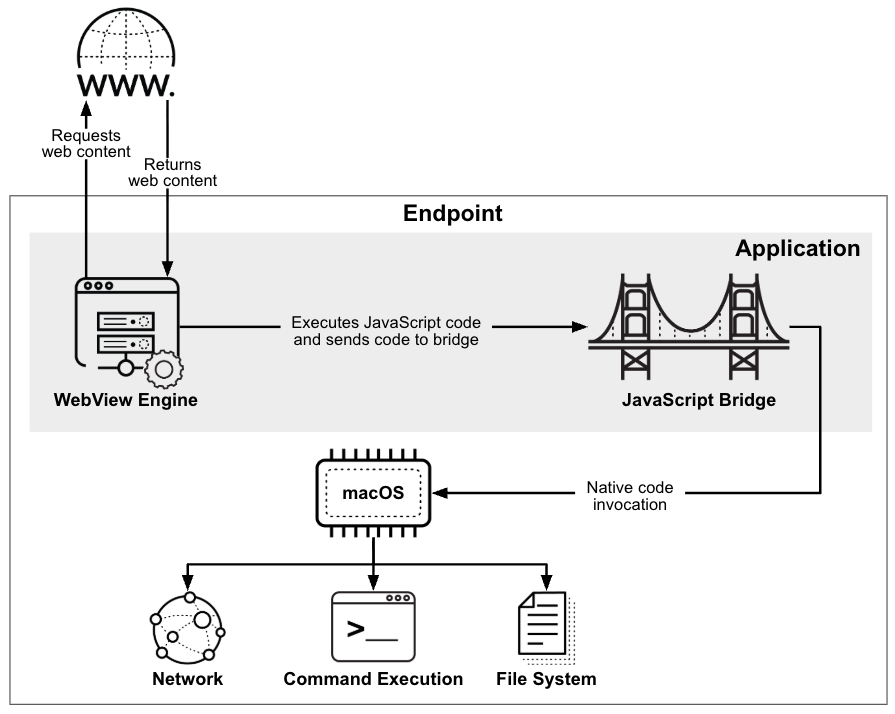
Once mapped, the internal engine uncovers an embedded WebView element utilizing a customized JavaScript-to-native communications bridge called flutterInvoke. This architecture ensures that the underlying binary does not contain hardcoded tactical instructions; instead, JSON-formatted commands are fetched dynamically at runtime from remote endpoints like /getConfig and /getUpdateThanksConfig hosted on an external landing page (/update-thanks.html). This allows the threat actors to modify target code parameters and payload behavior globally on the fly without needing to recompile or redistribute the physical application.
Dynamic Evasion, AI Exploitation, and Command Execution Capabilities
Beyond its sophisticated communication infrastructure, FlutterShell exhibits precise evasion logic and extensive post-compromise capabilities. Immediately upon system boot, the payload initiates a non-deterministic delay routine, polling the attacker domain’s /api/update-delay directory. If the endpoint is unreachable, the execution defaults to a 600-second pause, extending to 1200 seconds if an empty parameter response is returned, effectively exhausting automated sandbox monitoring environments before forcing the malware to the foreground. Once active, the backdoor possesses powerful system manipulation primitives across its variants, executing custom routines such as exec_sync, pdf_sync, or renderPDF alongside fundamental functions to verify file existence (exists/existsSync), read files (read_file), and write code to local directories (write_file).
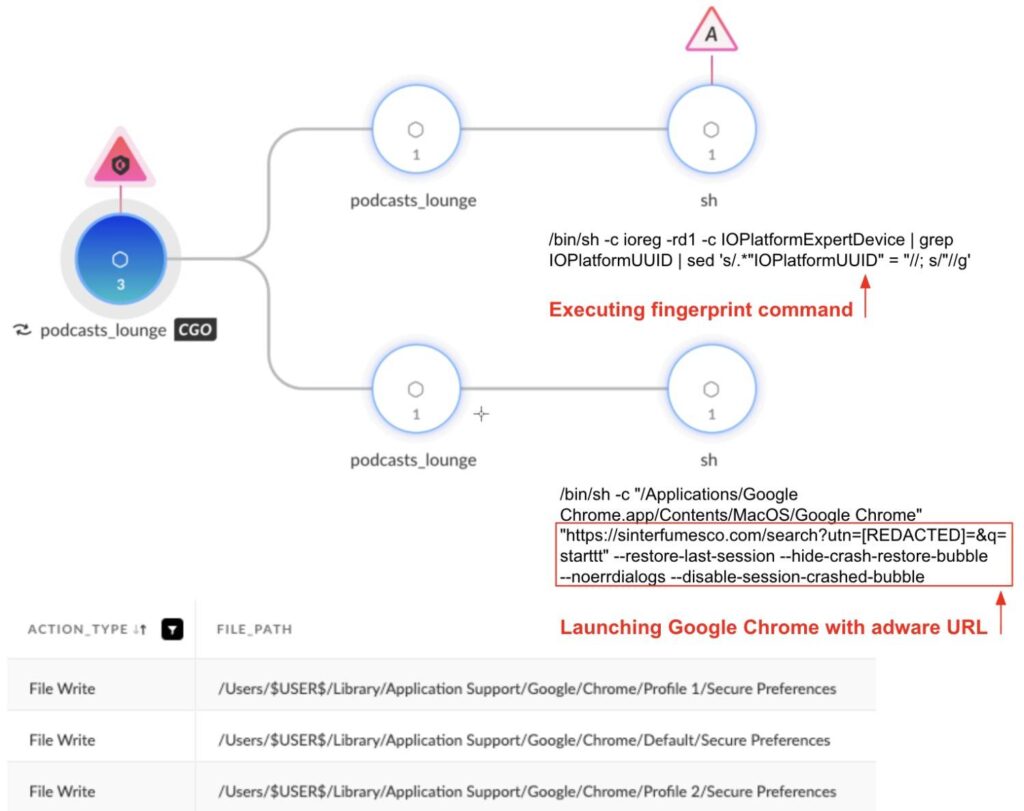
Remarkably, some variants have been observed possessing the privileged com.apple.security.files.downloads.read-write macOS entitlement, granting uninhibited file access to the user’s Downloads directory. Newer iterations have even begun weaponizing modern workflows by integrating artificial intelligence (AI) document summarization hooks. When a victim attempts to summarize a local document using the trojaned PDF viewer, the application covertly exfiltrates the document text, routing it through an attacker-controlled server before processing. Concurrently, the payload acts as persistent adware, altering local Google Chrome configuration parameters to hijack browser processes and force all outbound web traffic through ad-laden intermediary proxy domains like sinterfumesco.com.
Our Opinion on the Case
The emergence of Operation FlutterBridge highlights a critical infatuation among modern threat actors with cross-platform development frameworks like Flutter. By moving away from static, native compiled binaries toward dynamic, WebView-driven architectures, developers of malicious software have fundamentally altered the balance of endpoint detection. This campaign is not merely another adware nuisance; it represents an advanced blueprint for high-stealth post-compromise manipulation on macOS systems.
From an industry perspective, the most alarming takeaway is the tactical exploitation of corporate trust mechanisms. The ability of CL-CRI-1089 to register verified shell entities, age them artificially, and successfully navigate Apple’s strict developer notarization pipeline proves that our current automated vetting systems are ill-equipped to combat patient, well-funded adversaries. Furthermore, the integration of fraudulent AI document summarization tools signals a dangerous frontier where threat actors weaponize the enterprise’s reliance on artificial intelligence to siphon proprietary data silently. Organizations must look past baseline signature verification and adopt behavior-based analytics that monitor process lineage, unusual web-to-native communication events, and unauthorized browser modifications. Relying purely on traditional binary trust or initial app-store validation is no longer a viable security posture.
