

The Southeast Asian threat landscape continues to evolve as state-sponsored entities refine their tactics to gather critical geostrategic intelligence. The Acronis Threat Research Unit (TRU) exposed an active cyber espionage cluster tracked under the moniker “Khmer Shadow.” This targeted campaign has directly compromised high-profile government entities in Cambodia, focusing heavily on defensive infrastructure, military intelligence agencies, and public works sectors. Based on targeting vectors, specific regional interest indicators, and localized lure mechanisms, analysts have assessed with a moderate degree of confidence that this operation serves a state-backed intelligence collection mission tailored to regional geopolitics. The threat actors have systematically demonstrated a dual nature: deploying highly optimized, complex evasion code while simultaneously stumbling over fundamental architectural mistakes in their hosting infrastructure.
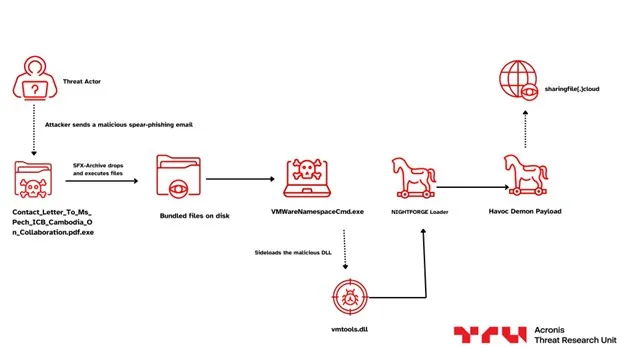
The Initial Access Phase and DLL Sideloading Architecture
To gain initial traction within targeted government networks, the Khmer Shadow actors leverage spear-phishing and social engineering tactics centered around meeting-themed self-extracting (SFX) archives. When an unsuspecting user executes the lure file, the archive unpacks its contents silently in the background, rendering a decoy document or application to minimize user suspicion while simultaneously initiating a classic Dynamic Link Library (DLL) sideloading attack sequence. This technique takes advantage of native Windows side-loading vulnerabilities by placing a malicious DLL within the same directory as a trusted, digitally signed legitimate executable. When the legitimate binary runs, it inherently prioritizes loading the adjacent compromised library over the system’s default directories. This process effectively executes the initial stage of malware within a trusted process context, blinding simple application whitelisting solutions and masking anomalous system behavior.

Reverse Engineering the NIGHTFORGE Loader: Anti-Sandbox and Environment Validation
Once the sideloading vulnerability is weaponized, execution control is handed off to a custom-engineered C++ loader designated by researchers as NIGHTFORGE. The early-stage execution flow of NIGHTFORGE highlights a deliberate emphasis on environmental awareness and sandbox evasion before any malicious code execution takes place. Upon initial runtime, the loader immediately verifies whether it is operating within a validated, persistent installation directory, ensuring that its deployment phase has successfully finalized before executing complex code routines. Simultaneously, NIGHTFORGE hides its active console window from the foreground view and initiates an interactive session validation check. By programmatically determining if a live user session is actively driving the endpoint, the loader detects automated sandbox analysis systems, which often execute files in headless or non-interactive environments. If a sandbox environment is suspected, the malware safely self-terminates to protect its broader capability set from discovery and automated signature generation.
Evading EDR Monitored Channels: NTDLL Unhooking and Hell’s Gate Syscall Resolution
The core architectural sophistication of NIGHTFORGE lies within its advanced defense-evasion module, which specifically targets user-mode monitoring hooks deployed by modern Endpoint Detection and Response (EDR) agents. Most EDR platforms monitor malicious API invocation by injecting inline hooks—frequently altering assembly code to include unconditional jumps or jmp instructions—inside the critical subsystem library ntdll.dll. To neutralize this visibility, NIGHTFORGE executes manual NTDLL unhooking, either by scraping the inline modifications or reloading a clean, untouched copy of the .text section of ntdll.dll directly from disk into memory.
Following the unhooking process, the loader implements the “Hell’s Gate” syscall resolution technique. Instead of relying on vulnerable high-level APIs that leave traces in user space, Hell’s Gate dynamically parses the export directory of the unhooked library to calculate the specific System Service Descriptor Table (SSDT) syscall numbers on the fly. NIGHTFORGE then transitions execution down to direct system calls via raw assembly instructions, establishing an unmonitored channel straight to the OS kernel and entirely bypassing EDR telemetry loops.
Memory Injection and Execution of the Havoc Demon Payload
With EDR logging blinded, NIGHTFORGE transitions to its core payload delivery phase by decoding its heavily encrypted embedded assets entirely within volatile memory. Rather than dropping easily detectable secondary binaries onto the physical disk, the loader relies on fileless execution vectors to minimize its forensic footprint. It coordinates closely with KaynLdr—a specialized, high-performance reflective loader associated with advanced post-exploitation frameworks—to dynamically map and launch a Havoc Demon payload directly inside the virtual memory space of the host process. The Havoc Demon operates as an exceptionally agile command-and-control beacon, giving the remote threat actors extensive interactive access to the host file system, memory space, and command execution shells, all while staying cloaked from disk-centric antivirus scanners.
Achieving Persistence via Scheduled Tasks Impersonation
To maintain access to the compromised Cambodian government networks through reboots and system modifications, the malware implements a covert persistence mechanism inside the Windows Task Scheduler. NIGHTFORGE configures a highly repetitive scheduled task masquerading under the administrative name VMwareNamespace. By deliberately adopting nomenclature associated with legitimate enterprise virtualization software, the threat actor forces the malicious task to blend seamlessly into standard administrative event logs. This persistence routine is structured to trigger every 10 minutes, systematically verifying whether the memory-resident backdoor remains functional and re-initializing the entire execution sequence if the command-and-control beacon has been dropped or terminated by local administrative interventions.
The OPSEC Paradox: Advanced Evasion Meets Infrastructure Blunders
While the technical engineering of the NIGHTFORGE loader demonstrates a sophisticated grasp of anti-forensics and kernel-level subversion, the Khmer Shadow operators suffer from a stark operational security (OPSEC) paradox. The threat actors effectively undermined their own highly stealthy code execution by demonstrating severe carelessness across their command-and-control (C2) hosting infrastructure. During the multi-phased campaign, the operators reused identical server configurations, structural deployment parameters, and cryptographic patterns across distinct operations with virtually zero retooling. This repetitive configuration architecture yielded an identical TLS JARM fingerprint—a unique passive fingerprinting metric generated by analyzing how a server responds to specific TLS Client Hello packets. Because the JARM signatures matched adjustments exactly, Acronis TRU researchers were able to proactively track, link, and map the actor’s secondary, redundant C2 nodes, rendering their infrastructure readily visible to global network defenders.
Our Opinion on the Khmer Shadow Campaign
The Khmer Shadow campaign presents a fascinating paradox that is becoming increasingly common in modern cyber espionage: the coexistence of sophisticated development with sloppy operational execution. From a software engineering perspective, the implementation of a custom C++ loader like NIGHTFORGE utilizing NTDLL unhooking and Hell’s Gate direct system calls reflects a highly mature understanding of modern Endpoint Detection and Response (EDR) evasion. The actors knew exactly how security tools monitor user-mode behaviors and spent significant engineering hours bypassing those hooks.
However, this high-level code craft completely falls apart at the structural level due to abysmal operational security (OPSEC). Reusing identical server configurations, command-and-control frameworks, and predictable TLS configurations resulting in identical JARM fingerprints reveals a striking disconnect between the developers writing the malware and the operators deploying the infrastructure. It suggests a decentralized or modular threat team where elite tool developers pass their payloads down to less skilled operational units. For defenders, this case proves that while bypassing localized endpoint defenses is getting easier for attackers through direct syscalls, holistic network-level tracking, behavioral analysis, and proactive infrastructure fingerprinting remain highly effective methods to expose state-sponsored espionage.
