

Modern warfare is no longer confined to physical battlefields. The 2026 escalation in the Gulf Cooperation Council (GCC) region demonstrates a critical shift—where cyber intelligence, long-term reconnaissance, and kinetic strikes operate as a unified strategy. The leaked “KittenBusters” dataset reveals how cyber operations conducted over several years may have directly influenced real-world military targeting.
This blog breaks down the technical findings, operational patterns, and strategic implications of this unprecedented cyber-kinetic convergence.
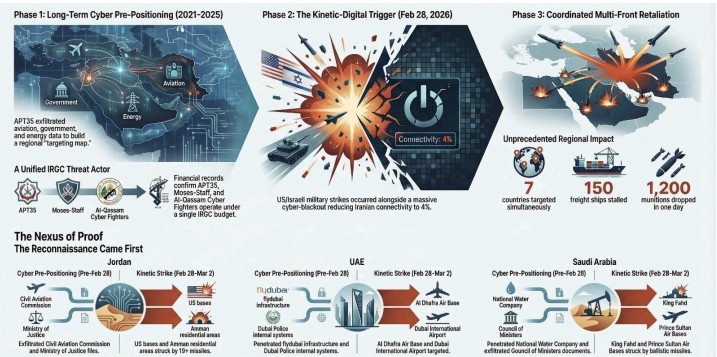
Operation Epic Fury: A Multi-Domain Offensive
On February 28, 2026, the United States and Israel launched Operation Epic Fury, targeting Iran’s nuclear infrastructure, missile production facilities, and IRGC command centers across 24 provinces. The scale was massive, with over 1,200 munitions reportedly deployed in a single day.
Simultaneously, a large-scale cyber offensive disrupted Iranian digital infrastructure, reducing national internet connectivity to approximately 4% of normal levels. Critical systems, including government services and communication networks, were taken offline.
Iran’s response was immediate and unprecedented. A coordinated missile and drone campaign targeted seven countries simultaneously, including Saudi Arabia, UAE, Qatar, and Israel.
The Central Finding: Cyber Reconnaissance Preceded Every Strike
The most critical insight from the report is clear:
Every country targeted by Iranian missiles had previously been profiled or infiltrated by APT35.
APT35 (also known as Charming Kitten) conducted extensive cyber reconnaissance across government systems, aviation infrastructure, energy sectors, and military-linked networks.
Key Observations:
- Jordan: Civil aviation and Ministry of Justice systems were compromised before missile strikes.
- UAE: Government networks and aviation infrastructure were targeted prior to attacks on Dubai airports.
- Saudi Arabia: Sensitive government documents and energy sector intelligence were exfiltrated before strikes on Riyadh.
- Qatar & Bahrain: Military and diplomatic infrastructure were mapped in advance.
This pattern strongly suggests that cyber operations were not random but part of a structured intelligence preparation phase for kinetic warfare.
APT35: A Unified and Strategic Threat Actor
The report confirms that APT35 operates under the Iranian Revolutionary Guard Corps (IRGC), specifically Unit 1500, Department 40.
More importantly, the leak establishes that multiple previously separate cyber personas—such as:
- Moses-Staff (destructive attacks)
- Al-Qassam Cyber Fighters (DDoS campaigns)
…are financially and operationally unified under APT35.
Why This Matters:
- It consolidates attribution for years of cyberattacks.
- It reveals a centralized command structure.
- It indicates coordinated multi-layered cyber strategies (espionage + disruption + influence).
The Cyber-Kinetic Integration Model
The report outlines a five-phase operational doctrine:
- Pre-Strike Cyber Reconnaissance (2021–2025)
Long-term infiltration of target systems. - Digital Disruption Phase
Cyberattacks weaken enemy communications and infrastructure. - Kinetic Strike Execution
Physical attacks on pre-identified high-value targets. - Cyber Retaliation Phase
Wiper malware, DDoS attacks, and infrastructure disruption. - Escalation Phase (Projected)
Advanced ransomware, SCADA attacks, and influence campaigns.
This structured approach highlights how cyber capabilities are now integral to military planning—not just supportive tools.
Malware Arsenal and Technical Capabilities
The leak exposed APT35’s full malware toolkit, including:
- BellaCiao: Webshell and persistence toolkit with AV evasion.
- Sagheb RAT: Advanced surveillance malware with TOR-based communication.
- Shamoon 4.0: Destructive wiper targeting energy sectors.
- Custom Python Webshell Frameworks: For lateral movement and command execution.
These tools demonstrate:
- Strong evasion techniques (anti-debugging, encryption)
- Multi-layered command-and-control infrastructure
- Capability to target both IT and OT (Operational Technology) systems
Financial and Infrastructure Transparency
One of the most unique aspects of the leak is a blockchain-verified financial ledger of APT35 operations.
Highlights:
- 19 months of Bitcoin transactions (2023–2024)
- Single-use wallet strategy for operational security
- Payments linked directly to infrastructure procurement and cyber campaigns
- Evidence tying funding across multiple cyber personas
This level of financial visibility is rare in nation-state cyber intelligence and significantly strengthens attribution confidence.
Strategic Implications for Cybersecurity
This case fundamentally changes how we understand cyber warfare:
- Cyber reconnaissance is now a precursor to physical conflict
- Critical infrastructure is a primary battlefield
- Nation-state actors operate with integrated cyber-kinetic doctrines
- Pre-positioned access can remain dormant for years before activation
Organizations in high-risk regions must treat cyber intrusions not as isolated incidents—but as potential indicators of future physical threats.
Our Opinion: What This Means for the Future
The findings in this report mark a turning point in how cyber warfare should be interpreted globally. What stands out is not just the sophistication of APT35, but the patience and strategic foresight behind its operations. This was not opportunistic hacking—it was a multi-year intelligence campaign aligned with geopolitical objectives.
From our perspective, the most concerning element is the concept of “pre-positioned access.” Organizations may already be compromised long before any visible conflict begins. This shifts cybersecurity from a reactive discipline to a proactive intelligence function.
Another critical takeaway is the fusion of cyber and kinetic warfare. Governments and enterprises can no longer treat cyberattacks as isolated digital risks. They are now directly tied to national security and physical infrastructure resilience.
However, there is also an opportunity. The exposure of APT35’s tools, infrastructure, and financial systems provides defenders with a rare advantage. If leveraged correctly, this intelligence can significantly improve detection, attribution, and response capabilities.
In conclusion, this case should serve as a wake-up call. Cybersecurity is no longer just about protecting data—it is about safeguarding nations, economies, and human lives in an increasingly interconnected battlefield.
