

1. Introduction
In the MITRE ATT&CK framework, Exfiltration is classified as TA0010, representing the set of adversary behaviors used to steal data from a target environment and transfer it to an external location. While earlier phases of an intrusion (Initial Access, Execution, Lateral Movement, Collection) prepare the ground, Exfiltration marks the point where an adversary monetizes or weaponizes the compromise—whether for espionage, extortion, sabotage, or public release.
Modern exfiltration techniques are increasingly stealthy and adaptive, leveraging both legitimate services and covert communication channels. Understanding these techniques is crucial for building resilient detection and prevention capabilities.
2. Exfiltration in the Attack Lifecycle
Exfiltration generally appears toward the final stage of the kill chain. The workflow commonly includes:
- Target identification – locating sensitive data and staging it.
- Collection – consolidating files, credentials, or memory data.
- Preparation – compressing, encrypting, splitting, or repackaging data.
- Transmission – moving data out via chosen exfiltration channels.
- Cleanup – deleting logs or temporary files to reduce forensic footprint.
ATT&CK’s Exfiltration techniques describe how an attacker executes step 4, though steps 3 and 5 overlap with Defense Evasion and Collection tactics.
3. MITRE ATT&CK Exfiltration Techniques Overview
MITRE ATT&CK currently documents the following Exfiltration techniques (T#### numbers may vary between Enterprise, Mobile, or ICS matrices; below focuses on Enterprise):
T1048 – Exfiltration Over Alternative Protocol
Adversaries bypass monitored protocols (like HTTPS or SMB) by tunneling data through less common or unmonitored protocols such as ICMP, SMTP, DNS, or custom TCP/UDP ports.
Technical behaviors:
- Crafting ICMP Echo Request packets containing payload chunks.
- Tunneling data over DNS (TXT or NULL records).
- Using high-numbered ephemeral ports to evade standard firewall rules.
Detection considerations:
- Unusual protocol usage to untrusted IPs.
- DNS TXT record size anomalies.
- ICMP traffic that is too frequent or too large.
T1041 – Exfiltration Over C2 Channel
Data is exfiltrated through the same channel already used for command-and-control.
Technical behaviors:
- Embedding base64-encoded chunks in HTTP POST bodies.
- Websocket or HTTPS multiplexing.
- Encrypted reverse shells supporting file transfer.
Detection considerations:
- High-volume outbound C2 traffic.
- TLS fingerprint anomalies.
- Beaconing patterns followed by large transfers.
T1040 – Exfiltration Over Bluetooth
A rare technique typically used in air-gapped or highly restricted environments.
Technical behaviors:
- Connecting to nearby rogue Bluetooth receivers.
- Exfiltrating data using BLE GATT characteristics.
Detection considerations:
- Unauthorized Bluetooth devices.
- Bluetooth adapter activity on servers.
T1020 – Automated Exfiltration
Malware automatically exfiltrates data on a timer or trigger.
Technical behaviors:
- Cron jobs, scheduled tasks, or UWF-based triggers.
- Keyloggers that periodically send logs.
- Ransomware uploading encryption keys or host metadata.
Detection considerations:
- Regular outbound bursts at fixed intervals.
- Repeated file staging in temporary directories.
T1049 – Exfiltration Over USB / Removable Media
Physical exfiltration through USB drives or other removable devices.
Technical behaviors:
- Data copied to removable drives automatically.
- Hidden partitions or encrypted containers (e.g., VeraCrypt).
- USB HID masquerading as mass storage.
Detection considerations:
- New removable media on sensitive servers.
- Large file writes to USB.
- Disabled auditing or tampered event logs.
T1567 – Exfiltration to Cloud Storage
Data uploaded to cloud platforms such as AWS S3, Dropbox, Google Drive, OneDrive, or Mega.
Technical behaviors:
- Using official APIs with OAuth tokens.
- Generating signed URLs and uploading via HTTPS.
- Direct-to-cloud exfiltration without staging.
Detection considerations:
- Rare user agents or API calls.
- Outbound connections to cloud storage domains.
- Creation of new access tokens or cloud keys.
T1560 – Archive Collected Data
While classified under Collection, it strongly supports Exfiltration.
Technical behaviors:
- Compressing with ZIP/RAR/7z.
- Encrypting archives with strong passphrases or asymmetric keys.
- Splitting archives to match packet size limits.
Detection considerations:
- Unusual use of compression tools.
- Password-protected archives created by unexpected processes.
T1011 – Exfiltration Over Unencrypted/Encrypted Non-C2 Channel
Use of legitimate application protocols that are not necessarily tied to C2.
Sub-techniques include:
- Over HTTP/HTTPS
- Over SMB
- Over SMTP
- Over FTP/SFTP
Technical behaviors:
- Sending sensitive files via outbound email.
- Uploading via HTTPS POSTs to non-C2 domains.
Detection considerations:
- Outbound uploads to unusual hosts.
- File size anomalies.
- Content-inspection triggers or DLP alerts.
4. Data Manipulation for Successful Exfiltration
Adversaries rarely send raw data; they typically pre-process it to reduce detection risk.
4.1 Compression
-
tar,zip,rar,7z
Reduces size and creates predictable signature patterns.
4.2 Encryption
- AES-256 in zipped files
- GPG or custom crypto packers
Encryption evades DLP solutions but creates entropy spikes detectable by defenders.
4.3 Obfuscation & Steganography
Examples:
- Embedding data in images (PNG pixel LSB).
- Exfiltrating via social media image uploads.
5. Common Real-World Exfiltration Patterns
5.1 Slow Drip Exfiltration
Small, continuous outbound transfers that mimic normal traffic.
5.2 Bulk, One-Time Exfiltration
Large archive sent in one transmission—common in ransomware breaches.
5.3 Multi-hop Exfiltration
Data is moved to intermediate internal nodes or cloud services before final extraction.
5.4 Covert Exfiltration via Legitimate Apps
Using Slack, Teams, Telegram, or GitHub repositories as covert channels.
6. Detection Strategies
6.1 Network-Based Detection
- Outbound data spikes beyond baseline.
- Connections to rare or newly registered domains.
- DNS anomalies (text size, request frequency, uncommon record types).
6.2 Host-Based Detection
- Unexpected compression or archiving operations.
- Suspicious use of PowerShell
Invoke-WebRequest,curl, or Python scripts. - Write operations to removable media.
6.3 Behavioral Analytics
- Multiple failed exfiltration attempts (e.g., blocked by EDR).
- Use of dual-use utilities (LOLBins):
bitsadmin,certutil,rclone,scp,robocopy.
7. Mitigation Strategies
7.1 Network Controls
- Egress filtering with allow-listed destinations.
- TLS inspection for outbound traffic.
- DLP enforcement on border gateways.
7.2 Endpoint Protections
- Blocking high-risk LOLBins.
- USB restriction policies.
- Monitoring of archive creation in sensitive directories.
7.3 Identity and Access Management
- Least-privilege access to sensitive files.
- Just-in-time access for privileged users.
7.4 Cloud Security
- CASB for SaaS exfiltration.
- Monitoring anomalous OAuth token creation.
- Restricting access to cloud storage APIs.
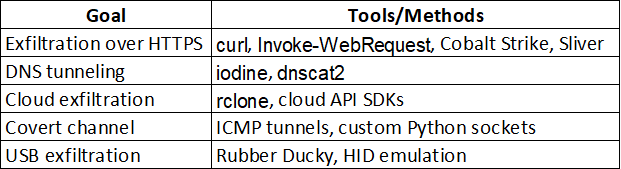
8. Red Team Simulation Techniques
To emulate exfiltration under ATT&CK:
9. Conclusion
Exfiltration is one of the most critical adversary behaviors to detect, as it represents the point where confidentiality is breached and the attacker gains tangible value. MITRE ATT&CK’s Exfiltration techniques provide a structured way to analyze attacker behavior, build detections, and perform threat-informed defense.
Enhancing detection requires visibility, baselining, analytics, and strong egress controls, while mitigation requires a layered, defense-in-depth architecture that reduces both the opportunity and impact of exfiltration.
