

In April 2024, Google announced Device Bound Session Credentials (DBSC), a breakthrough initiative aimed at tackling one of the most persistent threats in cybersecurity—session theft. Now, with public availability rolling out on Windows via Google Chrome version 146 and macOS support on the horizon, DBSC marks a pivotal shift in how modern browsers secure user sessions.
Understanding the Threat: Session Theft
Session theft is a widespread attack vector where malicious software extracts authentication cookies from a user’s browser. These cookies often remain valid for extended periods, allowing attackers to bypass login credentials entirely. Malware families such as LummaC2 specialize in harvesting such sensitive session data, which is then sold or shared across underground networks.
What makes this threat particularly dangerous is that once malware infiltrates a system, it can access browser memory and local storage, making it nearly impossible to prevent cookie theft through traditional software defenses alone. Historically, mitigation strategies relied on detecting suspicious activity after the breach—a reactive approach that often fails against sophisticated attackers.
The DBSC Solution: Proactive Protection
DBSC introduces a fundamentally new approach by binding session credentials to a specific physical device. Instead of relying solely on cookies, DBSC leverages hardware-backed security modules such as the Trusted Platform Module (TPM) on Windows and the Secure Enclave on macOS.
Here’s how it works:
- A unique cryptographic key pair is generated on the device.
- The private key never leaves the hardware, ensuring it cannot be stolen.
- The browser must prove possession of this key when requesting session cookies.
- Cookies are short-lived and require continuous revalidation.
Even if attackers manage to steal session cookies, they become useless without access to the corresponding private key. This effectively neutralizes session hijacking attempts and shifts the security model from reactive detection to proactive prevention.
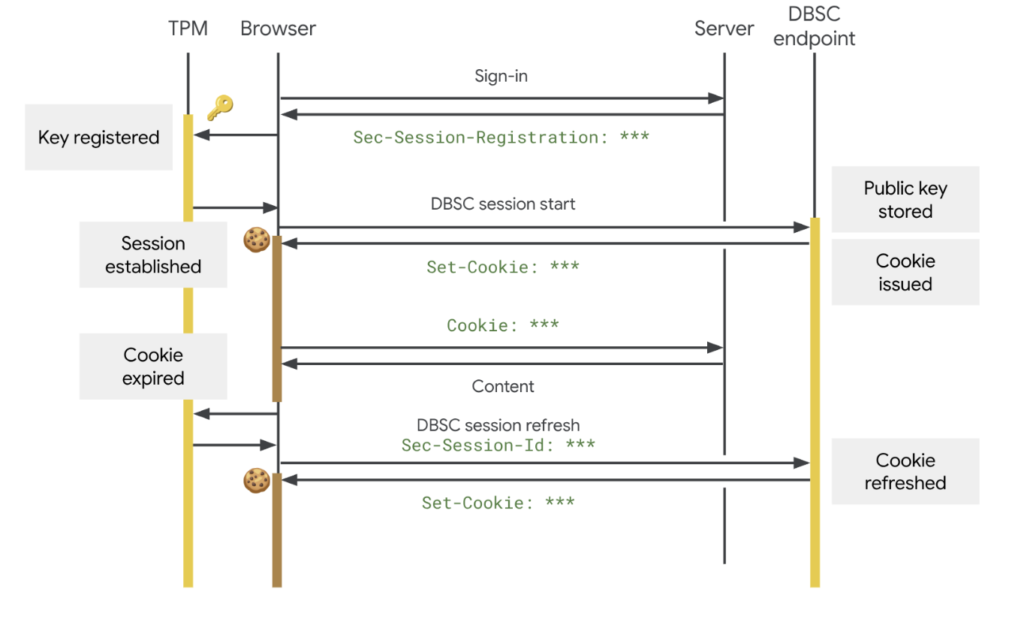
Source : Google
Seamless Integration for Developers
One of DBSC’s strongest advantages is its compatibility with existing web architectures. Developers can implement DBSC by adding registration and refresh endpoints to their backend systems. The browser handles all cryptographic operations and cookie rotation behind the scenes, allowing applications to continue using standard cookies without major front-end changes.
This makes DBSC accessible to both large enterprises and smaller platforms seeking enhanced security without complex overhauls.
Privacy by Design
In an era where privacy concerns are paramount, DBSC is built with strict safeguards:
- Each session uses a unique key, preventing cross-session tracking.
- No persistent device identifiers are shared.
- Minimal data exchange ensures no fingerprinting risks.
This ensures that improved security does not come at the cost of user privacy—a balance that many modern technologies struggle to achieve.
Industry Collaboration and Future Roadmap
DBSC is being developed as an open web standard through the W3C Web Application Security Working Group, with contributions from industry leaders including Microsoft. Platforms like Okta have also participated in trials, helping refine the protocol for real-world applications.
Future enhancements include:
- Federated Identity Support: Strengthening Single Sign-On (SSO) flows with continuous device binding.
- Advanced Registration: Integrating with mTLS and hardware security keys for stronger initial authentication.
- Broader Device Compatibility: Exploring software-based keys for devices lacking secure hardware.
These advancements aim to make DBSC universally adaptable across diverse ecosystems.
Our Opinion: Why DBSC Is a Game-Changer
DBSC represents a rare and meaningful evolution in web security—one that addresses the root cause of session theft rather than merely treating its symptoms. By binding sessions to hardware-level cryptographic keys, Google is effectively closing a loophole that attackers have exploited for years.
From our perspective, the most impressive aspect of DBSC is its practicality. Security solutions often fail because they are too complex or disruptive to implement. DBSC avoids this pitfall by integrating seamlessly into existing systems while offloading complexity to the browser. This lowers the barrier to adoption and increases the likelihood of widespread use.
Equally important is its privacy-first architecture. In a landscape where many security tools double as tracking mechanisms, DBSC stands out by minimizing data exposure and preventing cross-site correlation.
However, its success will ultimately depend on adoption. For DBSC to become a true standard, websites, developers, and platforms must actively implement it. If embraced at scale, DBSC could significantly reduce account takeovers and redefine how authentication works on the web.
In short, DBSC is not just an incremental improvement—it’s a foundational shift toward a safer, more resilient internet.
