

In early March 2026, Bitrefill, a Sweden-based cryptocurrency gift card service, experienced a targeted cyber intrusion that exposed weaknesses commonly exploited in crypto-focused environments. The attack has been attributed to the Lazarus Group, a threat actor widely linked to North Korea (DPRK). This incident is another example of how cyber operations are increasingly being used as financial tools at a geopolitical level.
The attackers managed to gain access to internal systems, compromise wallets, and retrieve a portion of customer transaction data. Rather than relying on advanced vulnerabilities, the intrusion stemmed from compromised credentials and operational oversights, reinforcing the idea that human factors remain one of the weakest links in cybersecurity.
Incident Overview
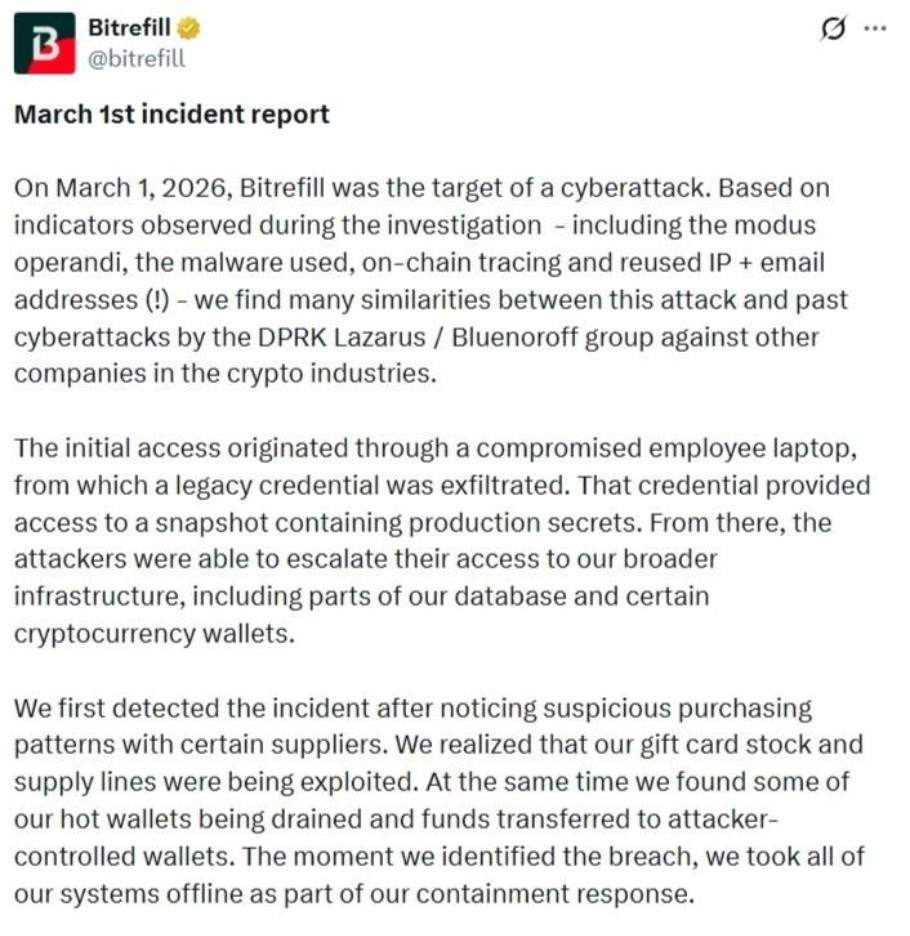
Bitrefill confirmed that unauthorized access to its infrastructure began on March 1, 2026. During the breach, attackers successfully drained cryptocurrency funds and accessed approximately 18,500 purchase records.
The exposed data included email addresses, wallet details, IP metadata, and limited encrypted identity information. While the scale of data exposure was not massive, the financial impact and method of compromise make this incident significant from a threat intelligence perspective.
Initial Access Vector
The attack originated from a compromised employee device. According to internal findings, the threat actor gained access to a laptop belonging to a staff member. From there, they extracted an outdated but still functional credential.
This credential allowed them to retrieve sensitive configuration data, including production secrets stored in a snapshot. Once inside, the attackers escalated privileges and navigated across internal systems without triggering immediate alarms.
This approach reflects a broader trend where attackers prioritize simple entry points such as credential misuse rather than relying on sophisticated exploits.
Attack Execution and Lateral Movement
After gaining access, the attackers did not act immediately. Instead, they spent time analyzing the environment. Logs suggest limited and targeted database queries, indicating reconnaissance aimed at identifying valuable assets like crypto wallets and gift card inventory.
The breach came to light when abnormal purchasing patterns were detected. Suspicious supplier-related transactions revealed that attackers were exploiting the platform’s operational flow while simultaneously extracting funds from hot wallets.
To contain the situation, Bitrefill shut down its systems entirely. While disruptive, this step likely prevented additional financial losses.
Data Exposure Analysis
Although the attackers did not download the full database, they accessed a subset of transaction records. Around 18,500 entries were exposed, including email addresses, crypto payment details, and IP logs.
In approximately 1,000 cases, encrypted customer names were also involved. The actual risk depends on whether encryption keys were compromised, which remains uncertain.
Bitrefill stated that data theft was not the main objective. Instead, the attackers appeared focused on financial extraction, which aligns with known Lazarus Group behavior.
Threat Actor Attribution
The attack has been linked to the Lazarus Group based on multiple indicators. These include similarities in malware behavior, reused infrastructure such as IP ranges, recognizable email patterns, and blockchain tracing of stolen funds.
Lazarus, along with subgroups like Bluenoroff, has been consistently associated with financially motivated cyber operations. Intelligence reports suggest that North Korea relies heavily on such activities to bypass economic sanctions.
In 2025 alone, North Korea-linked actors were estimated to have stolen over $2 billion in cryptocurrency globally. The Bitrefill incident fits into this broader pattern of targeted attacks on high-liquidity platforms.
Tactics, Techniques, and Procedures (TTPs)
The methods observed in this incident closely follow known Lazarus Group strategies. These operations typically begin with social engineering or phishing, followed by credential harvesting. Attackers often rely on legitimate system tools to avoid detection and deploy custom malware for persistence.
They are known for maintaining long-term access and adapting their methods based on previous campaigns. Their toolset includes credential extraction utilities, remote access tools, and custom loaders designed to evade security controls.
Response and Mitigation Measures
Following the breach, Bitrefill implemented several corrective actions. These include tightening access controls, improving monitoring systems, and conducting continuous security testing.
The company also collaborated with cybersecurity firms and law enforcement agencies to investigate the attack. Systems were restored by March 5, with services returning to normal operation.
One mitigating factor was Bitrefill’s limited data storage model, which reduced the overall impact on customer privacy.
Conclusion
This incident highlights how modern cyber threats are no longer just about data theft but are increasingly tied to financial and geopolitical objectives. The attackers leveraged weak credential management and operational gaps rather than advanced vulnerabilities.
The case reinforces the importance of strong authentication practices, continuous monitoring, and rapid detection mechanisms. In today’s threat landscape, defending against such actors requires focusing on behavior and access control rather than relying solely on perimeter security.
CyberP1 Opinion
The Bitrefill breach reflects a deeper shift in how cybercrime operates in the modern world, especially when state-sponsored groups are involved. What stands out in this case is not the complexity of the attack, but how ordinary the entry point was. A compromised laptop and a forgotten credential were enough to open the door. This raises an uncomfortable but important point: many organizations still underestimate the risks tied to everyday operational practices.
In the cryptocurrency space, the problem becomes even more serious. Platforms are built for speed and global accessibility, but that same design philosophy often leads to reduced friction in security controls. Hot wallets, instant transactions, and integrations with third-party suppliers create an environment where attackers can move quickly once inside. The Bitrefill incident shows how attackers are not just targeting systems, but entire workflows.
Another key observation is how disciplined and patient the attackers were. Instead of rushing to extract data, they studied the system, identified valuable assets, and then executed their plan. This level of control suggests a well-trained and highly organized group rather than opportunistic hackers. It also highlights why traditional security alerts often fail, because the activity may not immediately appear malicious.
From a defensive standpoint, this case underlines the importance of visibility and identity management. Organizations need to track not just who has access, but how that access is being used over time. Legacy credentials, in particular, represent a silent risk that often goes unnoticed until it is exploited.
Overall, this incident is a reminder that cybersecurity is no longer just a technical issue. It is a combination of human behavior, system design, and threat awareness. Companies operating in high-value sectors like cryptocurrency must assume that they are constant targets and design their defenses accordingly.
