

Ransomware groups are no longer relying on basic intrusion techniques. Instead, they are carefully studying enterprise environments and using built-in administrative tools against organizations. One recent case highlights how attackers attempted to exploit Group Policy Objects (GPOs) to disable defenses and spread ransomware across a large educational institution.
In this incident, Microsoft Defender successfully identified suspicious behavior early in the attack lifecycle and stopped the threat before it could fully execute. Even though the attacker had already gained privileged access, Defender’s predictive protection mechanisms limited the damage significantly.
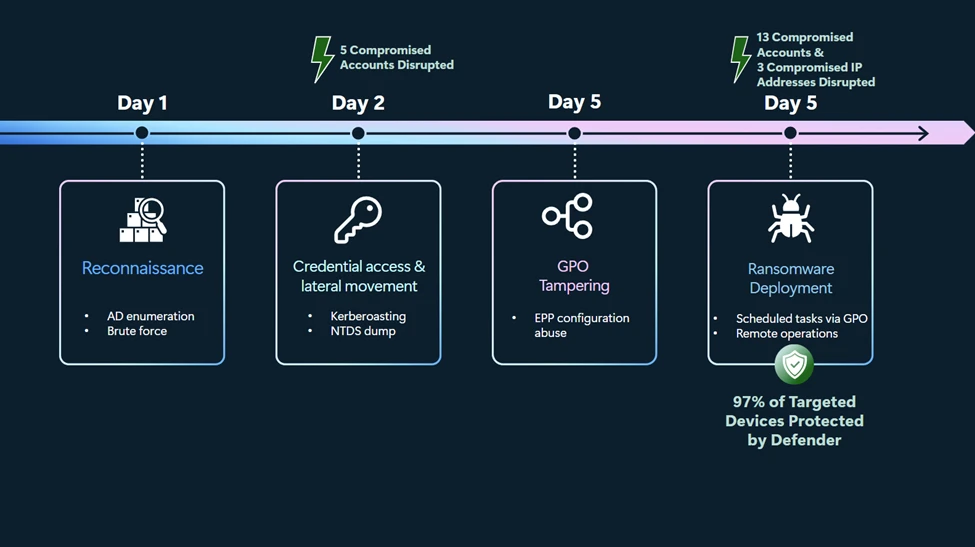
The attack targeted an environment with thousands of endpoints. Despite the scale and sophistication, Defender blocked nearly all encryption attempts and prevented ransomware deployment through GPO entirely.
This case offers an important look into how modern ransomware operations work—and how proactive defense strategies can stop them before they escalate.
Background: Why Attackers Abuse Group Policy
Group Policy Objects are a core part of Windows enterprise environments. They allow administrators to push configurations, scripts, and tasks across all connected devices.
From an attacker’s perspective, GPO is extremely powerful because:
- It is trusted by default
- It operates at scale
- It requires no interaction from end users
- It allows centralized execution of commands
Instead of deploying malware individually, attackers can simply configure one malicious policy and let the network distribute it automatically.
This is exactly what happened in this case.
Environment Overview
The targeted organization was a large educational institution with:
- Thousands of devices onboarded to Microsoft Defender
- 33 servers
- 11 domain controllers
- 2 Entra Connect systems
The infrastructure was complex, making it an attractive target for attackers looking to maximize impact.
Attack Timeline and Behavior
Initial Compromise
The attacker began from an unmanaged device. At this stage, at least one Domain Admin account had already been compromised.
The exact entry point is unknown, but the attacker had clearly achieved high-level access early in the operation.
Day 1: Reconnaissance
The attacker started mapping the environment using Active Directory tools such as AD Explorer. They also used brute force techniques to gather additional information.
This activity triggered early alerts from Defender, indicating unusual behavior.
Day 2: Credential Theft and Movement
The attacker escalated their access further by extracting credentials. Techniques observed included:
- Kerberoasting
- NTDS database dumping
With these credentials, the attacker began moving laterally across the network.
They also created multiple local accounts on compromised machines to maintain persistence.
At this point, Defender initiated automated disruption actions. Several compromised accounts were blocked, which significantly slowed down the attacker’s progress.
Thousands of unauthorized authentication attempts were stopped, reducing the attacker’s ability to expand quickly.
Day 5: Attempted Ransomware Deployment
Despite earlier disruptions, the attacker still retained access to other privileged accounts.
They shifted focus to the final stage—deploying ransomware.
Instead of attacking devices individually, they chose a more efficient method: abusing Group Policy.
Technical Breakdown: GPO Weaponization
Step 1: Disabling Security Controls
The attacker first created a malicious GPO designed to weaken defenses.
This policy attempted to disable key Defender protections, including:
- Real-time protection
- Behavioral monitoring
This step was intended to prepare the environment for ransomware execution.
However, Defender detected this as tampering activity and immediately responded.
A protective mechanism known as predictive shielding was triggered. It temporarily blocked the spread of new GPO changes across the environment.
This action protected approximately 85% of devices before the ransomware stage even began.
Step 2: Ransomware Deployment via Scheduled Tasks
Roughly ten minutes later, the attacker proceeded with the next phase.
They uploaded three files into the SYSVOL share:
- run.bat
- run.exe
- run.dll
These files were part of the ransomware payload.
A second GPO was then created to schedule execution across devices.
The execution chain looked like this:
- Command prompt launches the batch file
- Batch file executes the executable
- The executable triggers a DLL using rundll32
- The DLL performs encryption
This method is effective because each machine pulls and executes the payload on its own.
Why the Attack Failed
Because predictive shielding had already been activated, the malicious GPO could not propagate effectively.
The system recognized that GPO tampering often precedes ransomware deployment and acted before the payload spread.
This proactive approach prevented the attack from scaling.
Outcome and Impact
The results demonstrate how effective early intervention can be:
- No devices were encrypted through the GPO attack path
- Around 97% of attempted encryption actions were blocked
- Approximately 700 devices were protected through GPO hardening
- A small number of systems were impacted through SMB-based deployment, but the spread was quickly contained
Without Defender’s intervention, the attack could have caused widespread disruption across the entire organization.
Key Security Challenge: Trusted Tools as Attack Vectors
This incident highlights a growing problem in cybersecurity.
Organizations depend on tools like:
- Group Policy
- Scheduled tasks
- Remote administration utilities
These tools are essential for daily operations, but they are also highly trusted.
Attackers take advantage of this trust.
Security teams face a difficult balance:
- Locking down these tools too much disrupts operations
- Leaving them open creates opportunities for abuse
Traditional approaches struggle in this scenario:
- Static hardening breaks functionality
- Detection-based systems react too late
- Manual response cannot match attacker speed
The Role of Predictive Shielding
Predictive shielding represents a different approach to defense.
Instead of waiting for malware to execute, it focuses on identifying intent.
It works by:
- Correlating suspicious signals
- Understanding attack patterns
- Predicting the next step of the attacker
Once a likely attack path is identified, the system applies temporary protections to block it.
These protections are:
- Targeted
- Time-limited
- Context-aware
In this case, it stopped GPO-based ransomware distribution before it even started.
MITRE ATT&CK Mapping Summary
The attacker’s behavior aligns with several known techniques:
- Account discovery using Active Directory enumeration
- Credential theft through Kerberoasting and NTDS dumping
- Lateral movement via SMB
- Persistence through local account creation
- Defense evasion by disabling security tools
- Execution using scheduled tasks and command-line scripts
- Ransomware deployment attempts
This mapping confirms that the attack followed a structured and well-known ransomware playbook.
Our Analysis and Opinion
What stands out most in this incident is not just the attacker’s sophistication, but how predictable their strategy actually was. Modern ransomware operations have become highly standardized. Once attackers gain privileged access, they tend to follow a familiar path: reconnaissance, credential harvesting, lateral movement, defense evasion, and finally, large-scale deployment.
The use of Group Policy in this case is particularly important. It reflects a shift in attacker mindset. Instead of trying to bypass security controls directly on each machine, attackers now focus on controlling the systems that manage those machines. This approach is far more efficient and much harder to detect using traditional methods.
However, this also creates an opportunity for defenders. Because these attacks follow predictable stages, it becomes possible to intervene earlier—before the final payload is executed. This is where predictive security models show their value.
The success of Defender in this scenario demonstrates that timing is everything. By responding during the tampering phase rather than the execution phase, the system effectively removed the attacker’s ability to scale the attack. Even though the attacker had high-level access, they were unable to fully weaponize it.
Another key takeaway is the importance of automated response. Human-led intervention alone would not have been fast enough to stop this attack. The ability to automatically disrupt compromised accounts and apply protective controls made a significant difference.
At the same time, this case also highlights a limitation. A small number of devices were still affected through alternative methods like SMB. This shows that while predictive defense is powerful, it must be part of a broader, layered security strategy.
In our view, organizations should start treating administrative tools as high-risk assets rather than neutral infrastructure. Monitoring and controlling how these tools are used is just as important as detecting malware itself.
Ultimately, this incident reinforces a simple but critical idea: the earlier you stop an attacker in their workflow, the less damage they can cause. Prevention at the intent stage is far more effective than reaction at the execution stage.
Conclusion
This incident is a clear example of how ransomware attacks are evolving. Attackers are no longer just deploying malware—they are abusing the very systems designed to manage enterprise environments.
At the same time, defensive strategies are also advancing. Predictive and adaptive security models are proving effective in stopping attacks before they fully develop.
For organizations, the lesson is clear: visibility, early detection, and automated response are no longer optional—they are essential.
