
Microsoft has recently disclosed a high-severity local privilege escalation (LPE) vulnerability, CVE-2026-31431, nicknamed “Copy Fail.” This flaw impacts a wide range of Linux distributions including Red Hat, SUSE, Ubuntu, Amazon Linux, Debian, Fedora, and Arch Linux, making it one of the most broadly applicable kernel vulnerabilities in recent years. With a CVSS score of 7.8 (High), the vulnerability poses a serious risk to cloud workloads, Kubernetes clusters, and CI/CD environments where untrusted code execution is common.
Although exploitation has so far been limited to proof-of-concept demonstrations, the availability of a fully working exploit script and its inclusion in the CISA Known Exploited Vulnerability (KEV) catalog signals that widespread malicious use is imminent.
| Technical element | Details |
| Vulnerability type | Local privilege escalation |
| Attack vector | Code execution from unprivileged user |
| Prerequisites for exploitation | Local access to the machine as non-privileged user |
| Brief technical explanation | A bug in the Linux kernel’s crypto-subsystem can be abused by an attacker to corrupt the cache of any readable file, including setuid binaries. This corruption could be carried out by unprivileged users and could result in code execution with root privilege, effectively escalating the unprivileged user to root in an unauthorized way. |
Technical Analysis of the Vulnerability
The flaw resides in the algif_aead module of the Linux kernel’s AF_ALG cryptographic subsystem, introduced in 2017 as part of an in-place optimization. The kernel reuses source memory as the destination during cryptographic operations, but improper handling of memory during failed copy operations allows attackers to corrupt the kernel’s page cache.
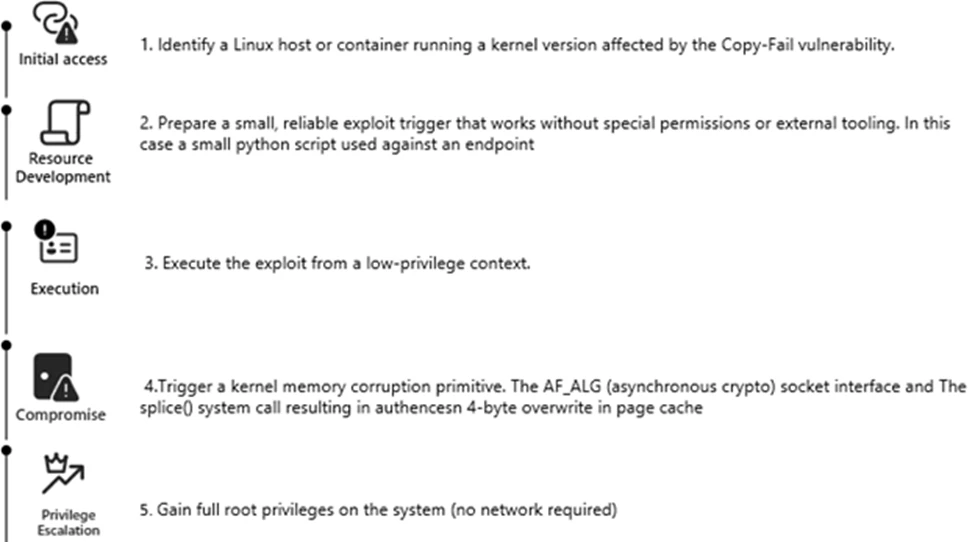
By chaining the AF_ALG socket interface with the splice() system call, attackers can perform a controlled 4-byte overwrite in the kernel page cache of any readable file. This enables corruption of privileged binaries (e.g., /usr/bin/su) in memory without altering the on-disk file. Once executed, the corrupted binary yields root privileges deterministically, bypassing traditional user-space protections.
Key characteristics include:
- Attack Vector: Local (AV:L), requiring only unprivileged user access.
- Exploit Reliability: Deterministic, no race conditions.
- Exploit Size: Extremely compact (~732 bytes), executable in restricted containers.
- Impact Radius: Containers share the host kernel, enabling container breakout and cross-tenant compromise.
Exploitation Phases
- Reconnaissance: Attackers identify vulnerable kernel versions from within containers or namespaces.
- Weaponization: A lightweight Python script interacts with kernel interfaces, requiring no compilation or external libraries.
- Execution: The script runs as a non-privileged user or compromised container process.
- Privilege Escalation: Exploiting AF_ALG and splice() results in kernel page cache corruption.
- Root Access: The attacker escalates to UID 0, bypassing SELinux/AppArmor and breaking kernel trust boundaries.
Impact Assessment
Successful exploitation leads to full root privilege escalation, with severe consequences for:
- Confidentiality: Attackers gain unrestricted access to sensitive data.
- Integrity: Kernel structures and privileged binaries can be corrupted.
- Availability: Attackers can disable or bypass local security controls.
- Cloud Security: Container escape and lateral movement across Kubernetes clusters.
Mitigation and Protection Guidance
Immediate Actions (0–24 hours):
- Identify vulnerable kernel versions across all Linux workloads.
- Apply vendor patches immediately where available.
- If patches are unavailable, implement interim mitigations:
- Disable AF_ALG socket creation.
- Enforce strict network isolation.
- Apply granular access controls.
- Treat any container RCE as potential host compromise.
- Enforce rapid node recycling after compromise indicators.
Our Opinion on CVE-2026-31431
The “Copy Fail” vulnerability represents a textbook example of how seemingly minor kernel optimizations can evolve into catastrophic security flaws when deployed at scale. What makes CVE-2026-31431 particularly dangerous is not just its technical elegance but its cross-environment applicability—from bare-metal servers to Kubernetes clusters. Unlike race-condition exploits that rely on timing, this flaw is deterministic, compact, and stealthy, making it highly attractive to threat actors.
In our view, the most concerning aspect is its ability to corrupt privileged binaries in memory without touching disk, effectively bypassing traditional forensic detection methods. This stealth factor means organizations may not even realize their systems have been compromised until attackers escalate privileges and move laterally. Furthermore, the vulnerability highlights the fragility of container security: because containers share the host kernel, a single vulnerable node can compromise an entire cluster.
We believe this case underscores the urgent need for proactive kernel hardening, continuous threat hunting, and rapid patch adoption. Organizations should treat container RCEs as host-level compromises and enforce aggressive node recycling policies. Ultimately, CVE-2026-31431 is a wake-up call for the industry: kernel-level flaws are not just local bugs—they are systemic risks that ripple across modern cloud-native infrastructures.
