

A relatively lesser-known cyber group, Nasir Security, has recently drawn attention within the cybersecurity community due to its targeted operations against energy-related organizations in the Middle East. According to intelligence findings, the group appears to have links—direct or indirect—to Iranian interests, although firm attribution remains uncertain.
Unlike traditional cybercriminal groups driven by financial gain, this actor demonstrates a mix of cyber espionage, supply chain compromise, and information manipulation. Their activities highlight how cyber operations are increasingly being used alongside geopolitical conflicts to influence perception, disrupt industries, and create strategic pressure.
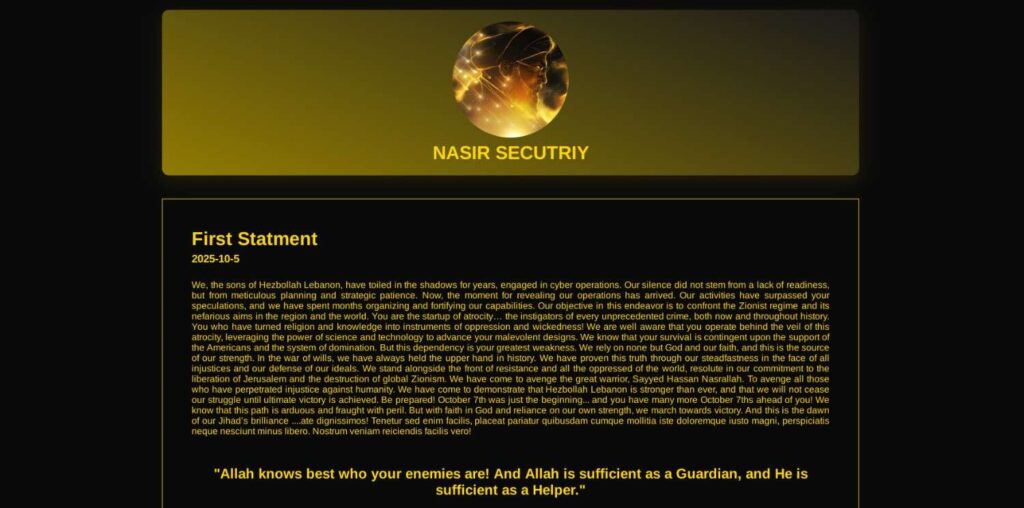
Background and Emergence
Nasir Security first appeared around early October 2025. Their initial operation targeted a major Israeli IT services provider, where they claimed unauthorized access to several cloud-based systems. Screenshots were shared publicly to support their claims, suggesting access to sensitive platforms used by defense and government-linked organizations.
However, deeper analysis indicated that the impact was limited. There was no solid proof of widespread compromise across the claimed entities. The attack seemed more focused on creating the impression of a large-scale breach rather than causing real operational damage.
This pattern—combining technical intrusion with psychological amplification—has remained consistent in their later campaigns.
Shift Toward Energy Sector Targeting
Over time, the group shifted its focus toward the oil and gas sector in the Gulf region. This is not surprising. Energy infrastructure has long been a strategic target due to its economic and geopolitical importance.
Organizations reportedly targeted include:
- Dubai Petroleum (UAE)
- CC Energy Development (Oman)
- Oil and gas entities in Iraq
- Al-Safi Oil Company (Saudi Arabia)
The claims made by the group suggest large-scale data breaches, sometimes stating hundreds of gigabytes of stolen information. However, intelligence analysis indicates these figures are likely exaggerated.
Instead of directly breaching these companies, the attackers primarily infiltrated third-party vendors—such as engineering firms, safety equipment providers, and contractors. The stolen data, while real, originated from these external partners rather than the main targets themselves.
Attack Techniques and Tactics
The group relies on a combination of well-known but effective cyberattack methods. Their approach does not involve highly sophisticated exploits but rather the smart use of accessible techniques.
Some of the key methods include:
- Spear phishing attacks designed to trick specific individuals into revealing credentials
- Business Email Compromise (BEC) schemes to gain access to corporate communications
- Impersonation tactics to appear as trusted entities
- Exploitation of public-facing applications with weak security
- Extraction of data from poorly secured cloud storage systems
This combination allows them to operate efficiently while minimizing the need for advanced tools.
Supply Chain as the Primary Entry Point
One of the most notable aspects of Nasir Security’s operations is its strong reliance on supply chain vulnerabilities.
Instead of attacking large, well-protected corporations directly, the group focuses on smaller vendors and contractors. These organizations often have weaker cybersecurity controls, making them easier targets.
Once access is gained, attackers collect documents such as:
- Engineering designs
- Risk assessments
- Contracts
- Infrastructure details
Even though the breach occurs at a third-party level, the data still holds significant value. It can provide insights into critical infrastructure, operational dependencies, and potential weak points.
This method also creates confusion during incident investigations, as organizations may initially believe they were directly compromised.
Data Manipulation and Misinformation
Another defining feature of this group is its use of information manipulation.
In several instances, Nasir Security has:
- Overstated the volume of stolen data
- Misrepresented the source of breaches
- Released small samples of files to support larger claims
Interestingly, affected organizations reported that they were never contacted for ransom or extortion. This suggests that financial gain is not the primary motive.
Instead, these activities appear to be part of a broader disinformation strategy. By exaggerating their success, the group aims to create fear, uncertainty, and reputational damage—particularly during ongoing geopolitical tensions.
Identity and Attribution Challenges
The group has used multiple identities over time, including:
- “Sons of Hezbollah Lebanon”
- “Sons of Al-Nusayr”
- “Al-Nasir Resistance”
These shifting identities make attribution extremely difficult. It is unclear whether these names reflect real affiliations or are simply attempts to appear more credible or intimidating.
There are indications that the group may consist of loosely connected individuals, possibly including cyber mercenaries or ideologically aligned actors. While Iran-linked involvement is suspected, there is no definitive proof tying the group directly to state operations.
This ambiguity itself may be intentional, serving as a form of “false flag” activity.
Infrastructure and Operations
Nasir Security maintains a data leak site (DLS) accessible through both the regular internet and the Tor network. The domain was registered using a provider that supports anonymous payments, allowing the group to maintain operational secrecy.
Rather than releasing full datasets, they typically publish limited samples to validate their claims. This tactic helps them maintain visibility without exposing the full scope—or limitations—of their operations.
Operational Impact and Risks
Although the group has not demonstrated the ability to cause large-scale disruption, their activities still pose real risks.
The stolen documents can:
- Provide intelligence for future targeted attacks
- Reveal infrastructure vulnerabilities
- Assist in planning sabotage or disruption
- Be weaponized in phishing or malware campaigns
Additionally, the focus on supply chains exposes a critical weakness in modern cybersecurity frameworks. Even well-secured organizations can be affected indirectly through their partners.
Recent Activity Surge
After a long period of inactivity following October 2025, the group resurfaced in March 2026 with renewed activity. This sudden increase aligns with escalating geopolitical tensions involving Iran.
Such timing suggests that their operations may be coordinated with broader strategic objectives rather than being purely opportunistic.
Our Analysis and Opinion
From our perspective, the case of Nasir Security reflects a growing shift in how cyber operations are being used in modern conflicts. What makes this group particularly interesting is not their technical sophistication, but their strategic approach.
They are not trying to compete with advanced state-sponsored hacking units. Instead, they focus on exploiting weak points—specifically third-party vendors—and then amplifying the perceived impact of their actions. This combination of low-cost intrusion and high-impact messaging is both efficient and difficult to counter.
Another important takeaway is the role of perception. In cybersecurity, what people believe has happened can sometimes be just as important as what actually happened. By releasing small amounts of real data and exaggerating the rest, the group successfully creates confusion and doubt. This can damage trust, disrupt operations, and force organizations into costly investigations.
We also believe that attribution in such cases should be handled very carefully. The use of multiple identities and ideological branding suggests an intentional effort to blur responsibility. Jumping to conclusions could lead to incorrect assumptions and potentially escalate tensions unnecessarily.
At the same time, this activity highlights a serious and often underestimated issue—supply chain security. Many organizations invest heavily in protecting their own systems but overlook the risks introduced by vendors and contractors. Nasir Security is clearly exploiting this gap.
In our view, the biggest lesson here is that cybersecurity is no longer just about defense against direct attacks. It is about understanding the broader ecosystem, including partners, communication channels, and even public perception.
Going forward, organizations—especially in critical sectors like energy—must expand their security strategies. This includes continuous monitoring of third-party risks, stronger access controls, and better awareness of misinformation tactics.
Ultimately, Nasir Security may not be the most technically advanced threat actor, but their methods are effective in today’s complex and politically charged cyber landscape. That alone makes them worth paying close attention to.
Conclusion
Nasir Security represents a new kind of cyber threat—one that blends modest technical capability with strategic messaging and supply chain exploitation.
While their actual impact may be limited, their ability to manipulate narratives and exploit indirect vulnerabilities makes them a relevant concern, particularly for organizations operating in sensitive industries.
The case serves as a reminder that in cybersecurity, the weakest link is often not within the organization itself—but somewhere in its extended network.
