

The Android threat landscape continues to evolve, and one of the most sophisticated recent developments is MiningDropper—a multi-stage malware delivery framework engineered for stealth, flexibility, and scale. Unlike traditional droppers, MiningDropper is not limited to delivering a single payload. Instead, it operates as a modular platform capable of deploying cryptocurrency miners, infostealers, banking trojans, and Remote Access Trojans (RATs), all while maintaining a low detection footprint.
Understanding MiningDropper’s Architecture
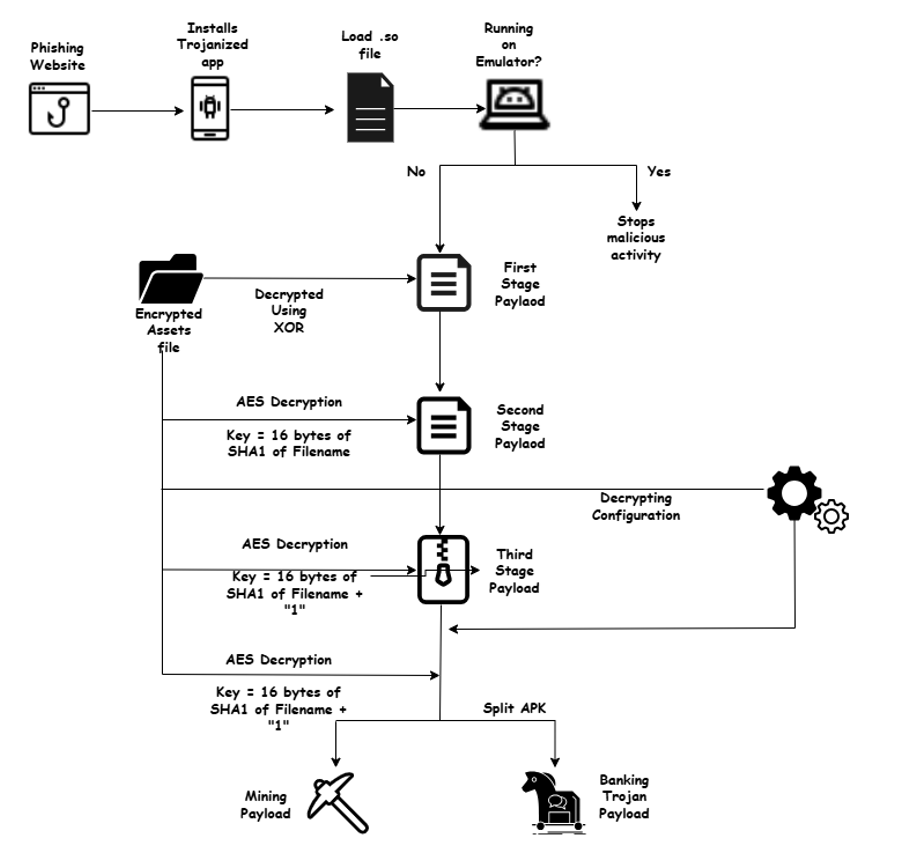
At its core, MiningDropper uses a multi-stage payload delivery system designed to evade detection and complicate analysis. The framework integrates:
- XOR-based string obfuscation in native code
- AES-encrypted payload staging
- Dynamic DEX loading
- Anti-emulation techniques
This layered approach ensures that each stage reveals only minimal information, preventing security tools from detecting the full attack chain early.
The infection typically begins with a trojanized Android application, often based on the open-source “LumoLight” project. Once installed, the app loads a malicious native library that decrypts and executes further payloads in stages.
Infection Vectors and Distribution
MiningDropper spreads primarily through:
- Smishing (SMS phishing)
- Social media links
- Fraudulent websites
Victims are tricked into downloading malicious APKs disguised as legitimate services such as:
- Banking apps
- Telecom services
- Government portals (e.g., RTO services in India)
Several phishing domains have been observed distributing these APKs, highlighting the scale and coordination behind these campaigns.
Campaign Analysis
1. Infostealer Campaign (India-Focused)
One of the most prominent campaigns targets Indian users by impersonating:
- Regional Transport Office (RTO) services
- Banks
- Telecom providers
Victims are lured into downloading fake apps, which ultimately deploy infostealer malware capable of harvesting:
- Banking credentials
- Personal data
- SMS messages
This campaign demonstrates strong localization tactics, increasing its effectiveness.
2. BTMOB RAT Campaign (Global Reach)
The second major campaign distributes MiningDropper globally across:
- Europe
- Latin America
- Asia
Here, the dropper installs BTMOB RAT, a powerful remote access trojan capable of:
- Full device control
- Credential theft
- Real-time screen monitoring
- Audio recording
- File manipulation
Interestingly, BTMOB RAT previously had higher detection rates. However, when distributed via MiningDropper, detection dropped dramatically—sometimes to just 1–3 antivirus engines.
Technical Deep Dive
Stage 1: Native Loader
The infection begins with a native library (.so file) that:
- Decrypts XOR-obfuscated strings at runtime
- Detects emulators and rooted devices
- Terminates execution in analysis environments
This stage also decrypts the first DEX payload from the app’s assets.
Stage 2: Bootstrap Loader
The first-stage payload acts as a bootstrapper, responsible for:
- Decrypting the second-stage payload using AES
- Dynamically loading code via
DexClassLoader
The AES key is cleverly derived from the filename using SHA-1 hashing, avoiding hardcoded keys and increasing analysis difficulty.
Stage 3: Social Engineering Layer
The second-stage payload introduces a fake Google Play update interface, tricking users into believing a legitimate process is underway.
Behind the scenes, it:
- Decrypts additional payloads
- Loads configuration files
- Determines execution mode (miner vs user payload)
Stage 4: Payload Execution
The final stage reconstructs and installs the actual malware using:
- Split APK components
- AES decryption
- Dynamic assembly
Depending on configuration, it deploys:
- Cryptocurrency miner
- Infostealer
- BTMOB RAT
Key Characteristics
| Category | Details |
|---|---|
| Type | Multi-stage dropper |
| Capabilities | Crypto mining + payload delivery |
| Obfuscation | XOR + AES encryption |
| Payloads | Infostealer, RAT, Banking Trojan |
| Distribution | Phishing, social engineering |
| Scale | 1,500+ samples observed |
Notably, over 50% of samples show low antivirus detection, underscoring the effectiveness of its evasion techniques.
Why MiningDropper Stands Out
MiningDropper is not just another malware—it is a malware-as-a-framework. Its modular design allows attackers to:
- Reuse the same infrastructure across campaigns
- Swap payloads without changing core logic
- Scale operations rapidly
This flexibility explains the surge in variants and widespread distribution.
Security Recommendations
To defend against threats like MiningDropper:
- Install apps only from official stores
- Avoid clicking unknown links (SMS/social media)
- Verify URLs before downloading APKs
- Enable multi-factor authentication (MFA)
- Keep devices updated
- Use mobile security solutions
Our Opinion on the MiningDropper Threat
MiningDropper represents a significant evolution in Android malware, shifting from single-purpose threats to modular, reusable attack frameworks. What makes it particularly concerning is not just its technical sophistication, but its adaptability. By separating the delivery mechanism from the payload, threat actors can rapidly pivot between campaigns—targeting different regions, industries, or objectives without rebuilding their infrastructure.
The use of layered obfuscation, dynamic loading, and anti-analysis techniques shows a clear intent to bypass both automated detection systems and manual analysis. This indicates that attackers are investing more resources into long-term, scalable operations rather than one-off attacks.
In our view, traditional security solutions alone are no longer sufficient. Combating threats like MiningDropper requires a multi-layered defense strategy, including user awareness, behavioral detection, and real-time threat intelligence. As mobile devices continue to handle sensitive financial and personal data, frameworks like MiningDropper signal a growing need for stronger mobile-first security ecosystems.
