

The Russian-linked malware family known as Kazuar has undergone a major architectural transformation, evolving from a traditional remote access trojan into a highly modular peer-to-peer (P2P) botnet ecosystem. Security researchers attribute this malware to the state-sponsored threat actor Secret Blizzard, a group associated with long-term cyber espionage campaigns targeting governments, diplomatic institutions, and strategic organizations across Europe, Central Asia, and Ukraine.
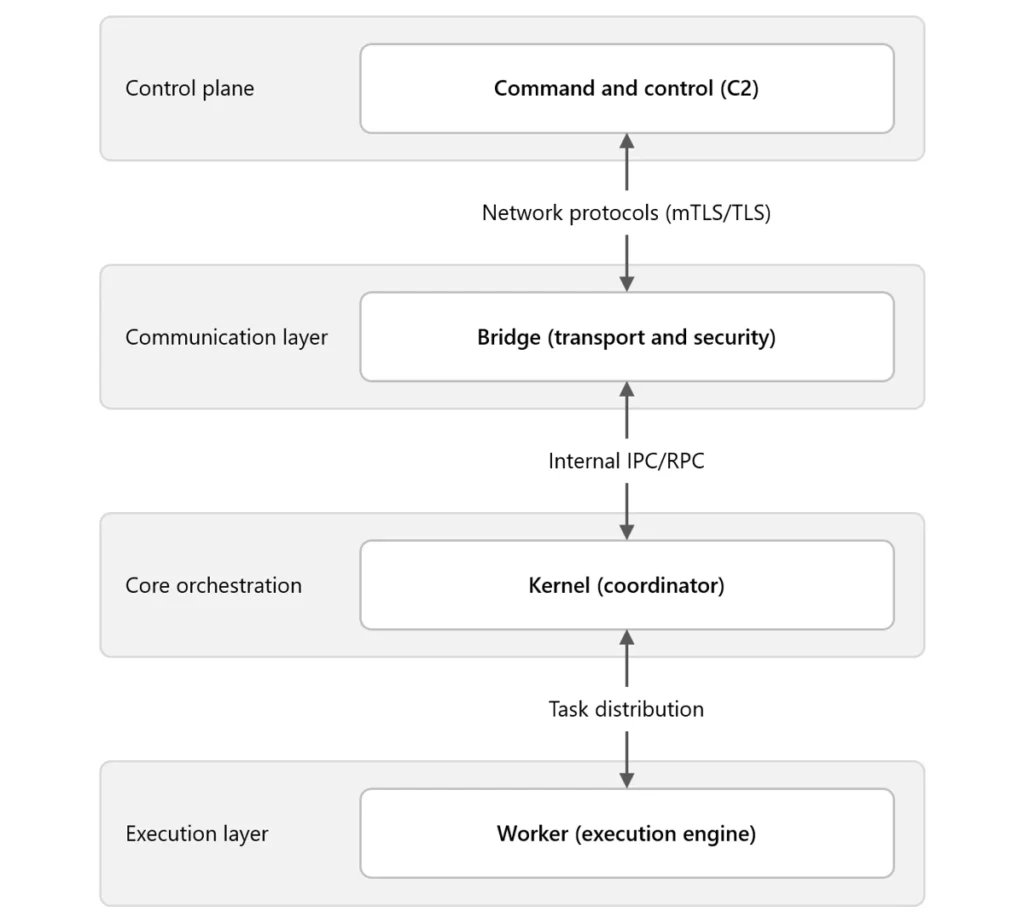
Unlike conventional malware that depends heavily on living-off-the-land binaries (LOLBins) to evade detection, Kazuar demonstrates a different approach. The malware now embeds stealth, resilience, and operational redundancy directly into its architecture. Its latest evolution introduces a sophisticated modular design composed of three major components: Kernel, Bridge, and Worker modules. Each module has clearly separated responsibilities, enabling the malware to maintain covert persistence while minimizing observable network activity. This separation significantly complicates detection and incident response because defenders can no longer rely on identifying a single malicious process or payload.
Advanced Delivery and Payload Deployment Techniques
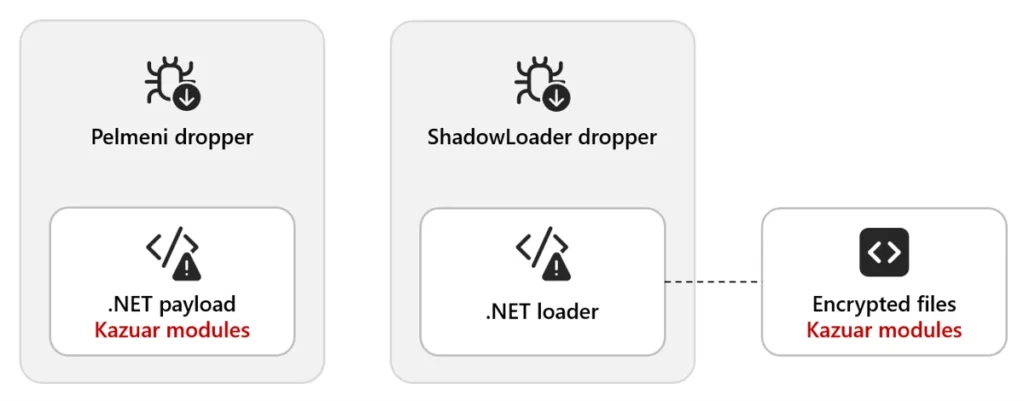
Kazuar employs multiple delivery mechanisms designed to maximize stealth and ensure successful execution only within intended environments. One observed deployment method uses a dropper called Pelmeni, which contains an encrypted second-stage payload embedded directly inside the executable as an encrypted byte array. In many cases, the payload encryption is tied to host-specific attributes such as the target hostname, ensuring the malware only decrypts correctly on the designated machine.
Another observed delivery chain involves deploying a lightweight .NET loader together with the final payload. The dropper launches this loader, frequently using COM object execution, and injects the decrypted Kazuar modules into memory. This technique reduces static detection opportunities and improves operational flexibility for attackers. The modularity also allows operators to update individual components independently without redeploying the full malware framework.
Kernel Module: The Central Command Layer
The Kernel module serves as the operational brain of the Kazuar ecosystem. It coordinates Worker modules, communicates with the Bridge module, maintains task logs, and controls overall botnet orchestration. Before execution, the Kernel performs extensive anti-analysis checks, including process enumeration for security tools, sandbox DLL detection, and canary file inspections. These defensive checks ensure the malware avoids execution in controlled analysis environments.
Kazuar’s configuration system has also become dramatically more advanced. Earlier variants relied on external configuration files, but modern samples embed configurations directly into the malware. Researchers observed more than 150 possible configuration types covering communication protocols, tasking behaviors, fallback infrastructure, and operational parameters. Supported communication methods include HTTP, WebSockets, and Exchange Web Services (EWS), providing resilience against infrastructure takedowns.

One of the most technically sophisticated aspects of Kazuar is its leadership election mechanism. Only one Kernel module within the botnet acts as the “leader” responsible for external communication with command-and-control (C2) servers. Other infected hosts remain largely silent and communicate internally using IPC channels such as named pipes, mailslots, and hidden Windows messaging systems. This architecture dramatically reduces suspicious outbound traffic and lowers the malware’s visibility within enterprise environments.
Worker and Bridge Modules Enable Distributed Operations
The Worker module performs most operational tasks including keylogging, filesystem enumeration, system information gathering, email data collection, and desktop monitoring. Data collected by Workers is encrypted and staged within a dedicated malware working directory before exfiltration. Each operational capability runs inside independent threads, allowing asynchronous execution and improving reliability.
The Bridge module acts as the communication proxy between the leader Kernel and remote C2 infrastructure. It abstracts external communications from operational logic and supports multiple transport methods. If a new leader is elected within the botnet, the corresponding Bridge module automatically assumes external communication responsibilities. This redundancy makes infrastructure disruption significantly more difficult for defenders.
Kazuar also uses Google Protocol Buffers (Protobuf) for internal message serialization. This structured communication system allows modules to efficiently exchange encrypted commands and telemetry while supporting flexible routing across IPC mechanisms and network transports.
Persistence, Data Staging, and Stealth Operations
A defining characteristic of Kazuar is its centralized working directory structure. The malware stores task files, logs, keylogger outputs, configuration data, result files, and other operational artifacts within segregated subdirectories. All data is encrypted before staging and retained locally until the Bridge module forwards it to the C2 infrastructure. This filesystem-centric architecture allows Kazuar to maintain operational continuity across reboots, leadership transitions, and temporary communication failures.
The malware’s communication scheduling also demonstrates advanced operational security. Heartbeat intervals, blackout communication windows, and asynchronous message handling help the malware blend into legitimate enterprise traffic patterns. Additionally, if communication with the Bridge module fails, Kazuar contains fail-safe logic that allows direct communication with remote C2 servers.
Our Opinion on the Kazuar Threat Landscape
Kazuar represents a major shift in modern cyber espionage tooling. Instead of focusing solely on stealth through LOLBins or fileless execution, Secret Blizzard has engineered resilience directly into the malware’s architecture. The separation between Kernel, Worker, and Bridge modules demonstrates a level of operational maturity typically associated with advanced state-sponsored campaigns rather than financially motivated cybercrime groups.
What makes Kazuar particularly dangerous is not just its technical sophistication, but its long-term persistence strategy. The leadership election system, redundant communication protocols, encrypted staging directories, and asynchronous task execution indicate a framework designed for prolonged covert access rather than smash-and-grab attacks. This aligns closely with geopolitical intelligence objectives where remaining undetected for months or years is more valuable than immediate disruption.
From a defensive perspective, organizations must shift away from purely signature-based detection models. Modern threats like Kazuar require behavioral analytics focused on IPC abuse, abnormal named pipe activity, hidden window messaging, encrypted staging behavior, and unusual inter-process communications. Endpoint detection and response (EDR), attack surface reduction rules, PowerShell logging, and network segmentation are no longer optional security controls; they are essential defensive layers against modular espionage frameworks.
Kazuar’s continued evolution also highlights a broader industry reality: nation-state malware is increasingly adopting software engineering principles similar to enterprise-grade distributed systems. This trend will likely define the next generation of advanced persistent threats.
