

Modern threat actors are no longer relying on noisy exploits or easily detectable malware. Instead, they are increasingly abusing trusted execution paths and legitimate software components to blend into enterprise environments. This analysis explores a sophisticated post-exploitation framework that leverages the Windows .NET ecosystem to execute malicious code stealthily, maintain persistence, and evade detection across multiple layers of defense.
Introduction: Trust as an Attack Vector
One of the most striking aspects of this framework is its abuse of trust. Rather than injecting code into arbitrary processes or dropping obvious malware binaries, the attacker hijacks the AppDomainManager mechanism within a legitimate, signed .NET application. This allows malicious code to execute before the application’s actual logic begins—without modifying the original executable.
Because the host binary is properly signed and trusted by the operating system, traditional security controls such as code-signing validation are effectively bypassed. This represents a shift from exploiting vulnerabilities to exploiting design assumptions in trusted frameworks.
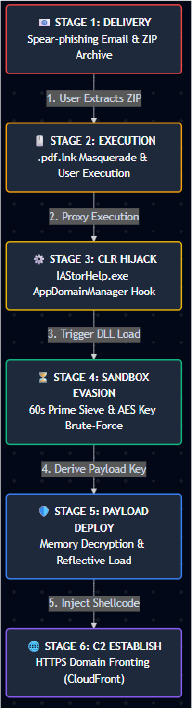
Infection Chain: A Six-Stage Attack Lifecycle
The attack follows a carefully engineered six-stage lifecycle:
- Delivery – A spear-phishing email delivers a ZIP archive containing all required components.
- Execution Trigger – A disguised
.pdf.lnkfile tricks the user into launching a trusted binary. - CLR Hijacking – A malicious
.configfile forces the .NET runtime to load attacker code. - Sandbox Evasion – CPU-intensive delays and cryptographic loops prevent analysis.
- Payload Execution – Encrypted payload is decrypted and executed in memory.
- Command & Control (C2) – Communication is established via CDN infrastructure.
Notably, the entire attack chain is self-contained within the extracted folder—no registry changes or external downloads are required.
Social Engineering Meets Technical Precision
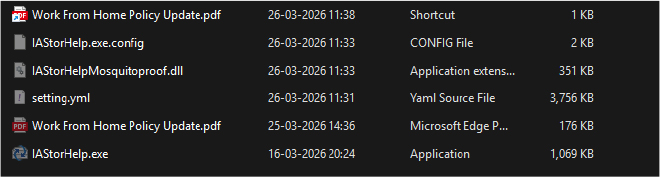
The attack begins with a highly convincing lure: a fake “Work From Home Policy” PDF styled as an official government document. Combined with a double-extension trick (.pdf.lnk) and a legitimate PDF icon, the file appears authentic to the user.
When executed, the shortcut launches the trusted binary while simultaneously opening a decoy document—keeping the victim distracted while the malicious payload runs silently in the background.
AppDomainManager Hijacking: The Core Technique
At the heart of this framework is AppDomainManager hijacking, achieved through a malicious .config file placed alongside the executable.
This configuration instructs the .NET runtime to:
- Load a malicious DLL
- Execute attacker-controlled code during application initialization
Because this behavior is part of standard .NET functionality, it does not trigger traditional security alerts. The malicious DLL inherits the trust of the signed host process, effectively bypassing signature-based defenses.
Multi-Layered Evasion Techniques
This framework demonstrates exceptional anti-analysis capabilities:
1. Timing-Based Sandbox Evasion
Instead of using obvious delays like sleep(), the malware performs CPU-intensive computations (prime number generation) for 60 seconds. This appears benign but exhausts sandbox analysis time.
2. Cryptographic Key Derivation Loop
A constrained loop of over 800,000 iterations generates AES keys using SHA-256 transformations. Only one valid key successfully decrypts the payload, further delaying execution.
3. String Obfuscation
All sensitive strings (file names, C2 domains) are:
- Base64 encoded
- XOR encrypted
- Decoded only at runtime
This prevents static analysis tools from extracting meaningful indicators.
Payload Protection and Execution
The payload is stored as an AES-128-CBC encrypted blob and only decrypted during execution. This ensures that even if the file is extracted, it remains unreadable without the correct key.
Once decrypted, execution occurs using an advanced technique:
JIT Trampoline Execution
Instead of calling suspicious APIs like VirtualAlloc, the malware:
- Generates a dynamic .NET assembly
- Forces the JIT compiler to allocate executable memory
- Overwrites that memory with shellcode
- Executes it via a function pointer
This bypasses many endpoint detection systems that monitor traditional memory allocation APIs.
Reflective Loading and API Evasion
The framework avoids standard Windows APIs by:
- Using PEB traversal to locate system libraries
- Implementing a custom export walker to resolve functions
- Dynamically constructing API calls at runtime
Additionally, it uses reflective DLL loading, manually mapping modules into memory with proper section permissions—making them appear legitimate during forensic analysis.
Noise Generation and Anti-Forensics
To further evade detection:
- A DLL injection storm loads multiple legitimate system libraries to create noise
- Memory pressure techniques degrade forensic tools
- A two-phase memory cleanup removes all traces after execution
This ensures that even if the system is investigated, little evidence remains.
Command-and-Control via Cloud Infrastructure
Instead of suspicious domains, the malware communicates through CDN-backed infrastructure. Traffic is routed via trusted cloud services, making it difficult to block without disrupting legitimate operations.
This technique highlights a growing trend: attackers hiding within widely trusted platforms.
Modular Architecture and Resilience
The framework is not a single-purpose tool—it is a plugin-based platform. It can dynamically load additional capabilities such as:
- Keylogging
- Data exfiltration
- Remote control modules
It also includes a heap-walking recovery mechanism, allowing it to regain execution state after crashes—ensuring long-term persistence.
Our Opinion on This Case
This framework represents a clear evolution in offensive cyber capabilities, where stealth and reliability take precedence over brute-force exploitation. What makes this case particularly concerning is not just the sophistication of individual techniques, but how seamlessly they are integrated into a cohesive attack chain.
The abuse of legitimate mechanisms like AppDomainManager and trusted signed binaries highlights a fundamental challenge in cybersecurity: trust can be weaponized. Traditional defenses that rely heavily on signatures, known indicators, or API monitoring are increasingly ineffective against such approaches.
Equally notable is the attacker’s investment in anti-analysis and operational resilience. Techniques like JIT-based execution, CDN fronting, and reflective loading are no longer experimental—they are becoming standardized in high-end threat tooling. This suggests a convergence between nation-state tactics and commercially available offensive frameworks.
From a defensive standpoint, this case reinforces the need for behavior-based detection, deeper visibility into runtime execution, and improved monitoring of trusted application flows. Organizations must shift from “Is this file malicious?” to “Is this behavior normal?”
Ultimately, this is not just an isolated threat—it is a preview of how future attacks will operate: quietly, persistently, and hidden in plain sight.
MITRE ATT&CK MAPPING
| Tactic | Technique | ID | Evidence |
| Initial Access | Phishing: Spear phishing Attachment | T1566.001 | LNK file masquerading as WFH policy PDF |
| Execution | User Execution: Malicious File | T1204.002 | User double-clicks .pdf.lnk shortcut |
| Execution | Native API | T1106 | Direct NTDLL syscall stubs |
| Execution | Shared Modules | T1129 | 16 DLLs via randomized LoadLibrary |
| Persistence | Hijack Execution Flow: AppDomainManager | T1574.014 | .config overrides CLR initialization |
| Defense Evasion | Masquerading: Match Legitimate Resource Name or Location | T1036.005 | LNK uses Edge PDF icon; DLL spoofs Intel |
| Defense Evasion | System Binary Proxy Execution | T1218 | Signed IAStorHelp.exe as execution proxy |
| Defense Evasion | Obfuscated Files or Information: Software Packing | T1027.002 | AES-encrypted + GZip-compressed payload |
| Defense Evasion | Obfuscated Files or Information: Embedded Payloads | T1027.009 | 27 API names via scrambled stack strings |
| Defense Evasion | Obfuscated Files or Information | T1027 | XOR de-obfuscation; 36 junk classes |
| Defense Evasion | Deobfuscate/Decode Files or Information | T1140 | Runtime AES key derivation loop combined with XOR-based string de-obfuscation |
| Defense Evasion | Reflective Code Loading | T1620 | Custom reflective DLL loader |
| Defense Evasion | Indicator Removal | T1070 | PE headers wiped; buffers zeroed |
| Defense Evasion | Impair Defenses: Disable or Modify Tools | T1562.001 | Bypasses EDR hooks via direct NTDLL |
| Defense Evasion, Discovery | Virtualization/Sandbox Evasion: System Checks | T1497.001 | 60-second prime sieve timing gate |
| Defense Evasion | Execution Guardrails | T1480 | File size validation (0x3AAC6C) |
| Defense Evasion, Priv. Esc. | Process Injection: Thread Execution Hijacking | T1055.003 | JIT trampoline via DefineDynamicAssembly |
| Discovery | System Information Discovery | T1082 | Registry processor/locale interrogation |
| Discovery | Process Discovery | T1057 | Thread enumeration; Process.Modules scan |
| Privilege Escalation, Def. Ev. | Process Injection: Dynamic-link Library Injection | T1055.001 | Reflective DLL injection |
| Command & Control | Application Layer Protocol: Web Protocols | T1071.001 | HTTPS/TLS C2 over CloudFront |
| Command & Control | Proxy: Domain Fronting | T1090.004 | C2 via cloudfront.net CDN |
