

In the landscape of modern enterprise software, supply chain security and configuration management remain two of the most critical defensive pillars. When vendors inadvertently distribute static cryptographic secrets across independent customer environments, the structural security model collapses entirely. In late 2025, Mandiant responded to a significant security incident involving KnowledgeDeliver, a prominent Learning Management System (LMS) developed by Digital Knowledge and widely utilized across various corporate and academic sectors in Japan. The investigation unmasked a critical, unauthenticated Remote Code Execution (RCE) vulnerability—subsequently tracked as CVE-2026-5426—which allowed threat actors to achieve full system compromise. This technical analysis explores the root mechanics of the vulnerability, the sophisticated post-exploitation tactics used by the adversaries, and actionable detection engineering strategies to mitigate the risk.
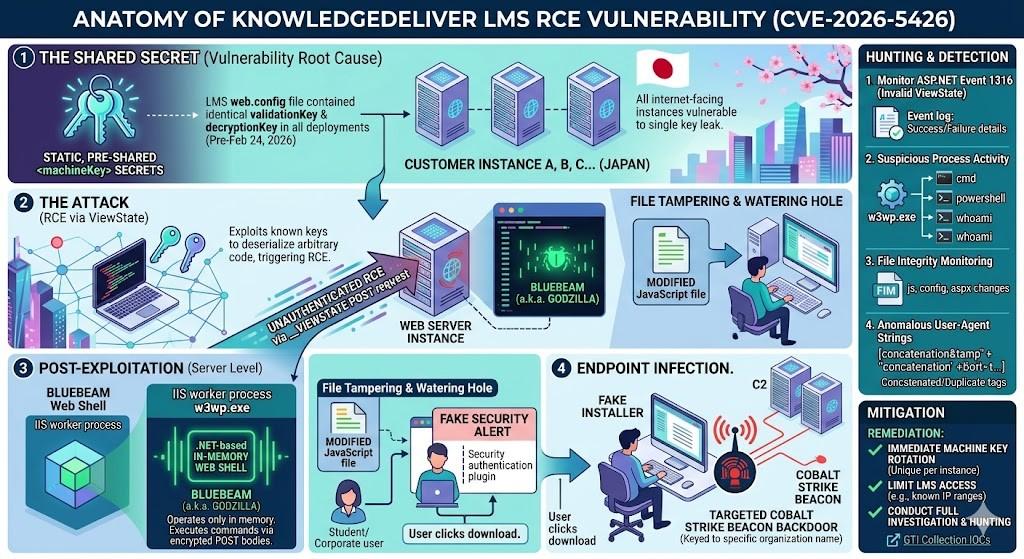
The Technical Root Cause: Static ASP.NET Machine Keys
The architectural vulnerability underlying CVE-2026-5426 stems from a foundational flaw in how the application managed its cryptographic identity. KnowledgeDeliver installations deployed prior to February 24, 2026, relied on a standardized, vendor-supplied web.config file. This configuration script contained hardcoded, static values for the ASP.NET <machineKey> element. In a standard internet-facing .NET application, the machineKey is responsible for providing data integrity protection and encryption for state mechanisms, most notably the application’s ViewState. Because these identical cryptographic keys were packaged globally into the deployment templates, an attacker who obtained the keys from a single instance could immediately target any other internet-facing KnowledgeDeliver environment globally.
The core of the exploit relies on subverting the ASP.NET ViewState mechanism, which marshals page state data across HTTP postbacks. When an application is configured with a known, static machineKey, the underlying security assumptions of data origin authentication are nullified. A threat actor can leverage open-source utility frameworks to craft a serialized payload containing malicious object graphs (gadget chains). By signing and encrypting this payload using the compromised decryptionKey and validationKey, the attacker transmits the malicious data via the __VIEWSTATE parameter in an unauthenticated HTTP request. Upon receiving the packet, the IIS worker process decrypts and attempts to deserialize the payload using its matching keys. This invokes arbitrary code execution directly within the context of the web application pools.
The following structure reflects the critical misconfiguration pattern found within the vulnerable web.config instances:
XML
<configuration>
  <system.web>
    <machineKey decryptionKey="<REDACTED>" validationKey="<REDACTED>" />
  </system.web>
</configuration>
This specific methodology maps identically to historical exploitation paradigms, such as the Sitecore ViewState Deserialization Zero-Day vulnerability and various legacy Microsoft advisory reports regarding static key exposures. The incident serves as a stark reminder that cryptographic integrity relies entirely on the uniqueness and secrecy of the underlying material.
Post-Exploitation Mechanics and Payload Delivery
Once the initial access phase succeeded via ViewState exploitation, the threat actors executed a well-coordinated post-exploitation playbook designed to establish long-term persistence, evade traditional Endpoint Detection and Response (EDR) telemetry, and monetize or weaponize the underlying user base.
In-Memory Web Shell Deployment (BLUEBEAM)
To retain an interactive command-and-control (C2) channel without generating noisy disk-write events, the adversary deployed BLUEBEAM (commonly tracked in the broader intelligence community as the Godzilla web shell). BLUEBEAM is an advanced, .NET-based in-memory web shell that hooks directly into the Internet Information Services (IIS) worker process (w3wp.exe). By utilizing reflective loading or dynamic compilation techniques, the malware avoids dropping physical .aspx files onto the host file system. Instead, it processes incoming HTTP POST requests containing encrypted command strings, decrypts them dynamically in memory, executes the payload, and returns the encrypted output. This architecture minimizes file-system footprints, rendering standard file-based antivirus scanners completely ineffective.
File System Tampering and Permissions Manipulation
To solidify control over the hosting environment and prepare the infrastructure for downstream exploitation, the actors pivoted to system-level utility execution. They executed the native Windows security identifier tool icacls.exe against the web application directories, modifying discretionary access control lists (DACLs) to grant the “Everyone” user group full access privileges. This step ensured that any restrictive application pool permissions would not impede subsequent file modification or creation phases. Following this permissions wipe, the threat actor targeted the application’s client-facing front-end files, injecting malicious JavaScript components directly into legitimate, commonly called application libraries. This secondary injection layer weaponized the platform against its own user base by triggering fake security warnings.
Legitimate User Request -> Compromised LMS Server -> Malicious JS Injection -> Fake Security Plugin Download -> Cobalt Strike Beacon Execution
Targeted Cobalt Strike Beacon Infrastructure
The ultimate objective of the web server compromise was to transform the LMS into a watering hole for client-side infection vectors. The injected JavaScript monitored user sessions and generated a highly convincing modal alert prompting the victim to download a critical “security authentication plugin.” When a user initiated the download, the platform delivered an installer that dropped a customized Cobalt Strike BEACON backdoor onto the workstation. Notably, the threat actor compiled the BEACON payload using an encryption key derived from the specific name of the compromised enterprise. This hyper-targeted configuration indicates distinct, targeted preparation designed to ensure the payload would align with internal operational environments and bypass general security filters.
Threat Hunting and Detection Engineering
Detecting active or historic exploitation of CVE-2026-5426 requires a multi-layered approach across Windows event logs, process execution telemetry, and web application logic analysis.
1. Application Event Log Analysis (Event ID 1316)
The primary diagnostic indicator for ViewState manipulation resides within the Windows Application log. Security analysts should build detection rules targeting Event ID 1316 generated by the ASP.NET source.
- Integrity Failures (Event Code 4009): If an attacker attempts to exploit an instance using an incorrect or guessed key, the log will record a
Viewstate verification failedmessage, citing an integrity check failure. This serves as a high-fidelity indicator of reconnaissance or failed targeting. - Invalid ViewState/Successful Cryptographic Processing (Event Code 4009): Conversely, if the message indicates that the ViewState was invalid but does not explicitly flag an integrity verification failure, it confirms that the attacker used the correct
machineKey. The cryptographic check passed, meaning the server successfully decrypted the data and proceeded to attempt deserialization, which subsequently failed during object parsing. Mandiant’s ability to extract and decrypt the payload strings within these events directly led to the recovery of the core BLUEBEAM loader components.
2. Monitoring Anomalous Process Lineage
From an endpoint telemetry perspective, security operations teams should establish strict behavior blocklists or alerts for the IIS worker process. Under standard operational bounds, w3wp.exe rarely invokes command-line interpreters or administrative utilities. Security analysts should actively hunt for the following process anomalies:
| Parent Process | Child Process | Common Observed Arguments / Indicators |
w3wp.exe | cmd.exe | /c arguments executing system discovery or permission scripts |
w3wp.exe | powershell.exe | Encoded commands (-e, -encodedcommand) or web-cradle requests |
w3wp.exe | whoami.exe | Immediate execution following an external HTTP postback event |
w3wp.exe | icacls.exe | Granting Everyone or Inherit permissions on C:\inetpub\ paths |
3. File Integrity Monitoring (FIM) and User-Agent Anomalies
Implementing continuous File Integrity Monitoring across the web root is essential to capture the client-facing JavaScript tampering. Any modifications to static asset directories, particularly modifications appending external script loaders, should trigger high-priority alerts. Furthermore, analysis of the web access logs associated with the initial compromise revealed an anomalous signature pattern involving HTTP User-Agent strings. The threat actor utilized specialized testing tools that concatenated two distinct, valid User-Agent identifiers into a single header string, as shown in the examples below:
HTTP
Mozilla/5.0 (Windows NT 6.1) AppleWebKit/537.2 ... Safari/537.2 Mozilla/5.0 (Windows NT 10.0; Win64; x64) ... Chrome/121.0.0.0
Mozilla/5.0 (compatible; MSIE 9.0; Windows NT 6.1; ...) Mozilla/5.0 (Windows NT 10.0; Win64; x64) ... Chrome/121.0.0.0
Hunting engines should flag web requests where the User-Agent field contains multiple instances of the Mozilla/5.0 token or overlapping OS generation parameters.
Remediation and Defensive Controls
Defending enterprise deployments against CVE-2026-5426 requires immediate architectural correction and network isolation strategies.
- Cryptographic Key Rotation: The primary and most critical remediation action is to invalidate the shared vendor secret. Administrators must immediately generate unique, cryptographically random, and high-entropy
machineKeyvalues within the application’s localizedweb.configfile. This halts the ability of an external actor to sign valid serialized payloads. - Network Segmentation and Access Control Lists: Where applicable, LMS portals should be removed from the public internet and positioned behind corporate Virtual Private Networks (VPNs) or restricted via IP-based Access Control Lists (ACLs) matching defined corporate network ranges.
- Comprehensive Compromise Assessments: Because the vulnerability allows unauthenticated RCE, changing the keys only stops future exploitation. Organizations running legacy builds must perform detailed forensic analyses of memory pools, active IIS modules, and outbound network connections to verify that a persistent backdoor has not already been established.
Our Opinion: The Persistent Danger of Pre-Shared Architecture
The exploitation of KnowledgeDeliver via CVE-2026-5426 highlights a frustratingly persistent anti-pattern in software engineering: the use of hardcoded, static cryptographic secrets within deployment templates. When software vendors treat operational secrets as static components of a configuration bundle, they create a systemic vulnerability across their entire customer ecosystem. The moment a single deployment is analyzed or decompiled, the security posture of every other client is degraded to zero.
In 2026, there is no technical justification for distributing software with pre-configured, shared keys. Modern deployment frameworks, containers, and orchestration tools provide robust mechanisms to generate unique, cryptographically secure secrets automatically at initialization. This incident underscores that a vulnerability in a third-party application is not just an isolated risk; it can be used as a stepping stone to launch a downstream attack against an organization’s internal endpoints. Relying on perimeter defense is no longer sufficient. Organizations must demand that software vendors follow secure-by-design principles, while detection teams must actively monitor internal application processes to detect anomalies before they scale into full corporate breaches.
Indicators of Compromise (IOCs)
The following threat intelligence indicator represents confirmed post-exploitation infrastructure linked to the KnowledgeDeliver compromise campaigns. Security teams should cross-reference this cryptographic hash against internal endpoint execution telemetry and proxy logs.
| File Name | Object Type | SHA-256 Cryptographic Hash |
LoadLibrary.dll | BLUEBEAM Web Shell Module | 7c1f99dca8e5a7897892f9d224a6495023a2cfd2671697d229d355978c415ed |
