1. What Is Lateral Movement?
Lateral Movement is the set of techniques adversaries use to move through a network after gaining initial access. Attackers perform lateral movement to:
- Expand control to more valuable systems
- Access internal services
- Collect credentials
- Reach domain controllers
- Deploy malware or ransomware at scale
It is part of the post-compromise phase and typically follows Privilege Escalation and Credential Access.
In MITRE ATT&CK, lateral movement techniques fall under TA0008 – Lateral Movement.
🏗️ 2. Core Principles of Lateral Movement
2.1 Credential Reuse
Attackers harvest credentials through:
- LSASS dumping (e.g., Mimikatz)
- NTLM hash extraction
- Kerberos tickets (TGTs/TGSs)
These credentials are used for:
- SMB/WinRM login
- RDP authentication
- Kerberos ticket injections
2.2 Trust Exploitation
Adversaries exploit:
- Shared admin accounts
- Poor segmentation
- Weak ACLs
- Open RDP/SMB/SSH
Impersonation and delegation abuse allow movement without triggering alerts.
2.3 Remote Service Invocation
Movement often uses existing remote administration protocols:
Windows:
- SMB (PsExec semantics)
- WMI
- WinRM
- RDP
- Distributed Component Object Model (DCOM)
Linux/UNIX:
- SSH
- Remote shells
- rsync/scp
2.4 Living-off-the-Land (LotL)
Modern attackers avoid malware:
- Using PowerShell (
Invoke-Command) wmic.exefor process creationsshfor key-based pivotingschtasks.exefor remote job creationnet usefor remote drive mounting
This hides movement within normal administrative traffic.
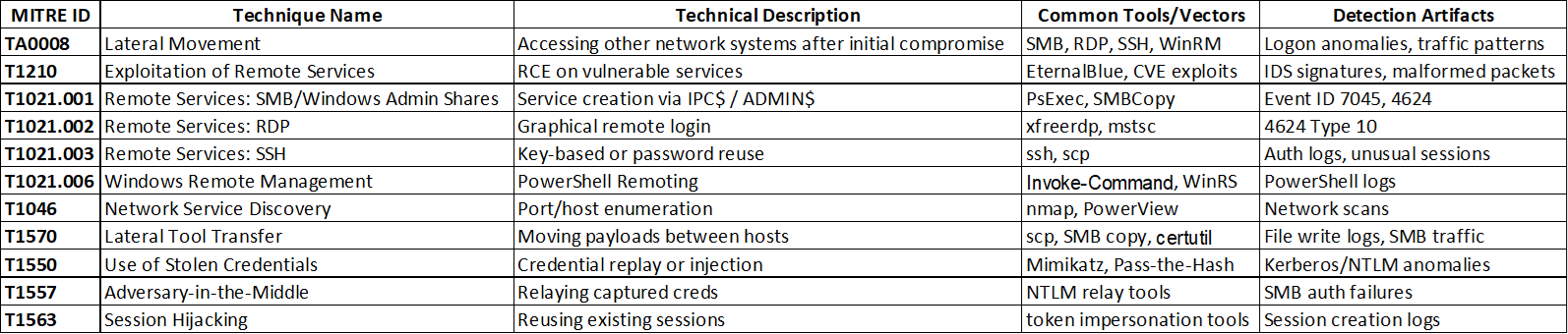
🔬 3. MITRE ATT&CK Lateral Movement Techniques (TA0008)
Below is a breakdown of each high-level technique with technical details.
T1210 – Exploitation of Remote Services
Adversaries exploit vulnerabilities to access remote machines.
Examples:
- EternalBlue (MS17-010) → SMBv1 buffer overflow
- RCE in RDP, vCenter, Confluence, Exchange
- CVE-based exploitation (deserialization, SSRF, RCE)
Technical artifacts:
- RPC anomalies
- Malformed SMB packets
- Rapid port scanning prior to exploitation
T1021 – Remote Services
Legitimate protocols used for malicious movement.
Windows:
- SMB/PSExec: remote service creation
- WMI: MOF or DCOM-based execution
- WinRM: PowerShell Remoting
- RDP: graphical remote connection
Linux/macOS:
- SSH: key-based or password reuse
- Telnet: legacy plaintext credential reuse
Indicators:
- Unusual
Event ID 4624Type 3/10 logins - Sudden spike in PowerShell Remoting
T1570 – Lateral Tool Transfer
Movement of tools across hosts.
Methods:
- SMB copy (
copy \\host\C$) scp/sftp- PowerShell Base64-encoded file drop
- Registry-based persistence via encoded payloads
Typical payloads:
- Cobalt Strike beacons
- Mimikatz
- Rclone
- Custom RAT droppers
T1046 – Network Service Discovery (pre-movement)
Attackers enumerate:
- Open ports
- Domain trusts
- Network shares
- LDAP queries for GPOs / users
- Hosts via ARP sweep
Tools:
net view,arp -a- PowerView
- Nmap
T1087 / T1069 – Account & Permission Enumeration
Used to identify high-value targets:
- Domain Admins
- Service accounts
- Kerberos delegations
T1550 – Use of Stolen Credentials
Credential replay vectors:
- Passing NTLM hashes (Pass-the-Hash)
- Injecting Kerberos TGT/TGS (Pass-the-Ticket)
- OAuth/SSO token theft (cloud lateral movement)
Key log sources:
- 4768 / 4769 Kerberos ticket events
- LSASS memory access attempts
T1557 – Adversary-in-the-Middle
Interception of traffic to obtain credentials:
- NTLM relay
- SMB relay
- Kerberoasting
T1563 – Remote Service Session Hijacking
Hijacking active RDP or SSH sessions using:
- Token impersonation
- Session duplication
- Virtual channel takeover
🧠 4. Operational Flow of Lateral Movement
Typical attacker sequence:
- Credential Harvesting – Dumping LSASS or capturing hashes
- Discovery – Mapping domain, hosts, shares
- Target Selection – Domain controllers, databases
- Credential Replay / Auth bypass
- Remote Execution – PSExec, PowerShell Remoting, WMI
- Tool Transfer – Dropping payloads or using LotL
- Privilege Escalation on new system
- Repeat until objective is achieved
🔥 5. Common Threat Actors Using Lateral Movement
APT29 (Cozy Bear)
- Sophisticated Kerberos ticket forgery
- Uses WMI + WinRM heavily
APT41
- Hybrid cybercrime + espionage
- Known for exploiting remote services
Conti / LockBit ransomware groups
- Aggressive SMB + RDP propagation
- Domain admin takeover within hours
🛡️ 6. Defensive Strategies
Detection
- Logon anomalies (4624 type 3/10, 4625 failures)
- WMI event subscriptions
- Remote service creation (7045)
- PowerShell logs (Script Block Logging)
- NTLM relay detection
Prevention
- Enforce MFA
- Disable SMBv1
- Segment networks
- Limit admin account reuse
- Implement Just-In-Time (JIT) administration
Hardening
- LSASS protection (
RunAsPPL) - Enable Credential Guard
- Disable unnecessary remote services
- Privileged Access Workstations (PAWs)
📊 7. MITRE Lateral Movement Summary Table