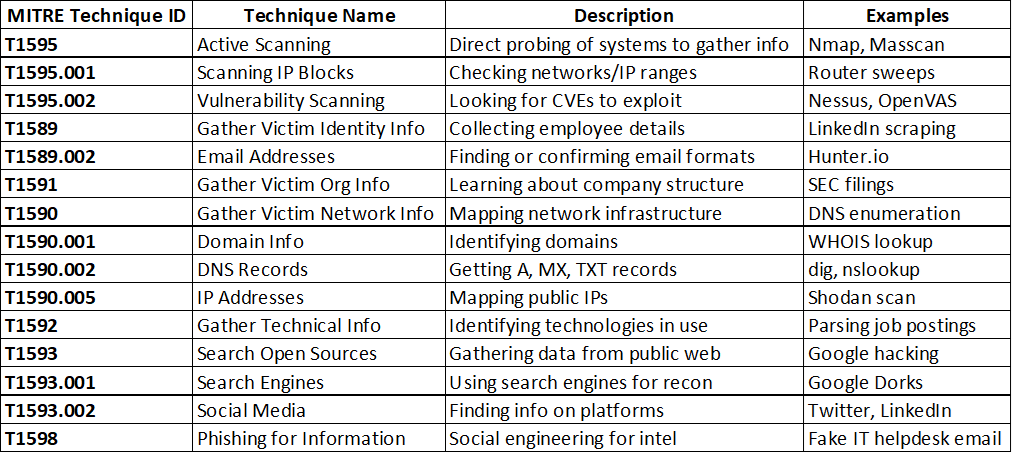
MITRE ATT&CK’s Reconnaissance tactic refers to the set of activities an adversary performs before launching an actual attack. Think of it as the information-gathering stage—the attacker is collecting details about a target environment, employees, technologies, or vulnerabilities to plan their operation.
Reconnaissance is passive or active:
- Passive recon: Attacker gathers information without interacting directly with the target (e.g., searching public data).
- Active recon: Attacker interacts with the target system/network (e.g., scanning).
🧠 Why Reconnaissance Matters
Adversaries need recon to:
- Understand the target’s infrastructure
- Identify weak points
- Tailor phishing, exploits, and malware
- Increase attack success while reducing detection
This stage often leaves minimal logs, making it harder for defenders to detect.
🕵️♂️ Common Reconnaissance Techniques (MITRE)
Below are the main techniques under MITRE’s Reconnaissance tactic (TA0043).
1. Active Scanning (T1595)
Attackers probe systems directly to gather:
- Open ports
- Services
- Operating systems
- Exposed devices
Examples:
- Nmap/Zenmap scanning
- Masscan internet-wide scans
Variants:
- Vulnerability Scanning (T1595.002) – scanning for specific CVEs
- IP Block Scanning (T1595.001) – scanning networks or IP ranges
2. Gather Victim Identity Information (T1589)
Collecting personal data of employees or executives to plan phishing or impersonation.
Types:
- Email addresses (T1589.002)
- Employee names, roles, org charts
- Credentials leaked online (T1589.003)
Sources include LinkedIn, Facebook, GitHub, corporate websites.
3. Gather Victim Org Information (T1591)
Understanding the target organization’s structure and operation.
Examples:
- Corporate hierarchy
- Business partners
- Locations
- Public filings (SEC, financial reports)
4. Gather Victim Network Information (T1590)
Identifying network infrastructure such as:
- IP addresses
- DNS records
- VPN gateways
- Cloud services
Examples:
- DNS enumeration
- WHOIS lookups
- AS number checks
Sub-techniques:
- Domains (T1590.001)
- DNS Records (T1590.002)
- IP Addresses (T1590.005)
5. Gather Victim Technical Information (T1592)
Researching the organization’s technologies such as:
- Operating systems
- Software versions
- Hardware devices
- Cloud platforms
Sources:
- Job postings (listing required tools)
- GitHub repositories
- Tech blogs
6. Search Open Sources (T1593)
Collecting information from publicly available resources.
Examples:
- Search engines (Google, Bing)
- Social media
- Online databases
- Public code repositories
- Dark web forums
Sub-techniques:
- Search Engines (T1593.001)
- Social Media (T1593.002)
7. Phishing for Information (T1598)
Using social engineering to extract data.
Examples:
- Email asking for employee credentials
- Fake HR messages
- Telephone pretexting
Sub-techniques:
- Spearphishing Service (T1598.003)
- Spearphishing Link (T1598.002)
8. Obtain Capabilities (T1588)
Although categorized under “Resource Development,” it is often part of recon in practice.
Adversaries acquire:
- Malicious tools
- Infrastructure (servers, domains)
- Zero-day exploits
Used to support later attack stages.
🛡️ How Defenders Detect & Mitigate Reconnaissance
- Monitor external scanning activities (traffic thresholds, unusual IPs)
- Use threat intelligence feeds to track scanning campaigns
- Apply web application firewalls (WAF)
- Regularly review DNS records & certificate transparency logs
- Employee security awareness training (phishing defense)
- Reduce publicly exposed data
- Implement rate-limiting and CAPTCHA on public portals.