

This report presents a detailed analysis of a sophisticated Android malware sample designed to target users within the Russian ecosystem. The malicious application functions as a banking Trojan with remote access capabilities, enabling attackers to monitor victims, intercept sensitive data, and execute commands remotely.
The malware demonstrates a high level of technical maturity. It integrates native code components, runtime decryption mechanisms, and Firebase-based command channels to maintain stealth and persistence. Through extensive permission abuse and advanced monitoring techniques, the malware collects a wide range of sensitive information from infected devices.
The threat appears to be financially motivated. Its architecture specifically targets Russian banking applications, enabling attackers to intercept authentication codes, observe transactions, and potentially perform fraudulent operations.
Given its capabilities—including full SMS control, real-time screen monitoring, credential harvesting, and remote device manipulation—this malware represents a significant risk to both individual users and financial institutions operating in the affected region.
Malware Capability Overview
1. Permission Abuse and Privilege Acquisition
The application requests an unusually large number of sensitive Android permissions. These permissions provide the malware with extensive surveillance and control capabilities.
Requested permissions include access to:
- SMS messages
- Call logs
- Contacts
- Device phone state
- Location data
- Overlay display capabilities
- Installed package visibility
- Boot persistence
- Exact alarm scheduling
- Battery optimization bypass
One particularly dangerous capability is the request to become the default SMS application. Once granted, the malware gains unrestricted access to SMS functionality, allowing it to read, send, and delete messages. This enables interception of one-time passwords (OTPs) and other authentication messages.
2. Targeted Banking Application Monitoring
The malware actively scans the device for installed applications and categorizes them by type.
It specifically identifies:
- Banking applications
- Cryptocurrency wallets
- Government services
- Online marketplaces
The malware maintains a list of targeted banking applications associated with Russian financial institutions. These application identifiers are stored in encrypted form and are decrypted during runtime using custom XOR routines.
This functionality allows attackers to monitor activity related to specific banks and potentially intercept financial credentials or transactions.
3. Data Collection and Exfiltration
Once installed, the malware begins harvesting a variety of sensitive data from the compromised device.
Collected information includes:
- SMS messages
- Contacts
- Call history
- Clipboard contents
- Installed application lists
- Notification data
- One-time passwords
- Lock screen PINs
- Keystroke logs
This information is transmitted to the attacker’s command-and-control infrastructure for further analysis or exploitation.
4. Native Code Integration and Obfuscation
To avoid detection and complicate reverse engineering, the malware shifts critical functionality into a native shared library named:
sysruntime.so
The use of native code provides several advantages for the attacker:
- Difficulties for static analysis tools
- Concealment of sensitive configuration data
- Increased resistance to signature-based detection
Sensitive values such as command servers and configuration parameters are stored in encrypted form and decrypted only during execution.
5. Command-and-Control Communication
The malware communicates with a remote command server located at:
193.233.112[.]229
Communication occurs using both HTTP POST requests and WebSocket connections.
The command infrastructure supports:
- Execution of attacker commands
- Transmission of stolen data
- Configuration updates
- Remote control operations
Additionally, the malware integrates Firebase push messaging, which enables attackers to trigger commands or wake the malware even when it is running in the background.
6. Remote Device Control
The malware implements a remote monitoring capability similar to VNC remote desktop functionality.
Using a combination of:
- Accessibility Services
- MediaProjection APIs
- WebSocket streaming
attackers can observe the device screen in real time and monitor user interactions.
This functionality enables:
- Screen recording
- Transaction monitoring
- Credential capture
- Active manipulation of the device interface
7. Persistence and Stealth Mechanisms
The malware implements several redundant persistence mechanisms to ensure it remains active on the device.
These include:
- Automatic launch during device boot
- Long-running foreground services
- Abuse of Accessibility permissions
- Scheduled background alarms
- Push message triggers
- User activity monitoring
Additional stealth techniques include:
- Removal of the application icon from the launcher
- Bypass of battery optimization
- Hidden background services
These techniques ensure that the malware continues running even if the user attempts to close it.
8. Communication Obfuscation
The malware protects its infrastructure through several obfuscation strategies.
These include:
- XOR-based encryption
- Rolling decryption keys
- Runtime string decryption
- Non-linear memory access patterns
These techniques hide command servers and configuration values until the malware is actively running, making detection more difficult.
9. Multi-Architecture Support
The malware is compiled for multiple processor architectures:
- arm64-v8a
- armeabi-v7a
- x86_64
This ensures compatibility with most Android devices and allows the malware to infect a broad range of victims.
Additionally, the malware supports worker keys, which allow multiple operators to use the same infrastructure while maintaining separate victim groups.
Static Analysis Findings
Excessive Permission Requests
The application requests a large set of intrusive permissions that far exceed what would normally be required by legitimate applications.
These permissions collectively allow the malware to monitor user activity, intercept communications, manipulate device behavior, and maintain long-term persistence.
Such permission patterns are commonly associated with Android spyware or banking Trojans.
SDK Targeting and Package Naming
The malware targets the latest Android API levels while also maintaining compatibility with older versions of the operating system.
The application package name appears randomly generated:
ru.y34tuy.t8595
This pattern is commonly seen in malware generated using automated RAT builder kits, which produce unique package names to avoid signature-based detection.
Launcher Icon Hiding
The malware modifies its Android manifest file to replace the standard launcher category with the INFO category.
This configuration prevents the application icon from appearing in the device launcher, effectively hiding it from the user interface.
This behavior strongly indicates deliberate concealment.
Native Library Analysis
sysruntime.so Initialization
At application startup, the malware loads the native library:
libsysruntime.so
This library is compiled for multiple architectures and stored inside the application’s /lib directory.
Critical configuration values are embedded within this library instead of the Java codebase.
Examples include:
- Bot identifiers
- Command server addresses
- WebView links
- Worker campaign identifiers
These values remain encrypted until the malware executes.
Native Function Capabilities
Analysis of the library revealed several exported functions including:
getBotIdgetServerListNativegetWebviewUrlNativegetWorkerKeyNative
These functions retrieve configuration values directly from the native layer.
The library also contains Firebase credential retrieval functions, confirming its use as part of the malware’s command infrastructure.
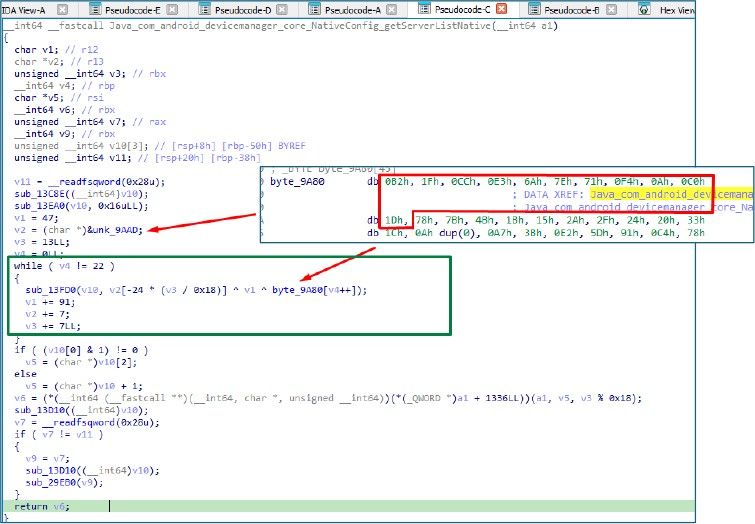
Command Server Obfuscation
The command-and-control server address is hidden using a custom decryption routine located in the native function:
getServerListNative
The routine references two key data structures stored in the .rodata section.
XOR Key Array (22 bytes)
B2 1F CC E3 6A 7E 71 F4
0A C0 1D 78 7B 4B 1B 15
2A 2F 24 20 33 1C
Encrypted Data Block
F5 69 1C 83 CB 52 9F E1
34 A0 6D 3A 7F B2 1D E9
54 C8 6B F7 B6
The decryption algorithm uses:
- Non-linear memory access
- A rolling XOR key
- Incremental key modification
The key begins with the value 47 and increases by 91 during each iteration.
C2 Address Recovery
A Python script was developed to reproduce the native decryption logic and reconstruct the hidden server address.
The script replicated the memory layout used by the malware and correctly reproduced the XOR algorithm.
The recovered command server address is:
http://193.233.112[.]229
This confirms that the malware intentionally hides its infrastructure to avoid static detection.
Firebase Credential Extraction
Using a similar approach, additional credentials embedded in the binary were recovered.
The malware uses an 8-byte XOR key:
3A 7F B2 1D E9 54 C8 6B
This key decrypts a 39-byte encrypted block containing Firebase configuration data.
Recovered information includes:
- Firebase API Key
- Project ID
- App ID
- Storage bucket
- Sender ID
Example recovered API key:
AIzaSyAjWqYjz1VbRByhLX8Mu0sXeh6FzIko90
WebView Behavior
Unlike other configuration values, the WebView URL is stored in plaintext within the native library.
https://taxi.ru
Additional values including the bot ID and worker key were also found in plaintext.
Worker Key Function
The malware includes the following worker key:
9bc096a5f4ec7ba133d743cbaf4b8a2e
This value functions as a campaign identifier and allows multiple operators to use the same infrastructure while maintaining separate victim pools.
This structure is typical in malware-as-a-service (MaaS) operations.
System Profiling Behavior
Upon execution, the malware collects device information including:
- Device model
- Android version
- Phone number
- SIM card information
- Operator details
It also scans for installed banking applications.
The collected data is transmitted to the server endpoint:
/api/v1/sync/init
Notification Monitoring
The malware intercepts system notifications and extracts:
- Application package name
- Notification title
- Notification text
Using regex parsing, the malware identifies authentication codes and OTP messages.
Captured notifications are sent to:
/api/v1/sync/notification
SMS Exfiltration
All SMS messages are extracted and transmitted to the command server.
Data fields include:
- Message ID
- Sender or recipient
- Message body
- Timestamp
- Message direction
- Read status
- SIM subscription ID
Data is sent to:
/api/v1/sync/backup/messages
Contact and Call Data Harvesting
The malware collects:
- Contact names
- Phone numbers
- Call history
These are transmitted to the following endpoints:
/api/v1/sync/backup/contacts
/api/v1/sync/backup/calls
Clipboard Monitoring
Clipboard contents are captured and sent to:
/api/v1/sync/backup/clipboard
Application Inventory Collection
The malware gathers detailed information about installed applications including:
- App name
- Package identifier
- Version number
- Category
- Banking application status
- System application status
This data is transmitted to:
/api/v1/sync/backup/apps
Banking Application Detection
The malware contains an encrypted list of targeted application package names.
These are decrypted using the XOR key:
{58, 127, -78, 29, -23, 84, -56, 107}
The decrypted list includes:
- Russian banking apps
- Government services
- Cryptocurrency wallets
- Marketplaces
Remote Access Functionality
The malware provides attackers with remote device monitoring through WebSocket connections.
This enables:
- Real-time screen viewing
- Interaction monitoring
- Screen capture
- Fraud monitoring
Lock Screen PIN Interception
The malware detects lock screen activity and records PIN entries.
Captured credentials are stored locally with timestamps and later transmitted to the command server.
Keylogging Capability
User keystrokes are recorded and structured into JSON data containing:
- Application source
- Captured text
- Event type
- Timestamp
This information is then sent to the attacker infrastructure.
Persistence Architecture
The malware uses several mechanisms to maintain continuous operation:
- Boot auto-start
- Foreground services
- Accessibility abuse
- Scheduled alarms
- Push messaging triggers
- User activity monitoring
- Network change detection
- Wake locks
- Battery optimization bypass
These mechanisms ensure the malware remains active even after reboots or system attempts to stop it.
Dynamic Analysis Observations
Default SMS Request
Upon launch, the application prompts the user to set it as the default SMS application.
Once granted, Android automatically approves several sensitive permissions.
WebView Execution
The malware attempts to open the URL:
https://taxi.ru
However, the domain was unreachable during analysis.
Command Server Connectivity
The malware repeatedly attempted to connect to:
193.233.112.229
The server did not respond during testing.
Threat Landscape Assessment
The malware shows strong indicators of regional targeting, focusing primarily on Russian users and financial applications.
Distribution appears to rely on:
- Social engineering
- Repackaged applications
- Localized distribution channels
The threat actor’s objective appears to be financial gain through credential theft and fraudulent transactions.
The malware’s design demonstrates strong operational security practices including:
- Native code obfuscation
- Runtime decryption
- Firebase command infrastructure
MITRE ATT&CK Mapping
| Tactic | Technique |
|---|---|
| Initial Access | Phishing |
| Persistence | Foreground Persistence, Scheduled Tasks |
| Privilege Escalation | Device Administrator Permissions |
| Defense Evasion | Hide Artifacts, Prevent App Removal |
| Credential Access | Clipboard Data, Keylogging |
| Discovery | System Information Discovery |
| Collection | SMS, Contacts, Call Logs, Screen Capture |
| Command and Control | Web Protocols, Encrypted Channels |
| Exfiltration | Data Exfiltration over C2 |
Indicators of Compromise
| Indicator | Type | Context |
|---|---|---|
| 67d5d8283346f850eb560f10424ea5a9ccdca5e6769fbbbf659a3e308987cafd | APK Hash | RuTaxi APK |
| 193.233.112[.]229 | IP | Command Server |
| 9bc096a5f4ec7ba133d743cbaf4b8a2e | String | Worker Campaign ID |
| 3A 7F B2 1D E9 54 C8 6B | Byte Array | Firebase XOR Key |
| B2 1F CC E3 6A 7E 71 F4 0A C0 1D 78 7B 4B 1B 15 2A 2F 24 20 33 1C | Byte Array | C2 XOR Key |
Conclusion
The analyzed malware represents a highly advanced Android banking Trojan with a clear focus on Russian financial targets.
Its design combines several sophisticated techniques, including native code execution, encrypted configuration storage, Firebase-based command delivery, and extensive surveillance capabilities.
Through its ability to intercept SMS messages, capture credentials, monitor notifications, record keystrokes, and provide real-time device access, the malware enables attackers to carry out financial fraud operations and maintain persistent control over compromised devices.
The presence of campaign-specific worker keys and region-specific targeting further suggests a coordinated threat actor operating within a structured malware distribution ecosystem.
Defending against such threats requires a combination of behavioral detection, threat intelligence sharing, and strong mobile security controls.
Security Recommendations
Threat Monitoring
- Monitor network traffic for connections to 193.233.112[.]229
- Track suspicious POST requests to
/api/v1/sync/* - Share threat indicators with intelligence communities
Mobile Security Controls
- Restrict installation of apps requesting excessive permissions
- Detect hidden applications removing launcher icons
- Monitor abnormal Firebase usage
User Awareness
- Educate users about SMS and Accessibility permission abuse
- Encourage installation only from trusted app stores
Infrastructure Protection
- Deploy authentication methods resistant to SMS interception
- Implement strict outbound network filtering
- Conduct regular permission audits on mobile devices
Incident Response
- Isolate infected devices immediately
- Reset compromised credentials
- Update detection signatures regularly
Collaboration
- Coordinate with financial institutions and national cyber response teams
- Report command servers and malware samples to threat intelligence platforms
