

Recent threat research has uncovered a sophisticated malware campaign known as BlackSanta, which specifically targets human resources (HR) and recruitment workflows within organizations. The operation relies heavily on social engineering techniques that trick victims into downloading files disguised as job applications or resumes. Once executed, these files initiate a multi-stage infection chain designed to silently compromise the victim’s system.
A central component of the campaign is the BlackSanta module, which functions as an EDR-killer. This module disables endpoint detection and response (EDR) tools and antivirus solutions before additional malicious payloads are deployed. By neutralizing defensive mechanisms at an early stage, the attackers significantly reduce the chances of detection while maintaining persistent access to compromised systems.
Evidence suggests the campaign has been active for over a year and has primarily targeted recruitment teams because their daily work involves opening external documents and attachments. This routine behavior makes HR departments a particularly attractive attack surface for threat actors.
Threat Actor Overview
The campaign appears to be conducted by a Russian-speaking threat group, although a direct attribution has not been confirmed. Based on observed techniques, the operators demonstrate a high level of operational discipline and technical capability.
Their approach combines multiple attack methods including:
- Spear-phishing and social engineering
- Living-off-the-land techniques
- Steganographic payload delivery
- Kernel-level exploitation
- Encrypted command-and-control (C2) communication
Together, these tactics allow the attackers to maintain stealth and evade traditional detection systems.
Initial Infection Vector
The attack typically begins with phishing emails sent to HR personnel. These emails appear to contain legitimate job applications or resumes and often include a link to download an ISO disk image hosted on cloud storage services such as Dropbox.
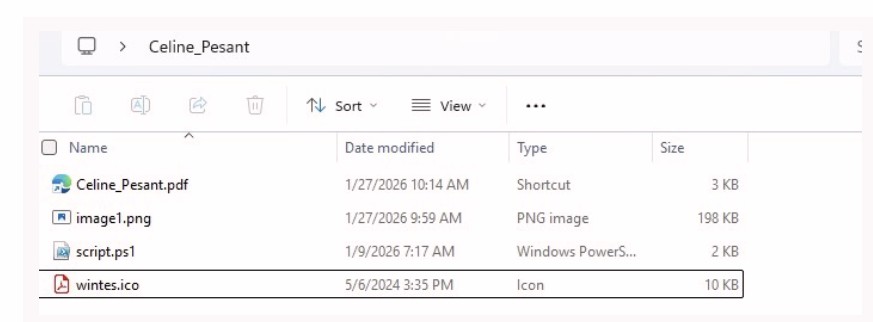
When the ISO file is mounted, it appears to the user as a normal disk drive containing several files. The contents may include:
- A shortcut file disguised as a PDF resume
- A PowerShell script
- An image file containing hidden data
- Additional supporting files
When the user opens the fake PDF file, the embedded shortcut executes an obfuscated command that launches PowerShell, initiating the malware execution process.
Infection Chain and Execution Flow
Stage 1 – Script Execution
The PowerShell script extracts hidden data from an image file embedded within the ISO. This technique uses steganography, allowing attackers to conceal malicious instructions within an apparently harmless image.
Stage 2 – Payload Delivery
After extraction, the script downloads a compressed archive containing:
- A legitimate executable application (e.g., SumatraPDF)
- A malicious DLL file
The legitimate program loads the malicious DLL through DLL sideloading, enabling the malware to execute under the disguise of trusted software.
Stage 3 – System Reconnaissance
Once active, the malware collects information about the host environment, including:
- Operating system details
- Running processes
- Hostname and system configuration
It also checks for sandbox environments, debugging tools, and virtual machines to avoid analysis by security researchers. If such environments are detected, the malware terminates execution.
BlackSanta EDR-Killer Component
The BlackSanta module is the most critical element of the campaign. Its primary purpose is to disable security monitoring tools before additional malicious activities occur.
BlackSanta operates using a technique known as Bring Your Own Vulnerable Driver (BYOVD). This approach loads legitimate but vulnerable kernel drivers to gain privileged access to the operating system.
Once kernel-level access is achieved, the malware can:
- Terminate antivirus and EDR processes
- Disable Microsoft Defender protections
- Modify system registry settings
- Suppress Windows security notifications
- Reduce logging and telemetry
These actions significantly weaken the system’s security posture, allowing subsequent malware components to run undetected.
Persistence and Command-and-Control
After disabling security defenses, the malware establishes communication with command-and-control (C2) servers using encrypted HTTPS channels. This communication enables attackers to deliver additional payloads and maintain remote control of the compromised system.
During this phase, attackers may perform activities such as:
- Credential harvesting
- Data collection and exfiltration
- Deployment of additional malware modules
These operations enable long-term persistence within the victim’s environment.
Defense Evasion Techniques
The BlackSanta campaign incorporates several advanced evasion strategies, including:
- Sandbox and virtual machine detection
- Process hollowing for stealth execution
- Steganography for hidden payload delivery
- Living-off-the-land execution using native system tools
- Kernel-level security bypass
These methods help the attackers remain undetected for extended periods.
Security Implications
The campaign highlights a significant security gap in recruitment workflows, which are often overlooked in enterprise security programs. HR personnel routinely interact with external files and unknown senders, creating a natural entry point for attackers.
Because the malware disables EDR systems before deploying its final payloads, traditional endpoint protection tools may fail to detect or block the intrusion. This increases the risk of credential theft, data exfiltration, and long-term compromise of enterprise systems.
Recommended Mitigation Strategies
Organizations should implement multiple defensive controls to mitigate this type of threat:
Email Security
- Deploy advanced phishing detection systems
- Block or sandbox ISO attachments and external downloads
Endpoint Protection
- Monitor for abnormal driver loading behavior
- Implement kernel-level monitoring and behavioral detection
User Awareness
- Train HR staff to identify suspicious job applications
- Encourage verification of external files before opening them
Network Security
- Monitor outbound HTTPS traffic to unknown domains
- Implement threat-intelligence-driven network monitoring
The BlackSanta campaign demonstrates how attackers can combine social engineering, multi-stage malware delivery, and kernel-level security bypass techniques to compromise enterprise systems. By targeting recruitment processes and disabling endpoint protection tools early in the attack chain, the threat actors significantly increase their chances of success.
Organizations should treat HR workflows as a critical security surface and apply the same defensive controls used for other high-risk departments. Strengthening endpoint monitoring, enforcing strict file-handling policies, and improving user awareness can significantly reduce the risk posed by campaigns such as BlackSanta.
