

Researchers have uncovered a large-scale and ongoing social engineering campaign that is mainly hosted on infrastructure associated with edgeone[.]app. This operation uses deceptive web pages to trick users into granting access to sensitive device features.
Unlike typical phishing attacks that focus on stealing usernames and passwords, this campaign takes a different approach. It convinces users to allow browser permissions such as camera and microphone access by presenting fake verification or recovery scenarios (for example, “ID Scanner,” “Telegram Account Freeze,” or “Health Fund AI”).
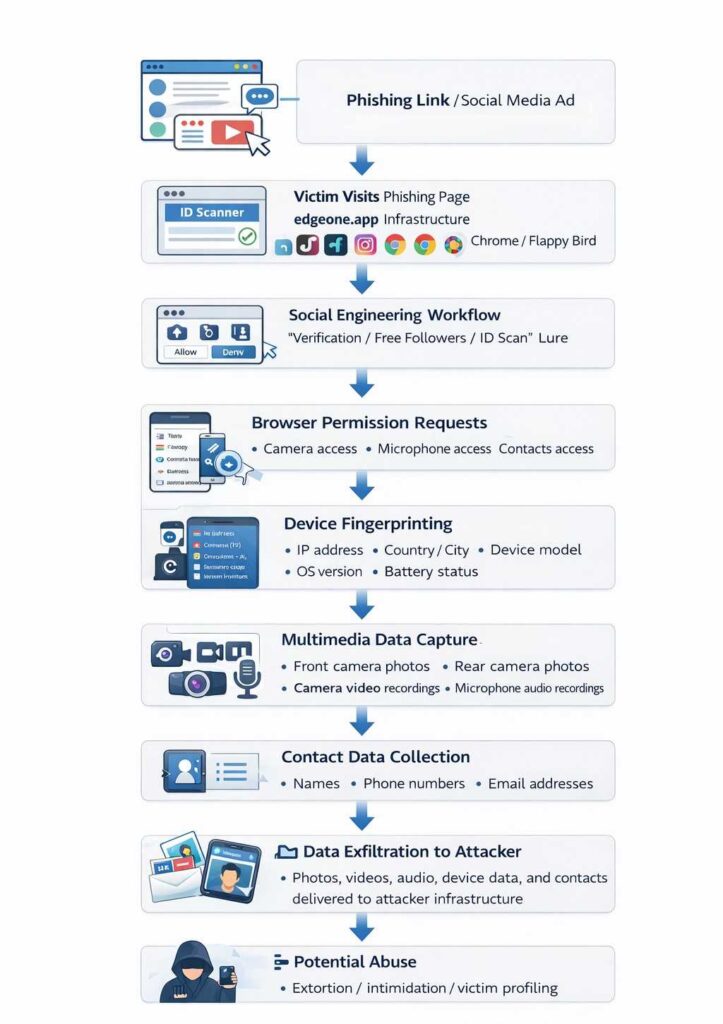
Once a user allows access, malicious scripts begin collecting real-time data from the device. This includes images, videos, audio recordings, device details, and approximate location. The collected data is then sent to attacker-controlled systems, enabling the theft of personally identifiable information (PII) and other sensitive context.
Key Findings
- Hosting Infrastructure: The campaign heavily relies on edgeone.app to deploy scalable phishing pages.
- Permission Abuse: Attackers misuse legitimate browser APIs to access camera, microphone, and system data after user consent.
- Data Exfiltration Channel: Stolen data is transmitted using the Telegram Bot API, avoiding the need for complex backend servers.
- Multiple Lures: Various themes such as “ID verification,” “health services,” and “account recovery” are used to target different users.
- Brand Impersonation: Fake pages mimic well-known platforms like TikTok, Telegram, Instagram, and Google services to build trust.
Campaign Overview
| Attribute | Details |
|---|---|
| First Observed | Early 2026 |
| Primary Goal | Collection of multimedia and device-level data |
| Infrastructure | edgeone.app (multiple subdomains) |
| Impersonated Services | TikTok, Telegram, Instagram, Google Chrome/Drive, Flappy Bird |
| Core Technique | Abuse of browser permissions for data capture |
This campaign operates as a browser-based phishing framework. Instead of asking users to input credentials, it relies on convincing them to grant hardware access permissions.
Attack Workflow
1. Initial Access
Users are redirected to phishing pages disguised as:
- Account verification portals
- Service recovery tools
- Reward or promotional platforms
These pages prompt users to allow access to device features.
2 Permission Exploitation
Once permission is granted:
- The browser activates the device camera and microphone
- A live media stream is initiated
- Scripts begin extracting frames, audio, and metadata
3 Data Collection
The campaign gathers a wide range of information, including:
- Photos from front and rear cameras
- Short video recordings
- Microphone audio samples
- Device specifications (OS, RAM, CPU, browser type)
- Network and battery details
- Contact information (if permitted)
- Approximate geolocation
4 Data Exfiltration
All collected data is sent directly to attackers using the Telegram Bot API. This allows operators to receive files instantly without maintaining dedicated servers.
Technical Analysis
1. Browser-Based Image Capture
The phishing pages use JavaScript to access the camera via browser APIs. After permission is granted:
- A video stream is initialized
- A frame is captured and drawn onto an HTML5 canvas
- The image is converted into a JPEG file
- The file is transmitted to attacker infrastructure
2. Device Fingerprinting
Before collecting media, the script profiles the device using browser APIs such as:
navigator.userAgentnavigator.platformnavigator.deviceMemorynavigator.hardwareConcurrencynavigator.connectionnavigator.getBattery()
This helps attackers understand the victim’s environment, including system type, performance, and network conditions.
3. Location Tracking
The script retrieves:
- Public IP address via external services
- Location details such as country, city, and coordinates
This adds contextual intelligence to the stolen data.
4. Audio and Video Recording
Using browser media APIs:
- Audio is recorded through the microphone
- Video clips are captured using MediaRecorder
- Files are stored in formats such as WebM and JPEG
- Data is uploaded through Telegram API endpoints
5. Contact Harvesting
In some cases, the script attempts to access user contacts using the Contacts Picker API. If successful, it extracts:
- Names
- Phone numbers
- Email addresses
6. User Interface Deception
The phishing pages display messages like:
- “Capturing photo”
- “Uploading data”
- “Verification successful”
These messages imitate legitimate verification processes and reduce user suspicion.
Indicators of AI-Assisted Development
Analysis of the scripts suggests possible use of generative AI tools during development. Observations include:
- Structured and well-formatted code patterns
- Emoji usage embedded within operational messages
- Consistent and templated logic across multiple phishing pages
This reflects a growing trend where attackers use AI to speed up phishing kit development.
Business Impact and Risk Assessment
1. Identity Fraud
Captured images, videos, and audio can be used to bypass identity verification systems such as:
- Video KYC
- Facial recognition checks
2. Targeted Social Engineering
Collected data enables attackers to:
- Build detailed victim profiles
- Launch personalized phishing attacks
- Impersonate victims in communication platforms
3. Extortion Risks
Because multimedia data is collected, attackers may:
- Threaten to release sensitive recordings
- Demand payment in exchange for silence
4. Organizational Impact
For businesses, the risks include:
- Account takeover attempts
- Fraud using stolen biometric data
- Targeted attacks on employees and customers
- Brand impersonation and reputational damage
- Compliance and regulatory exposure
This campaign shows a clear shift in phishing tactics. Instead of focusing only on credentials, attackers are now targeting biometric and device-level data.
Such data is far more dangerous because:
- It cannot be easily changed (e.g., face, voice)
- It can be reused for deepfake and impersonation attacks
- It enables advanced fraud techniques
This evolution increases the threat level across industries such as banking, fintech, telecom, and digital services.
Infrastructure Observations
- Phishing pages are mainly hosted on edgeone[.]app
- Multiple templates share the same underlying logic
- No dedicated backend servers are required
- Telegram is used for direct data delivery
This setup allows attackers to quickly deploy and rotate phishing pages.
MITRE ATT&CK Mapping
| Tactic | Technique | Description |
|---|---|---|
| Initial Access | T1566 – Phishing | Fake pages used to lure victims |
| Execution | T1059.007 – JavaScript | Malicious scripts run in browser |
| Collection | T1125 – Video Capture | Camera used for image/video capture |
| Collection | T1123 – Audio Capture | Microphone used for recording |
| Collection | T1005 – Local Data | Device information collected |
| Collection | T1213 – Repositories | Contacts accessed from device |
| Discovery | T1082 – System Info | Device profiling |
| Discovery | T1614 – Location | IP-based geolocation |
| Exfiltration | T1567 – Web Services | Data sent via Telegram API |
Security Recommendations
To reduce exposure to such threats, the following steps are recommended:
- Avoid granting camera or microphone access to untrusted websites
- Monitor browser traffic communicating with Telegram APIs
- Use browser security tools that detect phishing pages
- Track suspicious domains hosting phishing content
- Educate users about permission-based phishing techniques
Conclusion
This campaign highlights how phishing techniques are evolving beyond simple credential theft. By abusing browser permissions, attackers can directly collect sensitive multimedia and device data from victims.
The use of lightweight infrastructure and services like Telegram makes these attacks easy to deploy and scale. Additionally, signs of AI-assisted development indicate that such campaigns may become more advanced and widespread.
Organizations should strengthen detection mechanisms around browser-based threats and focus on preventing misuse of device permissions. Early awareness and proactive defense are critical to minimizing risk.
