

In March 2026, one of the most significant international cybercrime operations in recent history unfolded. Known as Operation Alice, this coordinated effort brought together law enforcement agencies from across the world to dismantle a massive dark web network that had been operating for years.
What initially began as an investigation into a single hidden platform soon evolved into a much larger case. Authorities uncovered an enormous ecosystem of fraudulent websites, criminal services, and illicit marketplaces designed to exploit users and facilitate cybercrime.
This report takes a closer look at how the operation developed, what investigators discovered, and why this case matters for the future of cybersecurity.
Background of the Investigation
The story begins in mid-2021, when German authorities started tracking a dark web platform known as “Alice with Violence CP.” At first glance, it appeared to be just another hidden service operating on the Tor network. However, as investigators dug deeper, they realized the scale was far greater than expected.
Over time, it became clear that this was not a single website but part of a highly organized and deceptive network. The operator behind the platform had created hundreds of thousands of hidden sites, all designed to lure users into making payments for illegal or fraudulent services.
Timeline of Operation Alice
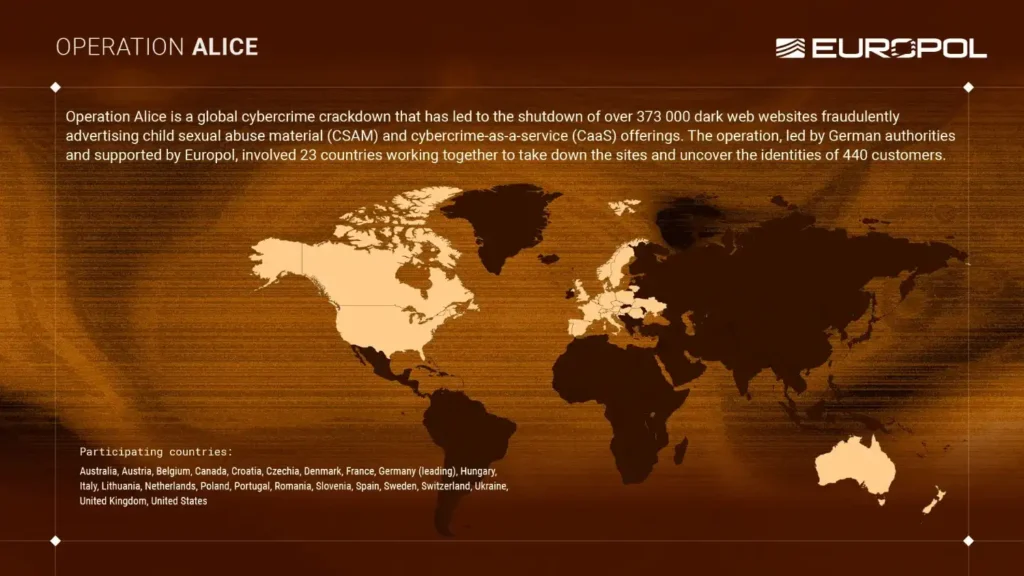
Between 9 March and 19 March 2026, law enforcement agencies from 23 countries joined forces to execute Operation Alice.
Originally, the goal was to identify and stop the individual running the platform. However, through international collaboration and intelligence sharing, authorities were able to expand the investigation significantly.
They identified not only the operator but also hundreds of users who had interacted with the network.
Key Outcomes of the Operation
Operation Alice delivered substantial results within a short time frame:
- One primary suspect identified as the operator of the network
- 440 customers identified across multiple countries
- Over 373,000 dark web domains taken offline
- 105 servers seized
- Numerous digital devices confiscated, including computers and mobile phones
The operation is still ongoing, with investigations continuing into more than 100 individuals linked to the platform.
The Scale of the Fraud Network
One of the most shocking discoveries was the sheer size of the infrastructure.
Investigators found that a single individual had been managing over 373,000 onion domains. These are special types of websites hosted on the Tor network, designed to hide both the identity of the operator and the users accessing them.
Out of these, more than 90,000 domains were actively used to advertise illegal content between February 2020 and July 2025.
How the Scam Worked
The platform followed a calculated and deceptive business model.
Users visiting these sites were offered access to illegal content packaged in different tiers. To make a purchase, they were required to:
- Provide an email address
- Make payment using Bitcoin
The pricing ranged from €17 to €215, depending on the supposed size of the data package. Some listings claimed to offer content ranging from a few gigabytes to several terabytes.
However, the key detail is this:
None of the promised content was ever delivered.
These were purely scam websites. They displayed previews and convincing descriptions, but their only goal was to extract money from users.
Cybercrime-as-a-Service (CaaS) Element
In addition to fraudulent content sales, the network also promoted various cybercrime services.
These included:
- Stolen credit card data
- Unauthorized access to foreign systems
- Other forms of digital exploitation tools
This model falls under what is commonly known as Cybercrime-as-a-Service (CaaS), where criminal tools and services are sold or advertised online.
Again, these services were also part of the scam ecosystem, designed to trick users into paying without receiving anything in return.
Profile of the Suspect
Authorities identified the operator as a 35-year-old individual based in China.
According to estimates:
- The suspect earned more than €345,000
- Around 10,000 customers attempted to purchase services
- The infrastructure included up to 287 servers at peak usage
- 105 of these servers were located in Germany
An international arrest warrant has been issued, and efforts to apprehend the suspect are ongoing.
Customers as Secondary Targets
Interestingly, the investigation did not stop at the operator.
Authorities also focused on individuals who attempted to purchase illegal material. Even though they never received the content, their intent placed them under investigation.
From a law enforcement perspective, these individuals are considered high-risk targets. Their behavior may indicate deeper involvement in criminal activities or potential future offenses.
Victim Protection Efforts
Throughout the investigation, authorities made victim protection a priority.
Whenever there was evidence suggesting that a child might be in immediate danger, action was taken without delay.
One example occurred in August 2023, when German investigators searched the home of a suspect who had attempted to purchase illegal material. This intervention led to a conviction and potentially prevented further harm.
Role of Europol
Europol played a central role in the success of Operation Alice.
Their contributions included:
- Facilitating communication between countries
- Providing intelligence analysis
- Tracking cryptocurrency transactions
- Coordinating the overall international response
This level of collaboration was crucial in identifying the suspect and dismantling such a large network.
Ongoing Initiatives to Combat Exploitation
Beyond Operation Alice, Europol continues to work on preventing online exploitation through various initiatives.
One such initiative is “Stop Child Abuse – Trace an Object,” where the public is encouraged to help identify objects linked to unresolved cases.
Another platform, Help4U, was launched in late 2025. It provides support for young people facing online harm, offering guidance, resources, and access to assistance.
Participating Countries
Operation Alice was a truly global effort involving law enforcement agencies from countries including:
Australia, Austria, Belgium, Canada, Croatia, Czech Republic, Denmark, France, Germany, Hungary, Italy, Lithuania, Netherlands, Poland, Portugal, Romania, Slovenia, Spain, Sweden, Switzerland, Ukraine, the United Kingdom, and the United States.
Our Analysis and Opinion
Operation Alice highlights a major shift in how cybercrime investigations are conducted today. This case is not just about shutting down illegal websites—it reflects how modern cybercriminals operate at scale, using automation, anonymity networks, and cryptocurrency to build complex ecosystems.
One of the most striking aspects of this case is the industrial level of fraud. Managing over 373,000 onion domains is not something that can be done casually. It suggests the use of automated deployment systems, scripting, and possibly infrastructure-as-code techniques adapted for criminal purposes. This is a reminder that cybercrime is becoming increasingly professional and technically advanced.
Another important takeaway is the dual-layer targeting strategy used by law enforcement. Instead of focusing only on the operator, authorities also investigated the users. This approach changes the risk equation for individuals engaging in illegal online activity. Even failed attempts to access such content can now lead to serious legal consequences.
From a cybersecurity standpoint, the use of cryptocurrency played a central role in enabling the fraud. While blockchain transactions are traceable, many users still believe they are completely anonymous. This case shows that with the right tools and cooperation, investigators can track and analyze these payments effectively.
The international collaboration seen in Operation Alice is also worth noting. Cybercrime does not respect borders, and no single country can tackle it alone. The success of this operation demonstrates how shared intelligence, coordinated actions, and unified strategies can produce real results.
However, this case also raises concerns. If one individual can create and manage such a vast network, it suggests that similar operations may still exist undetected. The dark web continues to provide a space where illegal activities can scale rapidly before being discovered.
In conclusion, Operation Alice is both a success story and a warning. It shows that law enforcement is becoming more capable, but it also highlights how sophisticated cybercriminal operations have become. Moving forward, continuous innovation, global cooperation, and proactive monitoring will be essential to stay ahead of such threats.
