

Artificial Intelligence is no longer just a research experiment sitting inside labs. Over the last few years, it has quietly become part of real-world systems—governments, defense operations, banking systems, and even autonomous technologies rely on it every day.
But while everyone is busy talking about AI models and their capabilities, very few are paying attention to something even more critical: the systems that build those models.
This is where the real risk lies.
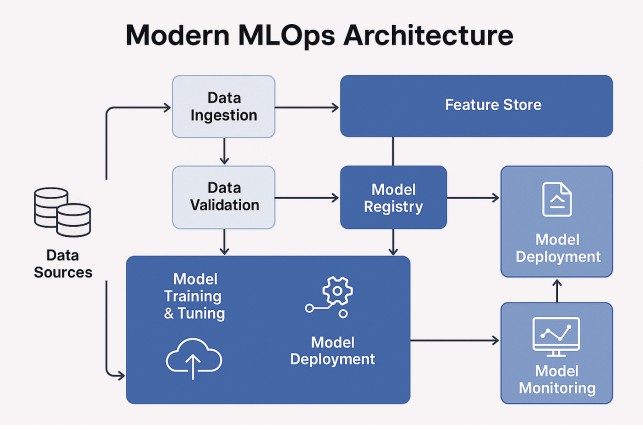
Behind every AI model is a complex operational backbone known as MLOps (Machine Learning Operations). These platforms manage everything—from training data to deployment pipelines. And today, they are becoming one of the most attractive targets for cyber attackers.
This blog breaks down how exposed MLOps platforms and leaked credentials are opening the door to large-scale cyber compromise—and why this matters more than ever in today’s geopolitical climate.
AI Systems Are Now Strategic Assets
AI systems are now deeply integrated into high-stakes environments. They are used in:
- Intelligence gathering
- Cyber defense
- Financial monitoring
- Autonomous systems
- Military decision-making
Because of this, attacking AI is no longer just about data theft—it’s about gaining strategic advantage.
Recent geopolitical tensions, especially the escalation involving U.S. and Israeli strikes on Iranian infrastructure in early 2026, have shown that cyber operations now run parallel to physical warfare.
Threat groups such as MuddyWater, APT34, APT33, and APT35 have historically demonstrated a pattern: they quietly infiltrate systems long before conflicts escalate, maintain access, and activate operations when needed.
This is not reactive behavior—it’s planned, persistent, and strategic.
The Shift: From Applications to Infrastructure
Traditionally, attackers targeted applications or endpoints. But modern threat actors have evolved.
Instead of attacking systems directly, they now focus on supply chains and control layers—places where a single compromise can give access to everything.
This is exactly why MLOps platforms are so valuable.
Think of them as the control panel of AI systems. They manage:
- Training pipelines
- Model storage
- Experiment tracking
- Cloud integrations
- Execution agents
If an attacker gains access here, they don’t need to break into multiple systems—they already have control over the entire AI lifecycle.
Why MLOps Platforms Are High-Value Targets
MLOps environments contain everything attackers want:
- Centralized credentials
- Continuous execution pipelines
- Persistent cloud access
- Sensitive datasets
- Proprietary models
Unlike traditional systems, these platforms are always active. Pipelines keep running, agents keep executing, and credentials often remain valid for long periods.
For attackers who prefer stealth and persistence, this is the perfect environment.
The Real Problem: Credential Exposure
One of the biggest findings in this research is surprisingly simple: the root issue is still exposed credentials—but with far bigger consequences.
Developers often leave API keys and tokens inside:
- Source code
- Configuration files
- Environment variables
These are then pushed to public repositories like GitHub.
The research identified exposed credentials such as:
- BIGML_API_KEY
- MLFLOW_TRACKING_USERNAME
- KUBEFLOW_USERNAME
- METADATA_SERVICE_AUTH_KEY
- ZENML_STORE_API_KEY
- WANDB_API_KEY
- CLEARML_API_SECRET_KEY
Once exposed, these credentials allow attackers to log in directly—no hacking required.
And unlike typical credentials, these don’t just give access to one service—they unlock the entire AI pipeline.
When No Credentials Are Needed
Even more concerning is that many MLOps platforms are exposed directly on the internet.
Using tools like Shodan and FOFA, researchers found:
- Over 80 publicly accessible MLOps instances
- Weak or no authentication
- Open dashboards visible to anyone
In some cases:
- No login was required
- Anyone could register an account
- Full system visibility was available
This means attackers don’t even need leaked credentials—they can just walk in.
What Attackers Can Do After Access
Once inside an MLOps platform, attackers gain powerful capabilities.
1. Dataset Theft
Training data is often more valuable than the model itself.
Attackers can:
- Locate datasets
- Download them
- Analyze patterns and signals
This gives insight into how AI systems interpret the world.
2. Model Theft
Models represent decision-making logic.
By stealing them, attackers can:
- Reverse engineer behavior
- Identify weaknesses
- Replicate capabilities
This is especially dangerous in defense and surveillance systems.
3. Data Poisoning
Attackers don’t always need to steal—they can manipulate.
By subtly altering training data, they can:
- Change model behavior over time
- Introduce hidden biases
- Create blind spots
This kind of attack is extremely difficult to detect.
4. Code Execution via Agents
MLOps platforms use worker nodes to execute tasks.
Attackers can:
- Inject malicious workloads
- Execute arbitrary code
- Move deeper into infrastructure
This turns the platform into a launchpad for broader attacks.
The Most Dangerous Part: These Are Not Exploits
What makes this situation more alarming is that attackers are not exploiting bugs.
They are simply using features as intended.
Downloading models, running pipelines, accessing datasets—these are normal operations.
That makes detection extremely difficult.
Security Gaps in MLOps Platforms
Many MLOps tools are still evolving and lack mature security controls.
Common issues include:
- Weak authentication mechanisms
- Poor credential handling
- Overexposed cloud integrations
- Lack of access boundaries
In some cases, cloud credentials are even visible through dashboards.
This creates a chain reaction: compromise one platform, and you gain access to storage, compute, and data systems.
Why This Matters in Modern Warfare
In today’s conflicts, the goal is not always destruction—it’s disruption.
An AI system doesn’t need to be shut down to be useless. It just needs to become unreliable.
Imagine:
- A model misclassifies a target
- A detection system ignores specific behavior
- An autonomous system makes incorrect decisions
These are subtle failures—but they can have massive consequences.
And they leave almost no trace.
How to Secure MLOps Environments
To reduce risk, organizations must treat MLOps as critical infrastructure.
Key steps include:
Strong Credential Management
- Never store secrets in code
- Use secure vaults
- Rotate keys regularly
Access Control
- Restrict public exposure
- Enforce authentication
- Disable open registrations
Cloud Security
- Use short-lived credentials
- Apply least privilege access
Monitoring
- Track dataset and model access
- Monitor pipeline activity
- Detect unusual execution patterns
Responsible Disclosure
This research was conducted ethically using publicly available data.
- No systems were modified
- No sensitive data was misused
- All identifying details were removed
The goal is awareness—not exploitation.
Indicators of Compromise (IOCs)
- BIGML_API_KEY
- MLFLOW_TRACKING_USERNAME
- KUBEFLOW_USERNAME
- METADATA_SERVICE_AUTH_KEY
- ZENML_STORE_API_KEY
- WANDB_API_KEY
- CLEARML_API_SECRET_KEY
Risk Assessment
High severity due to:
- Persistent access
- Low detection probability
- Strategic impact on AI systems
Mitigation Strategies
- Implement secret management systems
- Restrict platform exposure
- Use role-based cloud access
- Monitor platform activity
Our Opinion
What stands out most in this case is not just the technical vulnerability, but the shift in how cyber warfare is evolving. Traditionally, attackers focused on breaking into systems, exploiting vulnerabilities, and causing immediate disruption. But what we are seeing here is far more subtle and far more dangerous.
The compromise of MLOps platforms represents a move toward control rather than destruction.
Instead of attacking AI systems directly, adversaries are targeting the environments that build and maintain those systems. This approach is smarter, quieter, and significantly harder to detect. Once inside an MLOps platform, attackers do not need to act immediately. They can observe, learn, and wait. This aligns perfectly with the long-dwell strategies commonly used by advanced persistent threat (APT) groups.
Another critical concern is the normalization of insecure practices. Developers often prioritize speed and functionality over security, leading to exposed credentials and poorly configured systems. While this has always been an issue, the stakes are now much higher. Exposing access to an AI pipeline is not the same as exposing a simple database—it can potentially influence decision-making systems at scale.
The most alarming aspect is the possibility of silent manipulation. Data poisoning and subtle model alterations can introduce errors that are nearly impossible to trace back to an attacker. In high-stakes environments like defense or intelligence, even a small deviation in model behavior can lead to significant consequences.
This also highlights a maturity gap in the MLOps ecosystem. Compared to traditional infrastructure like CI/CD pipelines, MLOps platforms are still developing their security foundations. As adoption grows rapidly, security practices are struggling to keep up.
In my view, organizations are underestimating this risk. There is still too much focus on AI outputs—prompt injections, adversarial inputs—while ignoring the infrastructure layer. This is a mistake.
The real battle is not at the interface of AI systems. It is happening behind the scenes, in the pipelines, credentials, and control planes that power them.
Securing AI in the future will not just be about making smarter models. It will be about protecting the systems that create them.
