

The cybercrime economy continues to evolve at an alarming pace, and one of the most concerning developments in recent years is the rise of Phishing-as-a-Service (PhaaS) platforms. These platforms are transforming phishing from a technically demanding criminal activity into a commercially available service that can be operated by individuals with minimal technical expertise. One such emerging platform is BlueKit, a highly sophisticated phishing ecosystem recently analyzed by CloudSEK researchers. According to the investigation, BlueKit has evolved beyond traditional phishing kits and now operates as a mature cybercriminal service platform featuring subscription models, centralized management interfaces, automation capabilities, and advanced anti-detection mechanisms.
BlueKit demonstrates how phishing operations are becoming increasingly professionalized. Instead of requiring threat actors to build infrastructure, develop phishing pages, and manage stolen credentials manually, the platform provides a complete toolkit capable of supporting large-scale credential theft, session hijacking, account takeover attacks, and financial fraud campaigns. The platform significantly lowers the barrier to entry for cybercriminals while simultaneously increasing operational efficiency and scalability.
The Evolution of Phishing-as-a-Service
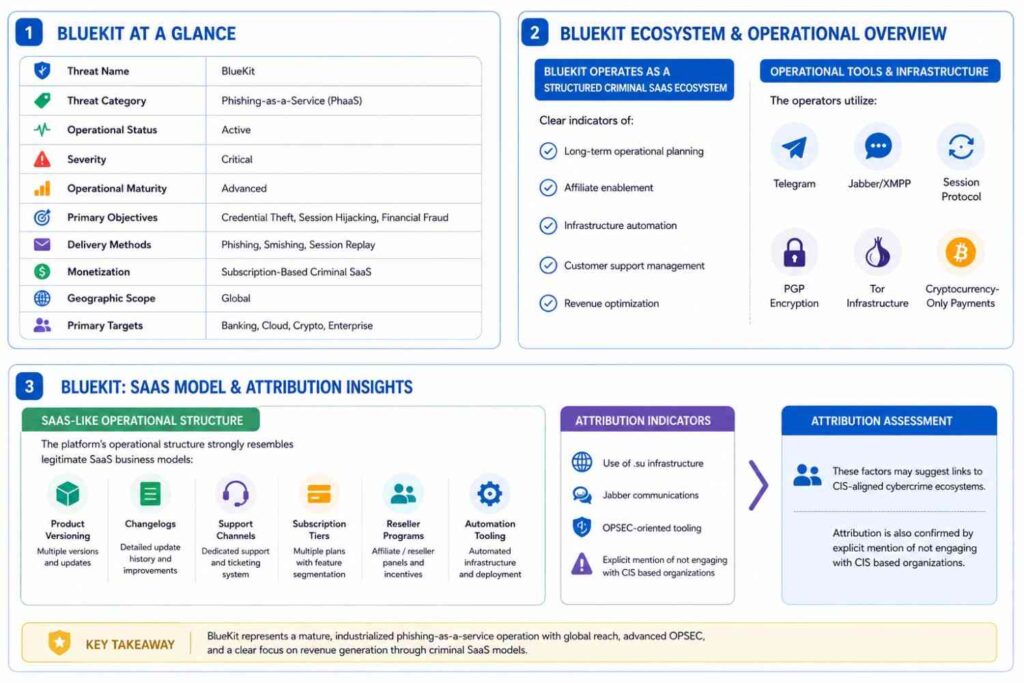
Traditional phishing operations required attackers to possess technical expertise in web hosting, domain registration, credential harvesting, and infrastructure management. However, PhaaS platforms have transformed phishing into a service-based business model. BlueKit exemplifies this trend by offering subscription-based access to phishing infrastructure, much like legitimate Software-as-a-Service (SaaS) platforms. The service includes product updates, customer support channels, version management, reseller programs, and automated deployment capabilities.
What makes BlueKit particularly dangerous is its operational maturity. The platform integrates multiple technologies such as Telegram notifications, Jabber/XMPP communication, Tor-based infrastructure, PGP encryption, and cryptocurrency-only payment systems. This combination creates an ecosystem where attackers can launch campaigns quickly while maintaining operational anonymity. The commercialization of phishing has effectively transformed cybercrime into a scalable business operation capable of serving a global customer base.
BlueKit’s Advanced Technical Capabilities
One of the most notable aspects of BlueKit is its extensive library of phishing templates targeting globally recognized brands and services. Researchers identified support for major cloud providers, banking institutions, e-commerce platforms, cryptocurrency exchanges, software development services, and productivity platforms. These templates are designed to replicate legitimate login pages with a high degree of accuracy, increasing the likelihood of successful credential harvesting.
The platform extends beyond simple credential theft. BlueKit incorporates session hijacking capabilities that allow attackers to capture authentication cookies, local storage data, and active user sessions. This approach enables account compromise even when multi-factor authentication (MFA) is enabled. By stealing active sessions rather than merely collecting usernames and passwords, attackers can bypass traditional security controls and gain unauthorized access to victim accounts.
Automation is another defining characteristic of BlueKit. The platform streamlines domain registration, phishing page deployment, campaign management, and data collection within a single dashboard. This level of integration removes much of the complexity historically associated with phishing operations and allows campaigns to be launched rapidly and at scale.
Peer-to-Peer Infrastructure and Anti-Detection Techniques
A major innovation identified during CloudSEK’s investigation is BlueKit’s migration toward a peer-to-peer (P2P) phishing page rendering architecture. This architectural change is designed to conceal backend infrastructure from browser developer tools and traditional network monitoring solutions. By decentralizing phishing page delivery, BlueKit significantly increases resilience against infrastructure takedowns and forensic investigations.
The platform also incorporates a range of anti-analysis and anti-detection capabilities. Features such as geolocation emulation, anti-bot filtering, device fingerprint validation, proxy detection, VPN filtering, and headless browser detection make it more difficult for researchers and automated security systems to identify malicious activity. These techniques reduce the effectiveness of traditional indicator-of-compromise (IOC) based detection methods and challenge conventional phishing defense strategies.
Global Targeting Strategy and Financial Motivation
BlueKit’s victimology reflects a deliberate global targeting strategy. Researchers observed phishing templates localized for North America, Europe, India, and East Asia, including region-specific services and financial institutions. The platform supports multilingual campaigns and adapts phishing content to local markets, significantly improving attack effectiveness.
Particularly concerning is the platform’s focus on cryptocurrency ecosystems. BlueKit includes templates targeting major exchanges and hardware wallet providers, enabling attackers to pursue irreversible financial theft. Because cryptocurrency transactions are difficult to recover once completed, these campaigns provide a highly attractive monetization path for cybercriminals. Combined with banking and enterprise cloud service targeting, the platform supports a wide range of financially motivated attacks.
Security Implications for Enterprises
The emergence of platforms like BlueKit highlights a broader transformation in the cyber threat landscape. Organizations can no longer assume that phishing attacks are unsophisticated or easily detectable. Modern phishing platforms integrate automation, session hijacking, anti-analysis techniques, and scalable infrastructure, making them significantly more dangerous than legacy phishing kits.
To defend against these threats, organizations should adopt phishing-resistant authentication mechanisms such as FIDO2 security keys and passkeys. Security teams should also implement continuous monitoring for abnormal session behavior, strengthen user awareness programs, and deploy advanced phishing detection technologies that combine URL analysis, visual similarity detection, and machine learning-based classification. Research demonstrates that modern phishing detection increasingly requires multi-layered approaches capable of identifying both infrastructure-level and behavioral indicators.
Our Opinion: Why BlueKit Represents a Turning Point in Cybercrime
BlueKit is more than just another phishing toolkit; it represents the ongoing industrialization of cybercrime. The platform demonstrates how threat actors are adopting business-oriented operational models that mirror legitimate SaaS companies. Subscription plans, customer support, automated deployment, and infrastructure management indicate a level of professionalism that was previously uncommon in phishing operations. This shift significantly increases the scale and accessibility of cybercrime.
From a defensive perspective, BlueKit exposes the limitations of traditional security controls that focus solely on credential protection. The platform’s ability to capture active sessions, bypass MFA protections, and evade infrastructure-based detection highlights the need for a modern zero-trust security approach. Organizations must focus on identity security, behavioral analytics, continuous authentication, and phishing-resistant login mechanisms rather than relying exclusively on passwords and conventional MFA solutions.
The most concerning aspect of BlueKit is its ability to empower low-skilled attackers. By packaging sophisticated attack capabilities into an easy-to-use platform, cybercriminals can conduct advanced phishing campaigns without extensive technical knowledge. This democratization of cybercrime will likely increase the volume and sophistication of phishing attacks worldwide. Businesses should view BlueKit as a warning sign that phishing threats are entering a new era—one defined by automation, scalability, and professional-grade criminal infrastructure.
