

The modern threat landscape is no longer defined solely by the sophistication of exploit payloads; rather, it is shaped by the strategic engineering of trust. In cyber-warfare, social engineering has evolved beyond standard phishing emails into comprehensive reputation-fabrication campaigns. Recent threat intelligence reveals a highly coordinated operation targeting cryptocurrency traders, automated bot seekers, and online crash-game gamblers. By building a sprawling ecosystem of synthetic popularity across GitHub, SourceForge, YouTube, and VirusTotal, a threat actor known under the digital alias @JoseCmanXD successfully distributed a dual-architecture (Windows and macOS) cryptocurrency clipboard hijacker written in Rust. This analysis provides an end-to-end technical breakdown of the delivery pipeline, the manipulation of telemetry markers, and the compilation architecture of the malware.
The Illusion Engine: Constructing Multi-Platform Ghost Networks
To successfully deploy untrusted executable binaries directly into user spaces, cybercriminals must circumvent the natural skepticism of tech-savvy users. The actor behind this campaign achieved this by manufacturing synthetic social proof through “Ghost Networks”—coordinated infrastructure arrays consisting of hundreds of automated bot accounts designed to simulate high user engagement.
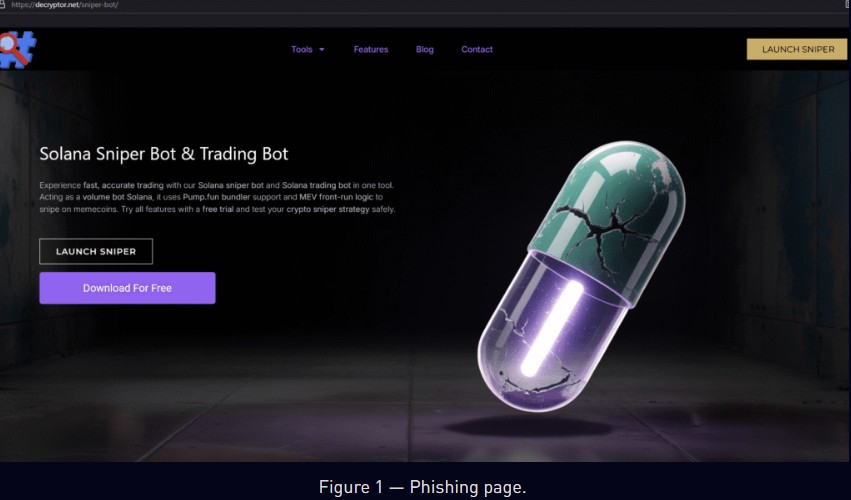
The focal point of the operation is a self-hosted WordPress phishing landing page. This page advertises an assortment of high-demand utility programs designed to give users an “unfair edge” in volatile financial environments. Among these are Solana, Pump.fun, and decentralized exchange (DEX) sniper bots—automated trading scripts engineered to front-run high-frequency asset launches. Alongside these financial utilities are various “Crash Predictors” and an “Aviator Predictor,” which deceptively claim to use algorithmic forecasting to reverse-engineer online multiplier betting games.
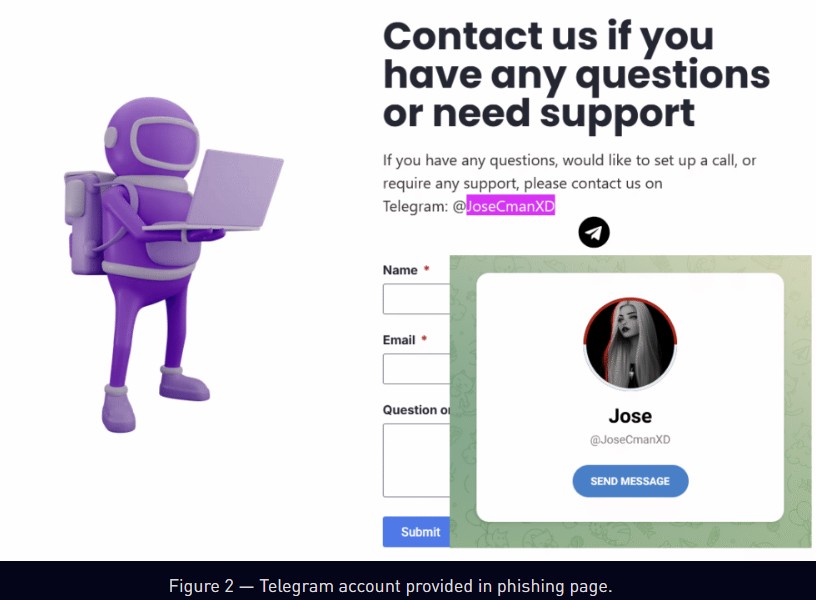
To give these fraudulent tools an aura of absolute legitimacy, the landing page channels users to external software repositories on GitHub and SourceForge. Across at least six distinct GitHub organizations controlled by the threat actor (including repositories named Decryptor-j, crash-predictor1, roblox-script1, hack-scripts, and stake-mines), the projects display inflated metrics, showing hundreds of repository stars and forks. This architectural feedback loop operates continuously: fake accounts automatically fork and star one another’s code repositories, creating a false reputation metric that influences both human developers and automated repository recommendation algorithms. Telemetry indicates that this GitHub vector alone yielded over 5,000 distinct binary downloads, with a notable subset of 1,250 downloads originating from macOS environments.
Deepfakes and Algorithmic Manipulation on YouTube and SourceForge
The reputation manipulation extends deeply into content delivery networks. On YouTube, the threat actor operates video channels featuring highly structured, professional-grade tutorials that demonstrate the software functioning flawlessly in real time. To automate content creation and reduce operational overhead, the attacker utilizes AI-generated synthetic narrators and deepfake avatars positioned in the corner of the video. The visuals depict authentic mouse trajectories, active interface elements, and simulated winning streaks, providing a compelling layer of visual confirmation.
The video analytics metrics, however, betray this organic front. Forensic data visualization reveals extreme, unnatural spikes in view counts and likes rather than a standard logarithmic or linear adoption curve. These spikes are directly attributable to black-hat view-boosting platforms, an area of interest explicitly found in historical forum posts linked to the @JoseCmanXD identity dating back to 2022. The comment sections under these videos are highly sanitized, flooded with coordinated positive reviews praising the utility of the tool.
On SourceForge, the strategy shifted toward massive scale. The metrics indicate a staggering 44,485 downloads, with a highly unusual geographic concentration in Pakistan and India. Intriguingly, over 37,000 of these requests were registered by devices running the Android operating system. Because the payload infrastructure exclusively accommodates desktop operating systems (Windows and macOS x86_64/ARM64 architectures), this statistical anomaly strongly points to the deployment of mobile device click-farms. These farms are used to artificially pump download counters, thereby pushing the software onto SourceForge’s trending pages.
Poisoning the Well: Deceiving VirusTotal and Threat Intelligence Aggregators
Perhaps the most alarming dimension of this campaign is the direct manipulation of public threat intelligence telemetry, specifically via VirusTotal. Modern Security Operations Centers (SOCs) and Endpoint Detection and Response (EDR) platforms heavily utilize reputation-based screening algorithms. When a local signature or heuristic engine reports a low-confidence detection, security tools query global intelligence aggregators to evaluate community sentiment and binary upvote ratios.
The threat actor deliberately targeted these consensus mechanisms. By utilizing specialized accounts on VirusTotal, the group systematically upvoted their freshly compiled malicious binaries and injected community commentary asserting that the files were entirely benign. When this coordinated reputation manipulation is coupled with the inherently low static signature profile of newly compiled, unique Rust binaries, a critical vulnerability emerges. The combination of minimal static antivirus alerts and overwhelmingly positive community upvotes tricks reputation-based filtering systems into categorizing the file as low-risk or safe, effectively granting the malware passage past corporate defensive perimeters and local firewalls.
Astroturfing through Compromised Legal and News Outlets
To finalize the illusion of mainstream credibility, the threat actor managed to secure publication placement on reputable news websites and legal journals, notably including The National Law Review. On April 27, 2026, a cluster of highly promotional, identical articles materialized across multiple press release aggregators and compromised news domains under the guise of legitimate software showcases.
These articles specifically praised the programmatic capabilities of the “Decryptor” utility, embedding hyper-contextualized anchor text linking directly back to the primary WordPress landing page. This technique leverages the domain authority of established publications. When search engine indexing bots scrape these high-reputation journalistic domains, the embedded hyperlinks artificially boost the SEO positioning of the threat actor’s phishing infrastructure. Consequently, regular users searching for specialized crypto tools are directed to malicious nodes directly through top-tier search engine results.
Technical Deep-Dive: The Windows Execution Vector and Rust Clipper Payload
When a victim falls prey to the social engineering apparatus, they receive a compressed ZIP archive containing a complex folder hierarchy designed to obfuscate the real executable payload. In the Windows configuration, the target is instructed to execute a binary titled SniperBot_Premium(Free).exe.
SniperBot_Premium(Free)/
├── SniperBot_Premium(Free).exe
├── Sniper_TradingBot.Premium(Trial).exe.config
├── src/
│   └── config/
│       └── silkebin.exe
The initial SniperBot_Premium(Free).exe file is a lightweight wrapper or loader compiled in .NET. Its sole functional objective is to decrypt, map into memory, or directly execute the hidden payload situated within the deep subdirectory: src/config/silkebin.exe.
The file silkebin.exe is a highly optimized, statically linked binary compiled in Rust. Upon execution, the malware instantly establishes local persistence to survive system reboots. It copies its binary image to %APPDATA%\silke\silke.exe and drops a corresponding .lnk shortcut file directly into the Windows Startup directory (%APPDATA%\Microsoft\Windows\Start Menu\Programs\Startup), ensuring execution at every subsequent user authentication event.
Rust
// Conceptual implementation of the core Windows API clipboard hooking logic
fn register_clipboard_listener(hwnd: HWND) {
    unsafe {
        AddClipboardFormatListener(hwnd);
    }
}
The executable creates a hidden message-only window and leverages the native Windows API subsystem by calling AddClipboardFormatListener. This registers the application within the OS-level chain of clipboard viewers. Whenever any process on the system alters the clipboard state, the operating system broadcasts a WM_CLIPBOARDUPDATE message to the malware’s message loop.
Upon receiving this signal, the malware opens the clipboard via OpenClipboard, extracts the raw textual data using GetClipboardData, and passes the string to a sequence of highly optimized, compiled Regular Expressions (Regex). These expressions are fine-tuned to match standard cryptographic wallet address geometries across a broad spectrum of protocols.
| Cryptocurrency | Target Regex Identifier | Embedded Attacker Wallet Count |
| Bitcoin Bech32 | \b(bc1)\b | 5,000 unique addresses |
| Bitcoin Legacy | \b(1)\b | 5,000 unique addresses |
| Bitcoin P2SH | \b(3)\b | 5,000 unique addresses |
| Ethereum / EVM | \b(0x)\b | 501 unique addresses |
| Monero (Standard) | \b(4)\b | 1 unique address |
| Tron (TRX) | \b(T)\b | 1 unique address |
If a match is successfully identified, the malware calls EmptyClipboard and substitutes the victim’s intended recipient address with an attacker-controlled wallet pulled from a massive internal database before executing SetClipboardData. To counter basic threat intelligence tracking and address-blacklisting operations, the threat actor embedded thousands of unique, pre-generated wallets directly inside the Rust compiled data section. The malware uses basic string mapping or randomization filters to dynamically cycle through these addresses, making it incredibly difficult for blockchain analytics companies to accurately cluster and trace the illicitly routed funds.
Cross-Platform Expansion: Bypassing macOS Gatekeeper
The campaign demonstrates a mature cross-platform focus by providing a tailored payload targeting Apple’s macOS ecosystem. When downloading the Mac variant, users receive an archive containing an executable binary named HashScanner along with a malicious triage script named unlocker.command.
Because unsigned or untrusted binaries downloaded from the web trigger macOS Gatekeeper protections—resulting in the standard "App is damaged and can't be opened" or "unidentified developer" security blocks—the attacker designed a native social-engineering bypass. The embedded instructions direct the victim to right-click unlocker.command and override the Operating System warnings.
Bash
# Internal logic executing inside the attacker's unlocker utility
#!/bin/bash
xattr -cr /Applications/HashScanner.app 2>/dev/null
chmod +x /Applications/HashScanner.app/Contents/MacOS/HashScanner
open /Applications/HashScanner.app
The unlocker.command script acts as a localized helper utility that explicitly executes xattr -cr against the downloaded application bundle. This command strips the com.apple.quarantine extended attribute recursively from the files. By programmatically clearing this attribute, Gatekeeper is completely bypassed, allowing the underlying Rust-based macOS clipboard listener to execute natively in user space with full system privileges. It then targets equivalent macOS clipboard APIs via the Cocoa framework (NSPasteboard), mirroring the exact address-swapping functionality implemented in the Windows variant.
Our Opinion on the Evolution of Trust Subversion in Cybercrime
The implications of this campaign extend far beyond the mechanics of a standard clipboard hijacker. What we are witnessing here is a fundamental paradigm shift in the economics of cybercrime: threat actors are now investing more capital, automation, and operational energy into engineering reputation than they are into engineering exploits.
Historically, security professionals viewed repositories like GitHub or SourceForge, and communities like VirusTotal, as inherently reliable baselines for evaluating software safety. This campaign completely shatters that baseline. By weaponizing “Ghost Networks” and leveraging AI-driven content engines to scale social engineering, the attacker has commoditized trust. When an executable boasts hundreds of stars, ranks as a trending download, features a polished AI presenter, and exhibits a clean, community-verified bill of health on VirusTotal, a user’s natural defense mechanisms are systematically dismantled.
Furthermore, the discovery of this campaign underscores a critical structural failure in modern reputation-based EDR models. If security infrastructure relies on public consensus metrics to resolve defensive ambiguity, and those metrics can be completely astroturfed via bot automation, our security layers are essentially blind. To counter this threat vector, the cybersecurity industry must abandon reputation metrics as a primary trust signal. Security paradigms must pivot toward uncompromising, Zero-Trust behavioral monitoring. A program’s code repository popularity or community upvotes should mean nothing; its runtime actions—such as silently registering global clipboard listeners and executing unverified background processes—must be the sole basis for terminal execution choices.
Comprehensive Indicators of Compromise (IoCs)
Primary Network Infrastructure & Handles
- Phishing Gateway Domain: WordPress-hosted distribution node linked to
@JoseCmanXD - Threat Actor Telegram Alias:
@JoseCmanXD - Attributed Attacker Identity:
JoseCmanXD(Active since at least 2022 across blackhat forums) - Coordinated Campaign Launch Window: April 27, 2026 (Simultaneous media push)
Main GitHub Distribution Repositories
Decryptor-jcrash-predictor1roblox-script1hack-scriptsstake-mines
Core Malware Binaries & Subcomponents
SniperBot_Premium(Free).exe(.NET Loader Wrapper – Windows)silkebin.exe(Rust Clipboard Hijacker Core – Windows)%APPDATA%\silke\silke.exe(Persistent Payload Location – Windows)unlocker.command(Gatekeeper Quarantine Strip Script – macOS)HashScanner.app(Rust Clipboard Hijacker Bundle – macOS)
