

The modern threat landscape is witnessing a profound tactical evolution as cybercriminals transition from manual campaign staging to automated, machine-driven operations. In recent security intelligence reports published by Zscaler ThreatLabz, researchers uncovered a highly coordinated initial access campaign utilizing artificial intelligence (AI) to scale deceptive infrastructure. By weaponizing AI-powered website builders, threat actors successfully generated high-fidelity brand replicas designed to host specialized social engineering mechanisms known as “ClickFix” lures. This particular campaign focused its efforts on the Latin American financial sector, leveraging sophisticated brand impersonation to deliver a resilient, PowerShell-implemented banking Trojan dubbed SmartRAT. The intersection of automated frontend deployment with advanced terminal-based execution highlights a dangerous trend in contemporary malware distribution models.
The Anatomy of AI-Driven Brand Impersonation and ClickFix Lures
The initial access phase of this campaign relies on rapid typosquatting infrastructure generation. Threat actors targeted a prominent Brazilian financial institution, deploying a deceptive domain—cartaobb[.]com—meticulously designed to mimic the legitimate banking portal at cartaobrb[.]com[.]br. Instead of building the front-end components manually, the adversaries utilized AI web-generation tools to rapidly construct pixel-perfect interfaces, ensuring a highly convincing visual experience capable of bypassing standard user scrutiny.
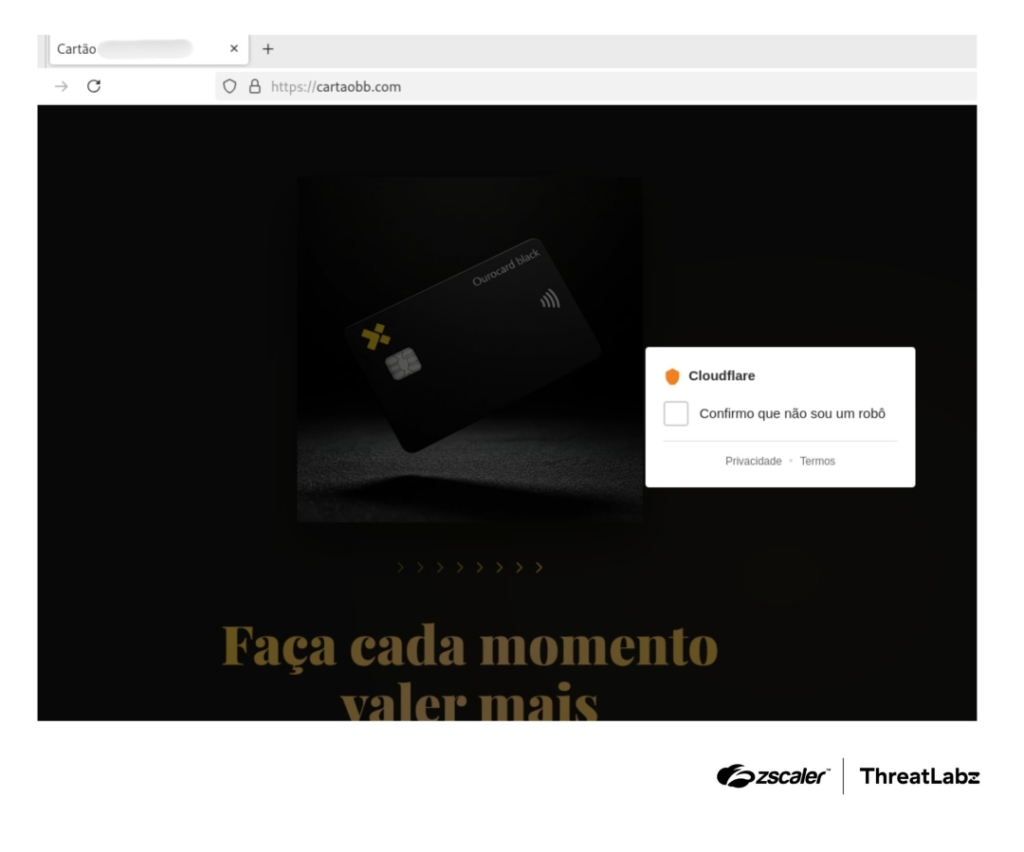
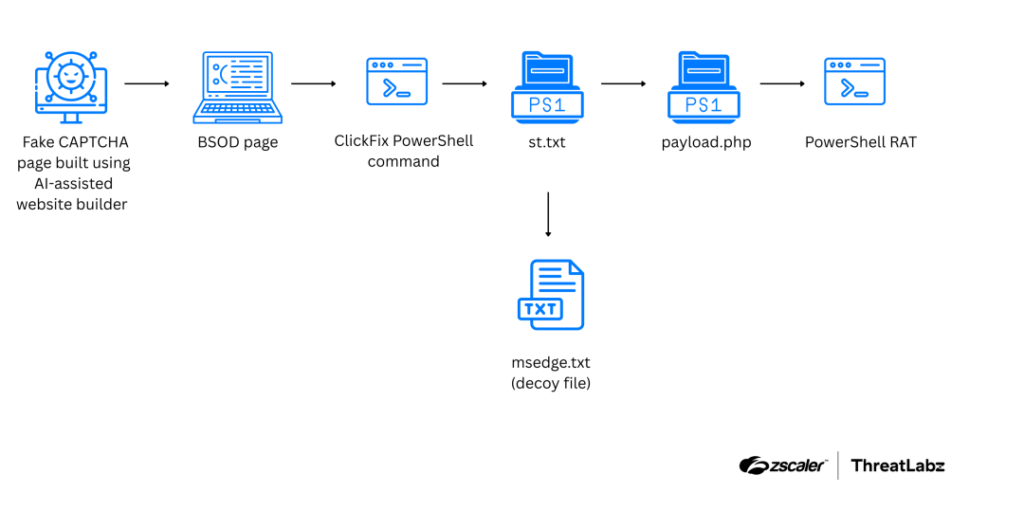
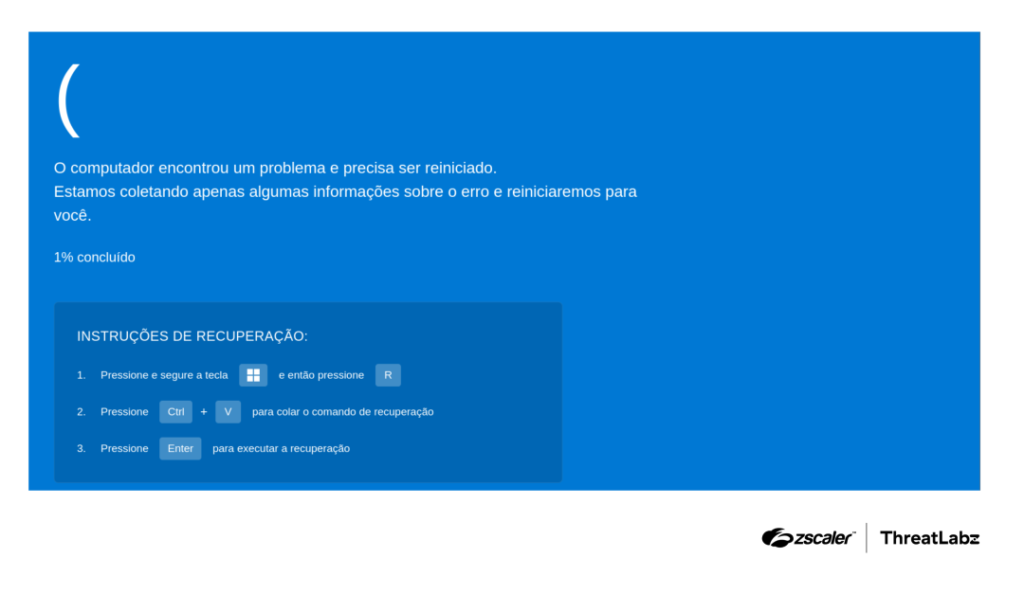
Upon navigating to the malicious typosquatting domain, victims are not met with standard credential harvesting forms immediately. Instead, they are funneled through a multi-stage social engineering engine. The sequence begins with a fabricated Cloudflare CAPTCHA verification screen designed to establish an initial layer of cognitive trust. Once the user interacts with the prompt, the webpage triggers a script that forces a fullscreen overlay depicting a simulated Windows Blue Screen of Death (BSOD) or a critical system recovery prompt. To resolve this artificial operating system failure, the lure pressures the victim into executing a predefined remedy: copying an encoded command string into the Windows “Run” dialog box or terminal window. This technique, structurally categorized as a ClickFix attack, effectively abuses the user as an involuntary proxy to bypass native browser security controls and initiate terminal-level script execution.
Staging and Payload Extraction Mechanics
When an administrative or standard user executes the clipboard contents forced upon them by the ClickFix overlay, a native PowerShell sequence is initiated in the background. This command acts as a first-stage stager, immediately establishing a connection to an attacker-controlled file repository hosted on the staging infrastructure at 64[.]95[.]13[.]238. The PowerShell command retrieves a remote artifact formatted as a text file (st.txt). This remote retrieval strategy allows the threat actors to change payloads dynamically without altering the front-end delivery infrastructure.
The downloaded file contains heavily obfuscated blocks of code that undergo reflective runtime interpretation. Upon execution, the payload decrypts an encapsulated binary stream, revealing a highly specialized, modular Remote Access Trojan implemented entirely within PowerShell scripts, cataloged by security analysts as SmartRAT. This secondary payload carries an embedded version identifier string: SMART_V25. By choosing to run a pure PowerShell-based architecture rather than dropping compiled Portable Executables (PE), the threat actors maximize their evasion posture against standard signature-based endpoint detection and response (EDR) platforms that fail to continuously monitor in-memory script behaviors.
Architecture and Core Functionality of SmartRAT (SMART_V25)
SmartRAT is engineered specifically to target corporate and retail financial entities throughout Brazil. Its internal architecture is fundamentally modular, structured around runtime compiled C# classes that are loaded directly into memory from the host PowerShell process. Once active, the implant’s primary directive shifts toward continuous financial data theft, information gathering, and systemic host takeover.
A core element of its monetization vector is its dynamic window-title surveillance engine. SmartRAT continuously checks the foreground window titles against an embedded watchlist containing keywords associated with major Brazilian banking applications, payment processors, and cryptocurrency exchanges. When a matching application or webpage is activated by the victim, SmartRAT immediately packages the process metadata, application name, window title, and a precise timestamp into a specialized BrowserAlert message packet, marked structurally as message type 0x80.
This packet is instantly exfiltrated to the operator’s command-and-control (C2) server, acting as a telemetry tip-off. Upon receiving this alert, the remote operator can choose to deploy fake bank-branded security forms directly over the legitimate application window using full-screen overlays (DisplayOverlay). These credential-harvesting windows capture raw keyboard strokes (dataEntry) and transmit inputs back to the attacker. Beyond credential harvesting, the malware includes specialized modules for keylogging, clipboard hijacking, mouse/keyboard movement locking, and an aggressive financial interception engine that dynamically swaps on-screen payment QR codes with attacker-controlled redirection targets during active sessions.
Cryptographic Foundations and C2 Communication Architecture
The command-and-control messaging tier of SmartRAT utilizes custom binary framing and standard symmetric encryption to protect traffic from perimeter network security appliances. Before connecting to its external infrastructure, the malware attempts to establish its communication destinations by decrypting its embedded configuration blocks. It contains two distinct configurations obfuscated via basic bitwise operations:
- The primary C2 domain—
c[.]windowsupdate-cdn[.]com—is resolved after processing an XOR decryption script with a hardcoded key of2. - If domain name resolution fails or is actively blocked by DNS filtering tools, a fallback IP address (
162[.]141[.]111[.]227) is decrypted using an XOR key of233.
Communications are funneled through a raw, unencrypted TCP socket operating on port 51888. To secure command packets, the malware initializes a cryptographic handshake utilizing a token derived via an HMAC-SHA256 algorithm. SmartRAT contains a hardcoded master plaintext key string: iuhbdaubdvauygd5562$3@##$r. This string plays a dual role within the payload’s cryptographic routines. The raw UTF-8 bytes of this master key are leveraged as the secret key for the initial HMAC-SHA256 operations to verify message tokens. Concurrently, a 32-byte AES encryption key is derived directly from the SHA-256 cryptographic hash of the exact same master key string. All follow-on traffic, including process lists, screen streams, and operator commands, is wrapped inside this custom AES envelope and structured inside binary framing blocks before traveling across the raw TCP stream.
Advanced Persistence, Privilege Escalation, and Evasion Tactics
To maintain long-term access within heavily defended enterprise environments, SmartRAT incorporates complex privilege management and persistence-layering components. To conceal its footprint from localized user inspection, the implant relies on the native user32.dll library, using the ShowWindow API function to force the parent execution window to run completely hidden from the desktop environment.
When evaluating its execution context, if User Account Control (UAC) elevation is successfully obtained or approved, SmartRAT implements an aggressive persistence technique. It executes the native C# compiler (csc.exe) directly on the local endpoint to dynamically build and compile an inline Windows service component. This binary is registered as a persistent system service named MicrosoftEdgeUpdateCore, dropping its configuration files into the system directory structure at %ProgramData%\Microsoft\Diagnosis\ETW. This service runs with NT AUTHORITY\SYSTEM privileges.
Running continuously under a SYSTEM context presents an architectural hurdle for banking Trojans, as windows opened within Session 0 cannot interact directly with a standard user’s graphical desktop session. To overcome this limitation, SmartRAT compiles another embedded C# component that calls the native Windows APIs DuplicateTokenEx and CreateProcessAsUser. This allows the malware to clone an active user’s session token and spawn a child interactive PowerShell process that bridges the gap between SYSTEM authorization and the victim’s visible UI environment. If UAC privileges are unavailable, the malware gracefully degrades its persistence approach, attempting to set a logon-triggered scheduled task under the same name or writing direct execution values to the registry run key directory at HKCU\Software\Microsoft\Windows\CurrentVersion\Run.
Flaws in the Adversary Architecture: The C2 Authentication Bypass
While the threat actors exhibited notable sophistication regarding their initial access social engineering framework and internal PowerShell malware structuring, their backend engineering introduced critical flaws. ThreatLabz researchers discovered a fundamental vulnerability within the web-based management console of the SmartRAT C2 infrastructure.
The administration panel, which operators use to monitor infected endpoints, review keylogs, and handle exfiltrated banking details, was built using flawed authentication mechanisms. Rather than performing cryptographically secure session validations on the server-side, the panel relied heavily on client-side software validation routines to guard administrative pages. This design flaw meant that carefully constructed HTTP requests omitting token signatures could successfully trick the platform into serving administrative content. Security analysts and threat hunters were able to exploit this authentication bypass defect, gaining complete access to the operator’s database and exposed interfaces. This breakthrough allowed defenders to extract configuration metrics, list current victims, and neutralize command routes from within the attacker’s own control panel.
Our Opinion on This Case
The ClickFix campaign delivering SmartRAT highlights a fascinating paradox in modern cybercrime: the simultaneous advancement of front-end automation and the stagnation of secure back-end development. By incorporating generative AI tools, the threat actors successfully removed the historical bottlenecks associated with creating highly tailored phishing campaigns. Visually perfect localization, clean user experiences, and complex front-end social engineering blocks can now be automatically spun up in a matter of minutes. This levels the playing field, allowing lower-tier threat actors to execute localized financial attacks that previously required extensive regional language expertise and web design capabilities.
However, this reliance on automated generation platforms ultimately served as the group’s undoing. The presence of a critical, elementary client-side authentication bypass within the C2 control panel strongly suggests that the adversary’s back-end infrastructure was also auto-generated or poorly adapted from open-source templates without passing basic security validation reviews. For security teams, this campaign highlights the vital necessity of prioritizing behavioral logging across infrastructure endpoints. While front-end phishing lures will inevitably achieve visual parity with legitimate platforms via generative AI models, the post-compromise actions of the malware—such as dynamic C# compilations via csc.exe and sudden privilege token duplications—remain explicitly distinct, providing clear indicator trends for proactive hunting operations.
