

The contemporary digital gaming ecosystem relies heavily on user-generated content (UGC) to extend the lifespan and community engagement of popular titles. Steam Workshop, Valve’s centralized hub for creating, sharing, and consuming modifications, scripts, and cosmetic enhancements, has long been regarded as a safe haven for PC gamers. However, recent cyber intelligence reports indicate a disturbing paradigm shift. Since late 2025, sophisticated malicious threat actors have weaponized this trust, leveraging community sharing mechanisms to execute a widespread malware delivery campaign. This sophisticated operation primary seeks to hijack active user accounts, establish persistent backdoors, and deploy unauthorized system utilities, effectively transforming an immersive customization platform into a high-yield vector for credential theft and system exploitation.
The Architecture of Vulnerability: Deconstructing Wallpaper Engine
To understand the mechanics of this threat vector, one must analyze the inner workings of Wallpaper Engine, an immensely popular interactive desktop application available on Steam. Boasting approximately 100,000 daily active users and accumulating nearly a million community reviews, the application offers profound desktop customization across Windows and Android environments. The software achieves this by supporting four distinct paradigms of visual content: standard localized videos (MP4, WebM formats), interactive scenes constructed via an internal proprietary editor, dynamic HTML/JavaScript webpages, and standalone third-party Windows-compatible executable applications.
It is this final category—”Application Wallpapers”—that fundamentally expands the system’s attack surface. By design, an application wallpaper functions as a self-contained binary execution frame running directly on the host computer. Users download these applications expecting mini-games, system monitoring dashboards, or hardware telemetry widgets. In reality, this framework allows the execution of unverified foreign code with the security permissions of the logged-in user, transforming a benign cosmetic choice into a severe architectural security risk.
Weaponization Frameworks: Delivery and Automatic Execution Mechanics
Security researchers analyzing the infected workshop items identified dozens of malicious application wallpapers that successfully circumvented native security filters, with individual files racking up thousands to tens of thousands of downloads. Cybercriminals utilized two primary delivery methodologies to plant their payloads into target systems:
- Uncompressed Binaries and Script Chains: Attackers packaged standard executable files, compromised Dynamic Link Libraries (DLLs), and malicious bootloader scripts directly within the core wallpaper directory. The moment a user selected the theme from their local inventory, a multi-stage infection chain was automatically triggered by the underlying execution engine without requiring secondary validation.
- Obfuscated and Password-Protected Archives: To evade traditional signature-based static analysis, some actors encapsulated their malicious payloads within password-protected compressed archives. To ensure execution, a helper script automatically read the password strings hidden in plain sight—either appended directly to the archive’s filename or embedded cleanly within an accompanying JSON configuration file distributed within the wallpaper’s asset package.
Micro-Analysis of an Infection Chain: From Launch to Session Hijacking
A concrete example surfaced in December 2025, involving an infected desktop mini-game wallpaper posing as a functional clone of NTRaholic. To an unsuspecting gamer, the wallpaper initialized perfectly, showing no anomalies, lag, or indicators of compromise while maintaining normal desktop interactions. Beneath the surface, however, a multi-threaded execution sequence immediately initiated a comprehensive machine compromise.
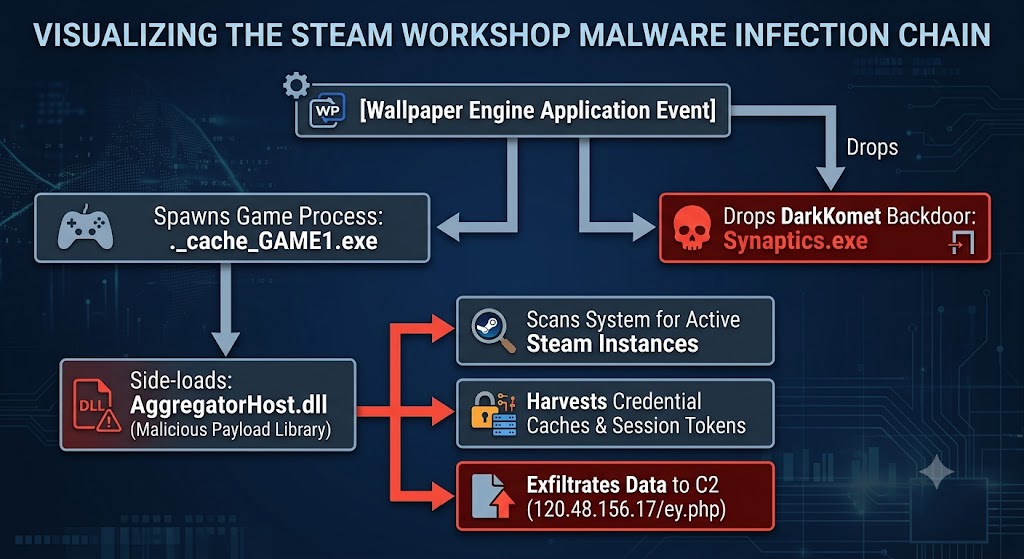
The underlying deployment engine immediately dropped an auxiliary backdoor binary labeled Synaptics.exe, an implementation belonging to the pervasive DarkKomet Remote Access Trojan (RAT) family. Simultaneously, the core gameplay loop launched via ._cache_GAME1.exe. This process executed a critical side-loading maneuver, forcing the application to load a heavily modified, malicious iteration of a legitimate system component, AggregatorHost.dll. This forged library targeted the system’s native Steam configuration file structures, hunting for cached authentication credentials, active process memory states, and configuration artifacts. Once the live Steam session tokens were localized, the library intercepted the active authenticated state and exfiltrated the sensitive session data to an external command-and-control (C2) endpoint operating at hxxp://120.48.156[.]17/ey.php. Armed with these hijacked sessions, attackers could bypass multi-factor authentication controls, seize complete ownership of the gamer’s profile, and programmatically utilize the compromised account to upload additional malicious wallpaper items back into the Steam Workshop ecosystem.
Victimology, Demographics, and Threat Actor Proliferation
The versatility of this distribution mechanism has attracted a fragmented landscape of independent threat groups rather than a singular threat actor. Evidence indicates various actors are retrofitting these application layers to deploy an expansive matrix of payloads, ranging from credential harvesters (like Lumma and Vidar) to high-overhead monero miners, ransomware engines, and botnet entry points.
Telemetry data shows the campaign heavily emphasizes specific regional demographics. Gamers located within China accounted for a massive 89% of all intercepted malicious download attempts, influenced heavily by targeted regional visual styles and linguistic titles tailored to Chinese gaming communities. The Russian Federation represented the second-largest impact zone with 5.5% of total recorded downloads. The remaining footprint is scattered globally across several regions, demonstrating the universal risk posed by this vector:
- Singapore: 1.4%
- Hong Kong: 0.9%
- Germany: 0.9%
- Vietnam: 0.9%
- India: 0.5%
- Canada: 0.5%
Tactical Mitigation and Proactive Threat Verdicts
While Valve’s internal security engineering teams purged identified indicators, malicious assets, and corresponding sharing links following discovery, subsequent telemetry updates from June 17, 2026, confirmed that historical samples of these corrupted wallpapers had integrated silently into the ecosystem as early as August 2025. Because threat actors continuously cycle through new iterations of workshop content, users cannot rely exclusively on downstream platform moderation.
Modern endpoint detection frameworks utilize both heuristic profiling and behavioral monitoring matrices to identify and quarantine these payloads before they achieve session persistence. Enterprise and consumer threat protection engines flag the underlying components of this threat campaign under the following specific detection verdicts:
HEUR:Trojan-PSW.Win32.genHEUR:Trojan-PSW.Win32.Python.genHEUR:Backdoor.Win32.DarkKometTrojan-Dropper.Python.AgentHEUR:Trojan-Ransom.Win32.Gen.genPDM:Trojan.Win32.Generic
Technical Analysis & Commentary: Our Opinion on the Steam Workshop Threat Vector
The exploitation of Wallpaper Engine’s application sharing framework exposes a fundamental flaw in how modern digital storefronts treat sandbox boundaries for user-generated modifications. Historically, security paradigms focused heavily on traditional executable distribution channels while classifying game modifications as low-risk assets. This campaign proves that treating rich, Turing-complete application files with the same relaxed validation standards applied to basic static graphics or audio files creates an optimal environment for threat actors. By embedding malicious structures directly within popular utility ecosystems, hackers weaponize community trust to achieve friction-free lateral delivery across thousands of machines.
Furthermore, this security incident highlights the glaring visibility gaps plaguing peer-to-peer distribution platforms. When an application natively allows arbitrary binary execution under the guise of an interactive desktop widget, standard client-side permissions become blurred. Valve must transition from a reactive “report-and-purge” operational methodology to an active, zero-trust containerized execution model. Enforcing mandatory application sandboxing, restricting localized system API interaction for live desktop assets, and integrating automated static and dynamic analysis pipelines during the Steam Workshop upload stage are no longer optional security considerations—they are fundamental requirements needed to preserve consumer trust and defend digital gaming endpoints against sophisticated supply-chain compromises.
Technical Appendix: Indicators of Compromise (IoCs)
Cryptographic File Hashes (MD5 Verification Signatures)
95856f2ce428c728d9781d3296558068
af080780cca2acd1d082ce01e7cc346a
c133c3dd9f7d6934598025047df41abf
d1693bbff456ae8fa3360446706df6da
8c2cc585ad8a13a72a704c0fda0c9854
b9fa763a53da3eea742d0f3c845a8c09
ded08ae5df7f1b12e5fdb767dbbed0b1
20965254e29104986e11939decd39549
18dedc0009f0927cba6425c84cce9883
0f4f01c6d495abb37403072dd017ce8d
5620f01284329f561b1839a36be55355
fe1f6485013cd5e6d5cf718049b0b8d6
74414ed4b63aadec039b603c32762b80
Active Command-and-Control (C2) Infrastructures
http://202.144.192[.]29
http://202.144.192[.]29/audit.php
http://202.144.192[.]29/download2/Themes2.zip
http://120.48.156[.]17
http://120.48.156[.]17/ey.php?ka=user1&id
http://brightly[.]to
http://brightly[.]to/download2/Themes2.zip
https://www.dropbox[.]com/s/zhp1b06imehwylq/Synaptics.rar?dl=1
https://docs.google[.]com/uc?id=0BxsMXGfPIZfSVzUyaHFYVkQxeFk&export=download
Weaponized Steam Workshop Reference URIs
https://steamcommunity[.]com/sharedfiles/filedetails/?id=3603213159
https://steamcommunity[.]com/sharedfiles/filedetails/?id=3591930233
https://steamcommunity[.]com/sharedfiles/filedetails/?id=3584318845
https://steamcommunity[.]com/sharedfiles/filedetails/?id=3436875036
https://steamcommunity[.]com/sharedfiles/filedetails/?id=3633494498
https://steamcommunity[.]com/sharedfiles/filedetails/?id=3556591375
https://steamcommunity[.]com/sharedfiles/filedetails/?id=3635875825
https://steamcommunity[.]com/sharedfiles/filedetails/?id=3601924072
https://steamcommunity[.]com/sharedfiles/filedetails/?id=3605588743
https://steamcommunity[.]com/sharedfiles/filedetails/?id=3553253793
https://steamcommunity[.]com/sharedfiles/filedetails/?id=3462675635
https://steamcommunity[.]com/sharedfiles/filedetails/?id=3605621824
https://steamcommunity[.]com/sharedfiles/filedetails/?id=3610240788
https://steamcommunity[.]com/sharedfiles/filedetails/?id=3610366547