

At one point, the phishing kit ecosystem was fragmented and highly modular. Threat actors typically sourced different components from multiple vendors—credential harvesting pages, domain rotation tools, SMS gateways—and manually integrated them into a functioning attack infrastructure. This decentralized approach required a certain level of technical skill, operational coordination, and infrastructure management. However, the emergence of Bluekit signals a significant evolution in this landscape. Bluekit consolidates multiple phishing capabilities into a single, unified platform. This shift mirrors broader SaaS trends in legitimate software ecosystems, where integration and ease of use are prioritized. By lowering the technical barrier, Bluekit enables a wider range of actors—including less experienced operators—to execute sophisticated phishing campaigns with minimal setup.
Feature Overview: What Bluekit Brings to the Table
Bluekit markets itself as a comprehensive phishing-as-a-service (PhaaS) solution. It includes over 40 pre-built templates targeting a wide array of services such as email providers, developer platforms, retail brands, and cryptocurrency wallets. These templates cover high-value targets like cloud accounts and financial platforms, making the kit versatile across multiple attack vectors. Beyond templates, Bluekit integrates automated domain purchasing and registration, two-factor authentication (2FA) interception capabilities, spoofing tools, and geolocation emulation. It also includes advanced features such as antibot cloaking, Telegram-based exfiltration, browser notifications, and optional add-ons like AI assistance, voice cloning, and bulk mail sending. This level of integration drastically reduces operational friction. Instead of relying on separate services, operators can manage the entire attack lifecycle—from setup to execution to data exfiltration—within a single dashboard.
Unified Control Panel: Streamlining the Phishing Workflow
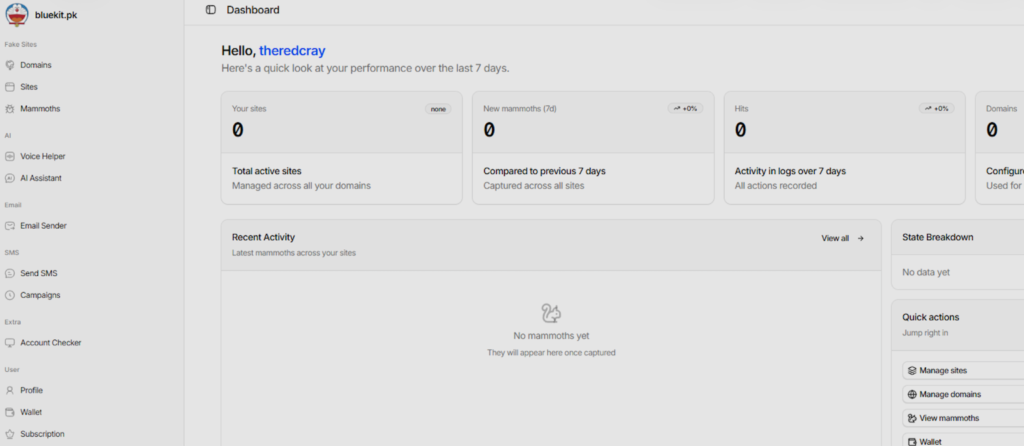
One of Bluekit’s defining features is its centralized operator panel. This interface consolidates multiple stages of phishing operations, including:
- Site creation and configuration
- Domain management
- Captured credential logs
- Campaign delivery tools
- Real-time monitoring
The platform allows operators to purchase or connect domains directly within the same interface used for managing phishing pages and logs. This eliminates the need for third-party domain registrars or external dashboards. The site creation workflow is particularly streamlined. Operators can select a domain, choose an operational mode, and deploy templates targeting specific brands or services. This abstraction simplifies what was traditionally a multi-step, technically demanding process.
Advanced Configuration and Session Handling
Bluekit provides granular control over phishing site behavior. Within the configuration panel, operators can define login detection triggers, redirect logic, anti-analysis mechanisms, spoofing parameters, and device-based filtering.
More notably, the platform extends beyond basic credential harvesting. It tracks session states, captures cookies and local storage data, and provides a live view of user interactions post-login. This capability enables attackers to hijack authenticated sessions, bypassing traditional security measures such as multi-factor authentication. The inclusion of proxy settings and session-level controls further enhances operational flexibility, allowing attackers to manipulate traffic flow and evade detection systems.
AI Assistant: Promise vs. Practicality
A standout feature of Bluekit is its built-in AI Assistant, which supports multiple model integrations, including Llama-based models and references to advanced systems like GPT-4.1, Claude, Gemini, and DeepSeek. In practice, however, the AI component appears to be in an early stage of maturity. Testing revealed that the assistant primarily generates structured campaign drafts rather than fully executable phishing workflows. Outputs often contain placeholders, generic links, and incomplete elements such as QR codes and email content. While the AI Assistant introduces automation potential, it currently functions more as a campaign blueprint generator than a fully autonomous phishing engine.
Ecosystem Positioning: A Kit Still in Development
Bluekit is not yet the most advanced phishing kit available, but its rapid development cycle makes it noteworthy. The consistent addition of features and templates suggests an active development roadmap aimed at increasing automation and usability. Compared to more mature phishing platforms, Bluekit still exhibits some limitations, particularly in its AI capabilities. However, its modular expansion and integration strategy position it as a strong contender in future phishing campaigns. The speed at which new features are being introduced also makes it challenging for defenders to keep up, emphasizing the need for adaptive and intelligence-driven cybersecurity strategies.
Our Analysis and Opinion
Bluekit represents a concerning but predictable evolution in cybercrime infrastructure. By consolidating multiple phishing tools into a single interface, it significantly lowers the barrier to entry for conducting sophisticated attacks. This democratization of cybercrime capabilities means that individuals with limited technical expertise can now execute campaigns that previously required coordinated efforts and specialized knowledge. From a defensive standpoint, Bluekit’s integrated approach complicates detection and mitigation. Traditional security models often rely on identifying isolated components—malicious domains, suspicious login pages, or unusual traffic patterns. However, when all these elements are tightly coupled within a single ecosystem, the attack surface becomes more dynamic and harder to isolate.
The inclusion of session hijacking and post-login data capture is particularly alarming. It indicates a shift from simple credential theft to full account takeover strategies, which can bypass even robust authentication mechanisms. In our view, Bluekit is not just another phishing kit—it is a signal of where the threat landscape is heading. Security teams must prioritize behavioral detection, user awareness, and real-time threat intelligence to stay ahead of such evolving platforms.
