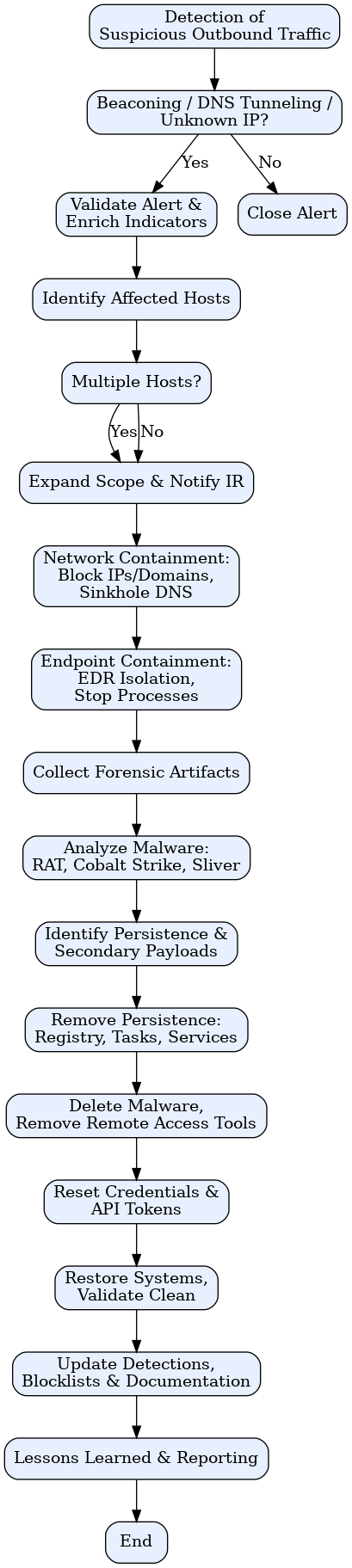
Below is a highly detailed, professional Command-and-Control (C2) Incident Response Checklist you can use during an investigation or active intrusion.
Phase 1 — Detection & Triage
Step 1.1 – Validate alert
- Confirm traffic is not business-legitimate
- Check frequency: Is it periodic?
- Check associated process on the host
Step 1.2 – Scope identification
- Identify all communicating hosts
- Identify all contacted domains/IPs
- Check for multiple protocols (HTTPS + DNS fallback)
Step 1.3 – Escalation
-
Escalate to Incident Response if:
- Confirmed malicious traffic
- Data staging or exfil detected
- Persistent connections to foreign infrastructure
Phase 2 — Containment
Step 2.1 – Network containment
- Block identified domains/IPs
- Quarantine host via EDR
- Disable outbound traffic that matches the pattern
- Implement DNS sinkhole if needed
Step 2.2 – Host containment
- Isolate host
- Stop malicious processes but do not reboot
- Disable unauthorized remote access software
Phase 3 — Investigation & Forensics
Step 3.1 – Collect host artifacts
- Memory image (Volatility-compatible)
- Autoruns, scheduled tasks, services
- Network connections (netstat)
- Prefetch, shimcache, amcache
- Browser history / download artifacts
Step 3.2 – Collect network artifacts
- Firewall logs
- Proxy logs
- Raw PCAP samples
- TLS handshake metadata
- DNS logs (queries + responses)
Step 3.3 – Malware analysis
- Identify RAT or loader
- Decode configs (URLs, sleep intervals, beacon keys)
- Identify persistence & lateral movement attempts
Phase 4 — Eradication
Step 4.1 – Remove persistence mechanisms
- Registry run keys
- Scheduled tasks
- Services / WMI persistence
- Kernel drivers (if rootkit present)
Step 4.2 – Remove malware artifacts
- Delete malicious binaries, scripts, DLLs
- Disable malicious remote access software
- Remove web shell or internal proxy if discovered
Step 4.3 – Patch and harden
- Patch exploited vulnerabilities
- Enable strict outbound filtering
- Ensure EDR coverage on all endpoints
Phase 5 — Recovery
Step 5.1 – Credential resets
Reset:
- Local admin accounts
- Domain accounts associated with infected systems
- Service accounts
- API keys and cloud tokens
Step 5.2 – System restoration
- Restore from clean backups if necessary
- Validate no persistence remains
Phase 6 — Post-Incident Actions
Step 6.1 – Lessons learned
- Identify detection gaps
- Improve DNS/HTTP/S inspection
- Update blocklists and hunt queries
- Add new detections for specific C2 techniques
Step 6.2 – Documentation
- IR report
- IOC repository update
- MITRE ATT&CK mapping update
- Executive summary