

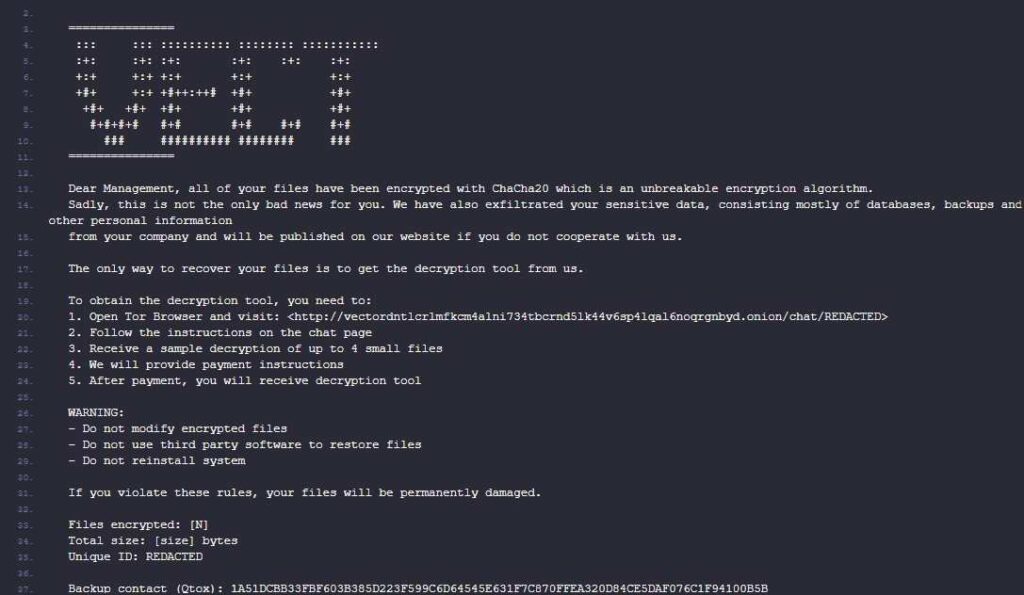
Ransomware has evolved into one of the most disruptive cyber threats of the modern era, with sophisticated threat actors offering Ransomware-as-a-Service (RaaS) platforms to affiliates worldwide. Among these emerging threats, VECT 2.0 ransomware stands out—not because of its technical excellence, but due to a critical flaw that fundamentally breaks its purpose. Instead of reliably encrypting files for ransom-based recovery, VECT 2.0 irreversibly destroys large files, effectively behaving as a data wiper disguised as ransomware. This blog dives deep into the technical architecture, cryptographic failures, cross-platform behavior, and operational implications of this unusual malware strain.
Cross-Platform Design: One Codebase, One Critical Flaw
VECT 2.0 supports three environments:
- Windows systems
- Linux servers
- VMware ESXi hypervisors
All variants are built from a shared C++ codebase using the libsodium cryptographic library. This design ensures consistency—but also propagates the same vulnerabilities across every platform.
Each version includes:
- Command-line configuration options
- Multi-threaded encryption routines
- Lateral movement capabilities
- Identical file encryption logic
Unfortunately, this shared architecture also means that a single cryptographic flaw compromises the entire operation.
The Core Issue: Nonce Mismanagement and Data Destruction
At the heart of VECT 2.0 lies a catastrophic implementation bug involving nonce handling in the ChaCha20-IETF cipher.
Incorrect Encryption Scheme
Contrary to public claims, VECT does not use ChaCha20-Poly1305 (authenticated encryption). Instead, it uses raw ChaCha20 without any integrity protection. This means:
- No authentication tag (Poly1305 MAC)
- No verification of ciphertext integrity
- Increased risk of corruption and tampering
This misrepresentation likely stems from the attackers themselves misunderstanding or mislabeling their cryptographic implementation.
Small Files vs Large Files: A Fatal Threshold
The ransomware behaves differently depending on file size:
Small Files (≤128 KB)
- Encrypted in a single pass
- One nonce generated and stored
- Fully recoverable (in theory)
Large Files (>128 KB)
- Split into four chunks
- Each chunk encrypted with a different nonce
- Only one nonce (the last) is saved
The first three nonces—essential for decryption—are permanently discarded.
Why This Matters
ChaCha20 requires both:
- A 32-byte encryption key
- The exact 12-byte nonce
Without the correct nonce, decryption is mathematically impossible.
Since VECT discards three out of four nonces for large files:
- 75% of the encrypted data becomes unrecoverable
- Even attackers cannot decrypt the files
- Paying ransom does not restore data
This effectively transforms VECT into a data wiper disguised as ransomware
Impact Scope: Nearly All Valuable Data
The 128 KB threshold is extremely low. Most real-world files exceed this size:
- Documents and spreadsheets
- Databases and backups
- Virtual machine disk images
- Archives and enterprise datasets
As a result, the vast majority of critical business data is permanently destroyed during encryption.
Additional Technical Weaknesses
Beyond the nonce flaw, VECT 2.0 suffers from multiple engineering failures:
1. Fake Encryption Modes
Flags like --fast, --medium, and --secure are parsed but ignored. All executions use identical logic regardless of operator choice.
2. Inefficient Threading
The ransomware spawns excessive threads (up to 256), often far exceeding CPU capacity. This leads to:
- Performance degradation
- Increased context switching
- Slower encryption overall
3. Broken Obfuscation
String obfuscation mechanisms cancel themselves out due to flawed XOR implementations, leaving readable strings in binaries.
4. Unused Anti-Analysis Features
Although detection mechanisms for debugging tools are present, they are never executed due to missing function calls.
Platform-Specific Behavior
Windows Variant
- Encrypts local and network drives
- Renames files with
.vectextension - Drops ransom notes and wallpaper
- Supports lateral movement via WMI, PowerShell, and SMB
ESXi Variant
- Targets
/vmfs/volumesdatastore - Shuts down VMs and disables services
- Wipes logs and shell history
- Spreads via SSH using harvested credentials
Linux Variant
- Similar to ESXi but with fewer features
- Includes same nonce flaw and broken encryption logic
Operational Implications
The most striking takeaway is that VECT 2.0 cannot fulfill the core promise of ransomware: recoverability after payment.
This has several consequences:
- Victims lose leverage in negotiations
- Attackers risk damaging their “reputation” in RaaS ecosystems
- Affiliates may unknowingly deploy ineffective malware
Despite its advanced distribution strategy, the technical shortcomings undermine the entire business model.
Conclusion
VECT 2.0 represents a fascinating paradox in modern cybercrime: high operational ambition paired with low technical maturity. Its multi-platform reach, affiliate expansion, and supply-chain distribution indicate a serious attempt to scale. However, the flawed encryption logic renders it fundamentally broken. For defenders, this highlights an important lesson: not all ransomware is created equal. Some threats may be less about extortion and more about destruction—intentional or not.
VECT 2.0 is a textbook example of how appearance can be misleading in cybersecurity. On the surface, it checks all the boxes of a modern ransomware operation—multi-platform support, affiliate programs, lateral movement, and polished infrastructure. But a closer look reveals a lack of deep technical understanding, particularly in cryptography and systems design. The nonce-handling flaw is not a minor bug—it is a fundamental failure that invalidates the ransomware’s core functionality. This suggests that the developers either misunderstood ChaCha20 or failed to properly test their implementation. In either case, it raises serious doubts about the competence behind the project.
More concerning, however, is the potential future trajectory. The infrastructure is already in place. If the developers fix these issues in later versions, VECT could quickly evolve into a far more dangerous threat. For now, VECT 2.0 serves as a reminder that not all cyber threats are equally sophisticated—but even flawed malware can cause irreversible damage. Organizations must focus not only on prevention but also on resilient backup strategies, as some attacks leave no path to recovery.
IOCs
| SHA-256 | VECT Version |
|---|---|
| a7eadcf81dd6fda0dd6affefaffcb33b1d8f64ddec6e5a1772d028ef2a7da0f2 | ESXi |
| 58e17dd61d4d55fa77c7f2dd28dd51875b0ce900c1e43b368b349e65f27d6fdd | ESXi |
| e1fc59c7ece6e9a7fb262fc8529e3c4905503a1ca44630f9724b2ccc518d0c06 | Linux |
| 8ee4ec425bc0d8db050d13bbff98f483fff020050d49f40c5055ca2b9f6b1c4d | Windows |
| 9c745f95a09b37bc0486bf0f92aad4a3d5548a939c086b93d6235d34648e683f | Windows |
| e512d22d2bd989f35ebaccb63615434870dc0642b0f60e6d4bda0bb89adee27a | Windows |
