

A newly disclosed high-severity vulnerability, Pack2TheRoot (CVE-2026-41651), has exposed a major security gap in modern Linux systems. With a CVSS score of 8.8, this flaw allows any local unprivileged user to escalate privileges and gain full root access, making it a serious concern for both desktop and server environments.
What is Pack2TheRoot?
The vulnerability resides in PackageKit, a widely used cross-distribution package management abstraction layer. PackageKit simplifies software management across Linux distributions by providing a unified interface for tools like apt and dnf.
However, this convenience has introduced a critical flaw: under certain conditions, PackageKit allows unauthorized package installation or removal without requiring authentication. This behavior opens the door for attackers to execute malicious actions with elevated privileges.
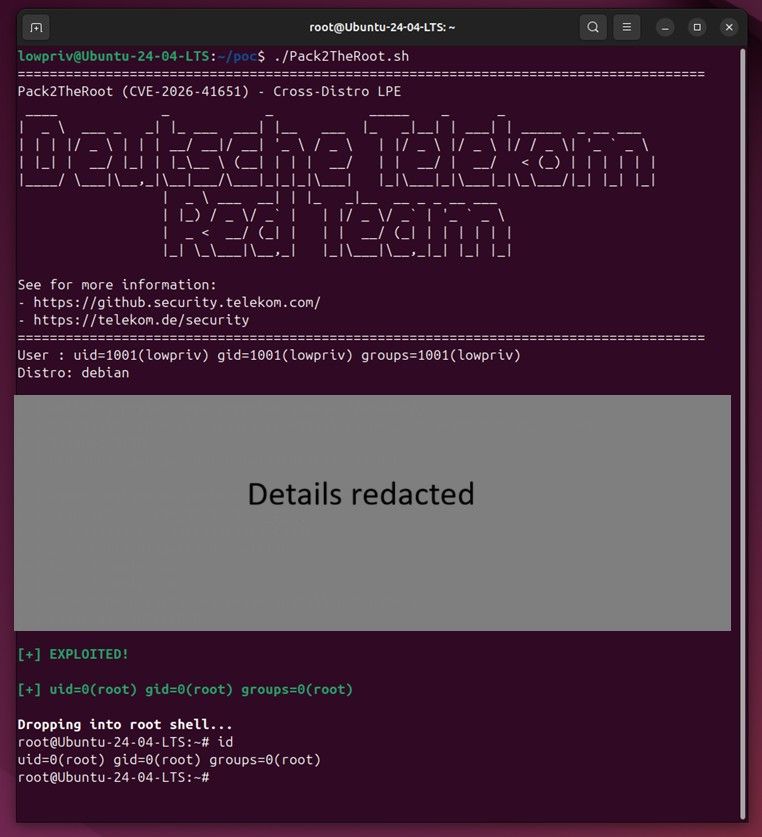
Discovery and Research
The vulnerability was discovered by Deutsche Telekom’s Red Team during research into privilege escalation vectors. Interestingly, the investigation was partially guided by AI-assisted analysis, which helped uncover the exploit path.
The team observed that commands like pkcon install could execute without prompting for a password on some systems. This led to deeper exploration, eventually revealing a fully exploitable path to root access.
Affected Systems
The vulnerability impacts a wide range of systems due to the long lifespan of PackageKit versions:
- Vulnerable versions: >= 1.0.2 and <= 1.3.4
- Affected distributions include:
- Ubuntu (Desktop & Server, multiple LTS versions)
- Debian (Trixie 13.4)
- Fedora (Desktop & Server)
- Rocky Linux
- Potentially RHEL and systems using Cockpit
Because PackageKit has been around for over a decade, the attack surface is extremely broad.
Exploitation Impact
An attacker with local access can:
- Install malicious packages
- Remove critical system components
- Execute arbitrary code as root
- Completely compromise system integrity
This makes the vulnerability particularly dangerous in multi-user environments, shared servers, or systems with limited user isolation.
Detection and Indicators of Compromise
Detecting exploitation requires examining system logs. A successful attack often triggers a PackageKit daemon crash, leaving traces such as:
assertion failed: (!transaction->priv->emitted_finished)Administrators should monitor logs using:
journalctl -u packagekitpkmonorpkgcli monitor
How to Check if You’re Vulnerable
Run the following commands:
- Debian/Ubuntu:
dpkg -l | grep -i packagekit - RHEL/Fedora:
rpm -qa | grep -i packagekit
Also verify daemon status:
systemctl status packagekitIf active and unpatched, your system is at risk.
Fix and Mitigation
The issue has been resolved in PackageKit version 1.3.5. Several distributions have also released backported patches.
Immediate actions:
- Update PackageKit to 1.3.5 or later
- Apply distribution-specific security patches
- Audit systems for suspicious package activity
- Restrict local user access where possible
Responsible Disclosure Timeline
The vulnerability followed a well-coordinated disclosure process:
- April 8, 2026: Initial report
- April 13–19: Patch development and vendor coordination
- April 22, 2026: Public disclosure and patch release
Our Opinion on the Pack2TheRoot Vulnerability
The Pack2TheRoot vulnerability highlights a recurring issue in modern system design: the trade-off between usability and security. PackageKit was designed to simplify package management across distributions, but this abstraction layer introduced unintended privilege boundaries that were not rigorously enforced.
What stands out is the role of AI-assisted research in discovering the vulnerability. This signals a shift in cybersecurity, where both attackers and defenders are increasingly leveraging AI to uncover complex exploit paths faster than ever before. While this accelerates innovation, it also raises the stakes for secure software development.
Another concern is the long exposure window. With vulnerable versions spanning over a decade, many systems remained unknowingly exposed. This underlines the importance of continuous auditing and not assuming that “stable” components are inherently secure. From an operational standpoint, organizations should rethink their trust in default configurations. Security should not rely on assumptions about user behavior or limited access scenarios. Ultimately, Pack2TheRoot is a reminder that even mature, widely adopted components can harbor critical flaws—and proactive patch management is no longer optional, but essential.
