

The cyber threat landscape continues to evolve with increasing sophistication, and the emergence of SHADOW-EARTH-053 highlights how persistent threat actors leverage both legacy vulnerabilities and modern post-exploitation frameworks. Activity linked to this group dates back to December 2024, demonstrating a sustained and strategic campaign spanning over a year.
This threat actor primarily targets government entities across Asia, with additional incursions into European NATO-aligned infrastructure. Such targeting patterns strongly indicate motivations aligned with cyberespionage and intellectual property theft rather than opportunistic cybercrime. The group’s operational maturity is evident in its consistent use of modular malware, stealthy persistence mechanisms, and layered communication channels.
Attack Chain Breakdown: From Initial Access to Full Compromise
Initial Access via Exploitation of N-Day Vulnerabilities
SHADOW-EARTH-053 predominantly exploits publicly exposed services, especially unpatched Microsoft Exchange servers. Notably, the group leverages the ProxyLogon vulnerability chain (CVE-2021-26855, CVE-2021-26857, CVE-2021-26858, CVE-2021-27065), demonstrating how even older vulnerabilities remain highly effective in poorly maintained environments.
Following exploitation, attackers deploy web shells such as GODZILLA to establish persistent access. These web shells are strategically placed in Exchange and IIS directories, enabling remote command execution while blending into legitimate server operations.
In some cases, legitimate tools like AnyDesk were used to deploy malware, suggesting either credential compromise or prior access persistence mechanisms.
Discovery and Reconnaissance Tactics
Once inside the network, the group performs detailed reconnaissance using both native Windows utilities and custom tools. Commands executed through IIS worker processes include domain enumeration, DNS queries, and Active Directory extraction using tools like csvde.exe and PowerView.
A notable tool, DomainMachines.exe, scans internal networks across multiple ports including SMB, RDP, SQL, and web services. Despite its small size (~28 KB), it demonstrates efficient reconnaissance capabilities tailored for rapid lateral mapping.
Malware Arsenal and Persistence Mechanisms
ShadowPad Deployment
The primary malware used is ShadowPad, a modular backdoor historically linked to advanced persistent threat (APT) groups. SHADOW-EARTH-053 uses an older variant, indicating limited access to newer builds but still leveraging its robust plugin-based architecture.
The deployment relies on DLL sideloading techniques involving:
- A legitimate signed executable
- A malicious DLL loader
- An encrypted payload stored in the Windows Registry
The loader retrieves payloads dynamically and executes them via callback injection, effectively bypassing traditional detection mechanisms. Persistence is maintained through scheduled tasks executed at regular intervals.
Additional Backdoors and Tunneling Tools
The group employs multiple tools to maintain covert communication:
- IOX Proxy for lateral movement and privilege escalation
- GOST for SOCKS5 and WebSocket tunneling
- Wstunnel for HTTPS-based proxying
This redundancy ensures uninterrupted command-and-control (C2) communication even if one channel is blocked. All tools are typically staged in publicly writable directories like C:\Users\Public, minimizing detection risk.
Defense Evasion and Lateral Movement
Advanced Evasion Techniques
SHADOW-EARTH-053 demonstrates a strong focus on stealth:
- Renaming system binaries (e.g., net.exe, PowerShell) to evade detection
- Using tools like RingQ to pack malware and avoid signature-based detection
- Employing domain names that mimic legitimate services
These techniques exploit weaknesses in detection systems that rely heavily on process names rather than behavioral analysis.
Lateral Movement Strategies
The group uses WMIC and SMB-based propagation to move laterally across networks. Web shells are copied between Exchange servers, enabling rapid expansion without introducing new malware artifacts.
Custom tools such as Sharp-SMBExec and disguised RDP launchers further facilitate remote access and execution across compromised environments.
Credential Theft and Data Exfiltration
Credential harvesting is a critical component of the attack chain. Tools like Mimikatz and Evil-CreateDump are used to extract credentials from LSASS memory and local databases.
For data exfiltration, the group:
- Compresses sensitive data into password-protected RAR archives
- Targets high-value assets such as executive email (PST files)
- Uses custom Exchange export tools via EWS API
This indicates a clear focus on intelligence gathering rather than disruption.
Victimology and Targeting Patterns
The campaign primarily targets:
- Government institutions across South and Southeast Asia
- IT consulting firms with defense contracts
- Transportation sector entities
Countries affected include India, Pakistan, Thailand, Malaysia, Sri Lanka, Myanmar, Taiwan, and Poland. This distribution reflects geopolitical intelligence priorities and potential supply chain attack vectors.
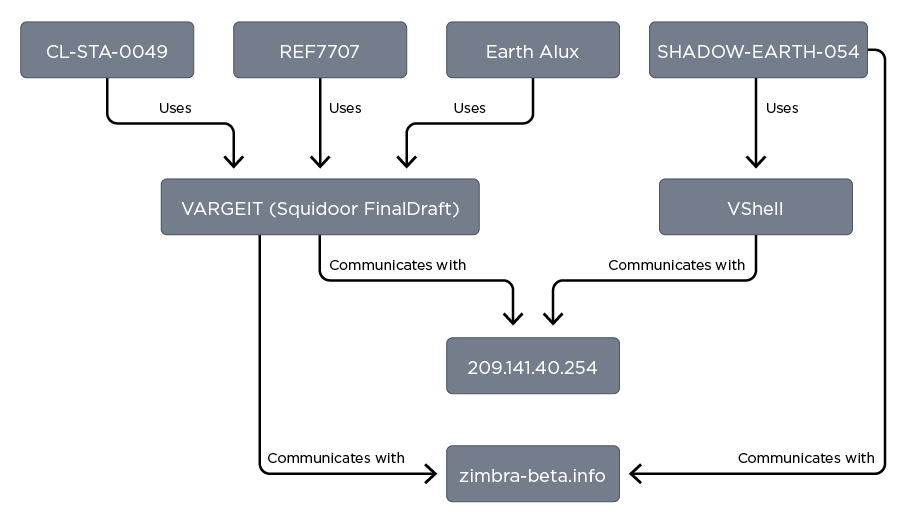
Overlap with SHADOW-EARTH-054: Shared Infrastructure or Coincidence?
A significant portion of the investigation highlights overlaps with another intrusion set, SHADOW-EARTH-054. Both groups:
- Exploit the same vulnerabilities
- Use identical tooling (same file hashes)
- Target similar environments
However, evidence suggests independent exploitation rather than coordinated operations. This aligns with a “Type A collaboration” model, where multiple actors exploit the same weak points without direct interaction.
Risk Mitigation and Defensive Recommendations
Organizations must adopt a proactive security posture:
- Patch Management: Regularly update Exchange and IIS servers
- Web Shell Detection: Monitor critical directories for unauthorized scripts
- Least Privilege: Restrict IIS process permissions
- EDR Monitoring: Detect suspicious child processes and outbound traffic
- Network Hardening: Limit access to commonly abused directories
Deploying Web Application Firewalls (WAF) and Intrusion Prevention Systems (IPS) can provide immediate protection where patching is delayed.
Our Opinion: Strategic Implications of SHADOW-EARTH-053 and 054
From our perspective, SHADOW-EARTH-053 represents a textbook example of how modern cyber-espionage campaigns blend persistence, patience, and precision. What stands out is not just the technical sophistication, but the operational discipline. The group avoids unnecessary noise, refines its techniques in real time, and focuses on high-value targets with clear geopolitical significance.
The continued success of exploiting older vulnerabilities like ProxyLogon highlights a systemic failure in patch management across organizations, especially in critical sectors. This is not merely a technical issue but an organizational one, where cybersecurity is often reactive rather than proactive.
Additionally, the overlap with SHADOW-EARTH-054 suggests a crowded threat ecosystem where multiple actors independently exploit the same weaknesses. This raises serious concerns about the scalability of cyber defense strategies—defenders are not facing a single adversary, but an entire class of opportunistic and state-aligned actors.
In conclusion, SHADOW-EARTH-053 is less an anomaly and more a warning. Organizations must move beyond compliance-driven security and adopt intelligence-led defense strategies, or risk becoming part of an increasingly expanding attack surface exploited by persistent adversaries.
Conclusion
SHADOW-EARTH-053 underscores the enduring risk posed by unpatched systems and the growing sophistication of cyber-espionage groups. By combining legacy exploits with advanced post-compromise tooling, the group demonstrates that effective attacks do not always require zero-day vulnerabilities—just neglected infrastructure.
For organizations, the message is clear: visibility, patching discipline, and behavioral detection are no longer optional—they are essential.
| SHADOW-EARTH-053 | SHADOW-EARTH-054 | |
|---|---|---|
| Infection Vector | Microsoft Exchange Vulnerabilities | Microsoft Exchange Vulnerabilities |
| Malware Toolkit | ShadowPad TosBtKbd.dll registry loader mdync.exe malware | Custom loaders VShell |
| Loader Filenames | RuntimeBroker.exe nvcontainer.exe osppsvc.exe CIATosBtKbd.exe | RuntimeBroker.exe SystemEventsBrokerTrustedService.exe identity_helper.exe |
| Post-Exploitation Toolkit | evil-createdump.exe IOX (Named explorer.exe) | evil-createdump.exe IOX (Named explorer.exe or svchost.exe) Custom Tools for Launching Privileged Processes |
| Targeted Regions | South Asia Southeast Asia East Asia Europe | South Asia Southeast Asia East Asia Latin America |
