

Online scammers are constantly changing the way they operate. As their tactics become more advanced, companies must adapt just as quickly to protect users. Criminals today use increasingly sophisticated techniques to deceive people across digital platforms. To counter this growing threat, Meta is investing in advanced artificial intelligence systems, introducing new safety tools to help users identify suspicious activity, and strengthening collaboration with law enforcement agencies and industry partners. These combined efforts aim to detect scams earlier, reduce risks for users, and disrupt criminal networks operating online.
Below is a closer look at Meta’s latest progress and the steps being taken to combat scams across its platforms.
New Anti-Scam Tools Across Meta Apps
Meta’s security systems already identify and remove large numbers of harmful accounts across its apps. However, scammers often attempt to bypass these systems, sometimes keeping accounts inactive or appearing legitimate until they find an opportunity to exploit victims. To address this challenge, Meta’s security specialists have developed new tools designed to warn users before they interact with potentially suspicious accounts or requests.
WhatsApp Device Linking Warning
One common scam involves criminals attempting to connect a victim’s WhatsApp account to their own device. They may ask users to share their phone number and then request a device-linking code sent to WhatsApp. In other cases, they might convince users to scan a QR code under false pretenses, which secretly connects the scammer’s device to the victim’s account.
To reduce this risk, WhatsApp will now provide alerts when system signals suggest a device-linking request may be suspicious. These notifications will indicate where the request originated and warn users that the action could be part of a scam. This gives people the opportunity to pause and reconsider before completing the linking process.
Facebook Alerts for Suspicious Friend Requests
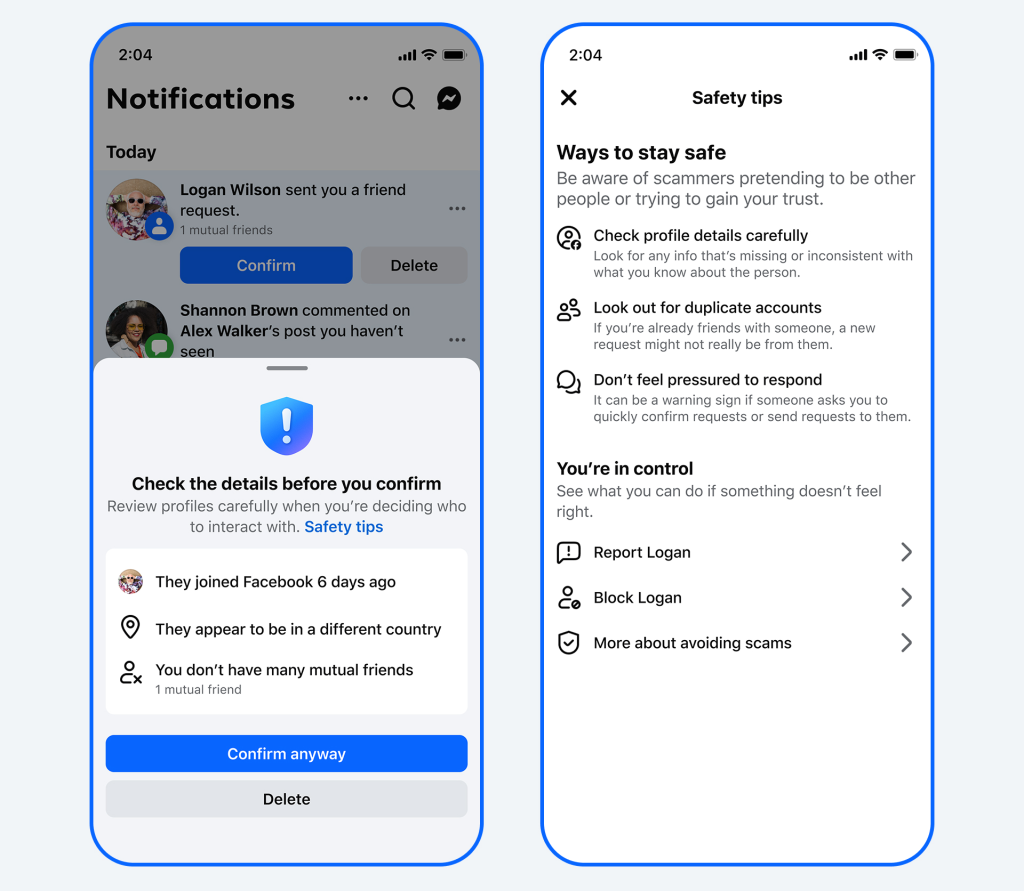
Meta is also testing new warning messages on Facebook designed to help users evaluate potentially unsafe friend requests. When someone sends or receives a request from an account that shows warning signs—such as having very few mutual friends or listing a location in another country—an alert will appear.
This prompt encourages users to carefully review the request and decide whether to block or decline the account if it appears suspicious.
Expanded Scam Detection on Messenger
Advanced scam detection tools on Messenger are being introduced to additional countries this month. If a conversation with a new contact begins to resemble known scam patterns—such as questionable job offers or financial opportunities—Messenger will notify the user.
Users may also be asked if they want to submit recent messages for an AI-based scam review. If the system identifies potential fraud, users receive more information about common scam tactics and suggestions for next steps, including blocking or reporting the suspicious account.
Using AI to Detect Celebrity and Brand Impersonation
Many modern scams rely on impersonating celebrities, well-known personalities, or trusted brands. These scams often use misleading posts, fake endorsements, or deceptive advertisements that appear convincing at first glance.
To tackle this issue, Meta has developed advanced AI systems capable of analyzing multiple signals at once—including text, images, and contextual information surrounding the content. This technology allows the company to identify more complex scam patterns quickly and at large scale.
Detecting Impersonation
Artificial intelligence plays a key role in identifying accounts that pretend to represent celebrities, public figures, or businesses. AI can evaluate signals such as suspicious fan engagement, misleading biographies, or false associations with well-known individuals or brands. By processing a wider range of contextual information about public figures, these systems help uncover impersonation attempts that traditional detection methods might miss.
Detecting Deceptive Links and Fake Websites
Scammers frequently create websites that closely resemble legitimate ones in order to trick users into sharing personal information or making payments. Meta now uses advanced AI systems to identify content that redirects users to such fraudulent websites.
This technology enables more accurate detection of domain impersonation and other deceptive practices, helping safeguard thousands of brands from being misrepresented online.
Expanding Advertiser Verification
Meta is also strengthening the verification process for advertisers to make its platforms safer for both users and businesses. Currently, advertisers may be required to verify their identity based on factors such as where their ads are displayed, their past compliance with platform rules, or whether the category of ads they run is considered higher risk.
The company plans to expand this program significantly. By the end of 2026, Meta aims for verified advertisers to account for 90% of its advertising revenue, up from 70% today. Verification will primarily focus on higher-risk advertising categories, while the remaining 10% will include lower-risk businesses such as small local shops.
The verification process improves transparency and makes it harder for scammers to misrepresent themselves while advertising.
Taking Action Against Scam Networks
Meta continues to take aggressive steps to identify and shut down large-scale scam operations. These efforts often involve close cooperation with law enforcement agencies and technology companies worldwide, since scam networks frequently operate across multiple platforms and international borders.
In the past year alone:
- More than 159 million scam advertisements were removed, with 92% taken down before being reported by users.
- In India in 2025, Meta banned over 12.1 million pieces of advertising content that violated policies related to fraud, scams, or deceptive practices. More than 93% were detected and removed proactively.
In addition, Meta removed 10.9 million Facebook and Instagram accounts linked to organized scam centers.
Investigations have revealed that scam operations are becoming increasingly sophisticated and industrialized, often run by coordinated criminal networks.
Global Law Enforcement Operation
Recently, Meta participated in a large international enforcement effort with global law enforcement agencies. As part of this operation, Meta investigators disabled over 150,000 accounts associated with scam networks based in Southeast Asia.
These criminal groups used digital platforms to carry out multiple types of fraud, including:
- Impersonating law enforcement officials to stage fake “digital arrest” scenarios
- Using video calls to pressure victims into paying fake fines or transferring money
- Promoting fraudulent cryptocurrency investment opportunities
More information about these investigations is available in Meta’s Adversarial Threat Report, which details enforcement actions against criminal scam centers.
Raising Awareness About Online Safety
Technology alone cannot eliminate scams. Public awareness and education play a crucial role in helping people recognize and avoid fraud.
To strengthen awareness in India, Meta launched the third edition of its “Scam Se Bacho” campaign in collaboration with the Indian Cyber Crime Coordination Centre (I4C) and the Securities and Exchange Board of India (SEBI).
The year-long initiative features well-known Indian actor Neena Gupta along with popular digital creators. The campaign focuses on teaching people how to identify common online scams and take steps to protect themselves.
Continuing the Fight Against Online Fraud
The battle against scammers is ongoing. As criminals refine their tactics, Meta plans to continue investing in new technologies, expanding detection systems, and strengthening partnerships with industry organizations and law enforcement agencies.
By combining advanced AI, stronger verification systems, proactive enforcement, and public awareness campaigns, Meta aims to create a safer environment for people using its platforms around the world.
