

In October 2025, security researchers observed a highly targeted spear-phishing campaign aimed at a Taiwanese non-governmental organization (NGO). The attack delivered a newly identified malware stager named LucidRook, marking a significant evolution in modular and stealth-focused cyber intrusion techniques.
What makes this campaign particularly concerning is its use of legitimate email infrastructure, suggesting that attackers may have compromised or abused trusted systems to bypass traditional email security controls.
Initial Attack Vector: Social Engineering Meets Obfuscation
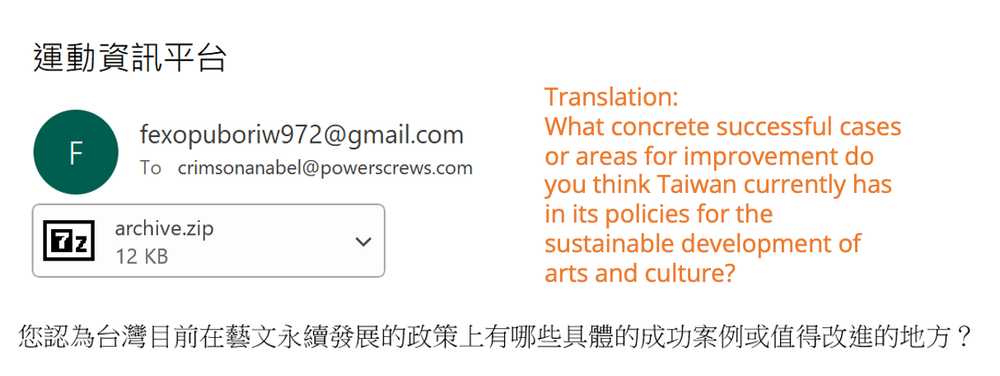
The infection begins with a carefully crafted phishing email containing a shortened URL. This link leads victims to download a password-protected RAR archive, with the password conveniently included in the email body—a tactic designed to build trust while bypassing automated scanning tools.
Inside the archive, attackers deploy decoy documents to create legitimacy. One such file mimics an official Taiwanese government directive regarding travel regulations for university staff. These decoys serve a dual purpose:
- Distracting the victim
- Masking malicious activity in the background
Two Distinct Infection Chains
Researchers identified two separate infection chains used to deploy LucidRook:
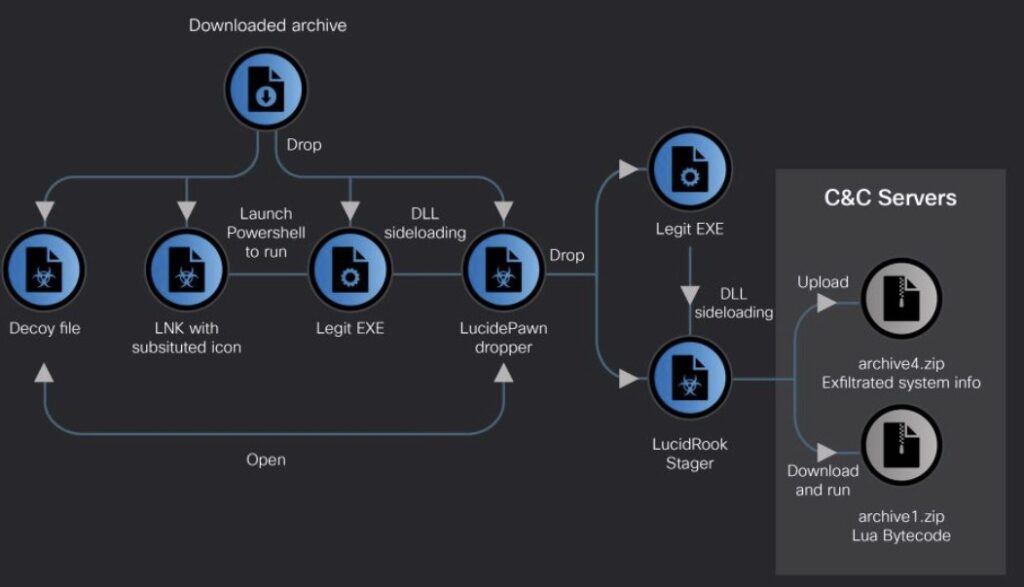
1. LNK-Based Infection Chain (LucidPawn Dropper)
This method relies on a malicious shortcut (LNK file) disguised as a PDF document. When executed:
- It triggers a PowerShell script using legitimate Windows components (LOLBAS technique)
- Launches a hidden payload stored deep within nested directories
- Uses a legitimate Windows binary (
index.exe) to sideload a malicious DLL via DLL search order hijacking
The dropper, known as LucidPawn, decrypts embedded payloads and installs them in system directories while masquerading as legitimate applications like Microsoft Edge. It also establishes persistence through the Startup folder.
2. EXE-Based Infection Chain
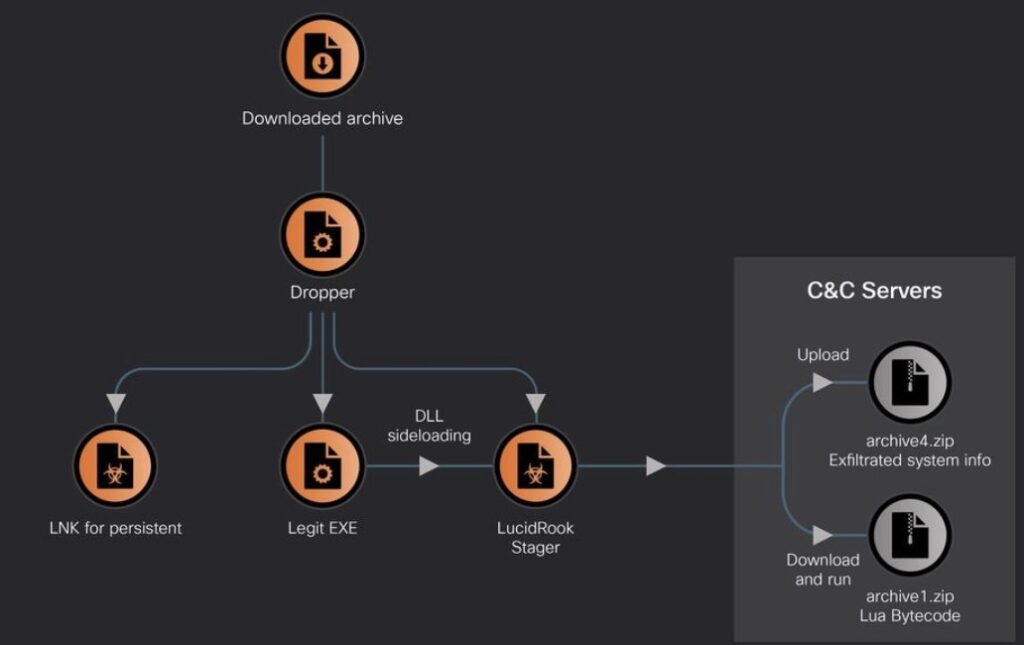
The second method is simpler but equally deceptive:
- Delivered as a password-protected 7-Zip archive
- Contains a fake executable impersonating a legitimate security product
- Built using the .NET framework with embedded Base64-encoded payloads
Once executed, it:
- Drops malicious files into system directories
- Displays a fake “cleanup completed” message
- Establishes persistence using a startup shortcut
LucidRook: A Modular and Flexible Stager
At the core of the campaign lies LucidRook, a sophisticated 64-bit Windows DLL. Its architecture combines:
- An embedded Lua interpreter (v5.4.8)
- Rust-compiled libraries
- Obfuscated Lua bytecode payloads
This design allows attackers to dynamically update malware behavior by simply modifying the Lua payload, without changing the core binary. It enhances:
- Operational flexibility
- Stealth
- Resistance to reverse engineering
Advanced Obfuscation and Anti-Analysis Techniques
LucidRook employs several advanced techniques to evade detection:
String Obfuscation
- Uses runtime XOR decryption with dynamically generated keys
- Prevents static analysis and signature-based detection
Geo-Targeting
- Executes only on systems configured with Traditional Chinese language settings
- Avoids sandbox environments typically configured in English
Safe Mode Lua Environment
- Disables certain Lua functions like
package.loadlib - Limits external module loading to reduce exposure
Data Exfiltration and Command-and-Control (C2)
LucidRook communicates with its C2 infrastructure using plaintext FTP, an unusual but effective choice:
- Uploads encrypted reconnaissance data
- Downloads additional payloads
Interestingly, attackers leveraged publicly exposed FTP credentials from legitimate Taiwanese printing companies. These servers unknowingly acted as:
- Low-cost staging infrastructure
- Anonymous data exfiltration channels
Reconnaissance and Modular Tooling
The malware collects extensive system data, including:
- User and system information
- Installed applications
- Running processes
This data is:
- Encrypted using RSA
- Packaged into password-protected archives
- Uploaded to attacker-controlled servers
Additionally, a related tool named LucidKnight was discovered. Unlike LucidRook, it:
- Focuses on reconnaissance
- Exfiltrates data via email using SMTP (Gmail infrastructure)
- Suggests a modular toolkit approach where attackers tailor tools per target
Why This Campaign Matters
This campaign stands out due to:
- Its targeted nature
- Use of legitimate infrastructure
- Advanced multi-stage infection chains
- Highly modular malware design
These characteristics strongly indicate a well-resourced threat actor focused on stealth and adaptability rather than mass exploitation.
Our Opinion: What This Means for Cybersecurity
The LucidRook campaign represents a clear shift toward precision-driven cyber operations rather than widespread attacks. What’s most striking is not just the technical sophistication, but the strategic mindset behind it. Attackers are no longer relying solely on zero-days or brute force; instead, they are blending social engineering, legitimate tools, and modular malware to create highly adaptable intrusion frameworks.
The abuse of publicly available FTP credentials is particularly noteworthy. It highlights a growing trend where attackers exploit misconfigurations in benign services, turning everyday infrastructure into covert C2 channels. This lowers operational costs while increasing anonymity.
From a defensive standpoint, traditional security measures—such as signature-based detection—are increasingly ineffective against such threats. Organizations must adopt:
- Behavioral analysis
- Zero-trust architectures
- Strong email authentication and monitoring
Equally important is user awareness. Even the most advanced defenses can be bypassed if users unknowingly execute malicious files.
In our view, LucidRook is not just another malware strain—it’s a blueprint for future targeted attacks. Security teams should treat this campaign as an early warning and proactively adapt their detection and response strategies before similar threats become widespread.
