

Cyberattacks targeting transportation and logistics are evolving rapidly, moving far beyond simple phishing or credential theft. In a recent controlled investigation conducted in a decoy environment, researchers observed a sophisticated threat actor maintaining unauthorized access for over a month—providing rare insight into post-compromise behavior, persistence strategies, and financial targeting techniques.
This case highlights how attackers are no longer focused solely on gaining entry but are instead investing heavily in long-term control, stealth, and monetization pathways.
Initial Access: Load Boards as an Entry Point
The attack began with the compromise of a freight load board platform—an essential marketplace connecting brokers and carriers. From there, the attacker distributed malicious emails posing as legitimate freight inquiries.
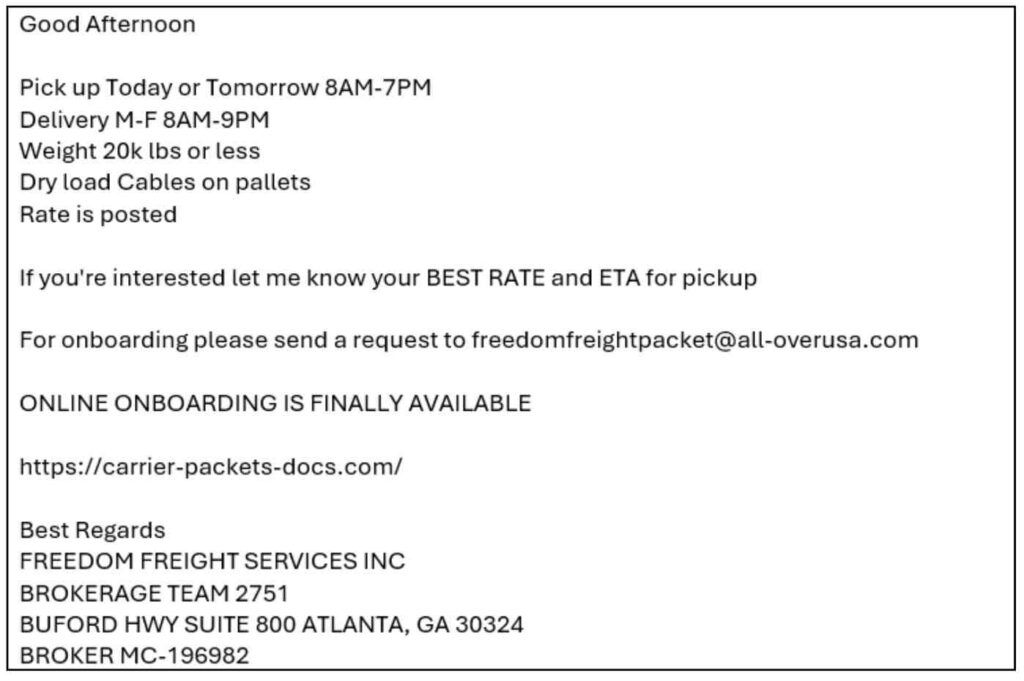
The payload was a Visual Basic Script (VBS) file that executed a multi-stage infection chain:
- Downloaded a PowerShell script
- Installed remote access software (ScreenConnect)
- Displayed a decoy agreement to avoid suspicion
This blend of social engineering and staged execution reflects a well-planned intrusion strategy designed to appear operationally legitimate.
Persistence Through Redundant Remote Access
Once inside, the attacker prioritized persistence. Instead of relying on a single backdoor, they deployed multiple Remote Monitoring and Management (RMM) tools, including:
- Multiple ScreenConnect instances
- Pulseway RMM
- SimpleHelp
This redundancy ensured continued access even if one tool was detected or removed. It also indicates a mature operational model where access resilience is critical.
Signing-as-a-Service: A New Evasion Technique
One of the most notable discoveries was the use of a signing-as-a-service capability—a previously undocumented tactic.
The attacker:
- Submitted malicious installers to a third-party signing service
- Received binaries signed with a valid certificate
- Replaced revoked or suspicious components with newly trusted ones
This effectively allowed malware to:
- Bypass security warnings
- Evade endpoint protection
- Maintain trust within the operating system
By abusing legitimate trust mechanisms, the attacker blurred the line between benign and malicious software.
Hands-on-Keyboard Activity and Financial Targeting
Unlike automated malware campaigns, this intrusion involved manual operator activity.
Key actions included:
- Accessing financial platforms like PayPal
- Deploying cryptocurrency wallet stealers
- Executing custom reconnaissance tools
This indicates a shift toward human-driven exploitation, where attackers actively evaluate the value of each compromised system.
Deep Reconnaissance via PowerShell
The attacker executed over a dozen PowerShell scripts designed to assess the financial potential of the victim. These scripts:
- Enumerated users and browser profiles
- Extracted browsing history across multiple browsers
- Identified access to banking, logistics, and payment systems
- Exfiltrated summarized data to Telegram
Particularly concerning was the focus on:
- Fleet payment systems
- Fuel card platforms
- Freight brokerage tools
This aligns closely with tactics used in cargo theft and freight diversion schemes.
Stealth and Operational Discipline
The attacker demonstrated strong operational security:
- Stored artifacts in hidden directories
- Executed under SYSTEM privileges
- Used scheduled tasks to evade detection
- Returned intelligence via existing channels (avoiding new alerts)
These behaviors show a high level of discipline and experience in enterprise environments.
Conclusion
This case underscores a critical shift in cyber threats targeting logistics and transportation. Attackers are:
- Investing in persistence over speed
- Leveraging trusted systems to evade detection
- Conducting deep reconnaissance before monetization
Organizations must prioritize:
- Monitoring for unauthorized RMM tools
- Detecting abnormal PowerShell activity
- Tracking browser-based access to financial platforms
The attack lifecycle no longer ends at compromise—it begins there.
Our Opinion on This Case
This incident represents a significant evolution in financially motivated cybercrime, particularly within the transportation sector. What stands out is not just the technical sophistication, but the strategic patience demonstrated by the attacker. Maintaining access for over a month suggests a deliberate approach focused on maximizing return rather than executing quick wins.
The use of signing-as-a-service is especially concerning. It highlights a broader industry issue: trust mechanisms, once considered reliable, are now being actively exploited. This creates a dangerous scenario where traditional defenses—like certificate validation—can no longer be blindly trusted.
Additionally, the strong focus on logistics platforms, fuel cards, and payment systems indicates that attackers deeply understand industry workflows. This is no longer opportunistic hacking; it is domain-aware cybercrime.
In our view, many organizations in transportation still underestimate their attractiveness as targets. The combination of financial systems, real-time operations, and third-party integrations makes them uniquely vulnerable.
Ultimately, this case reinforces a hard truth: cybersecurity is no longer just an IT concern—it is a core business risk, especially in industries where digital access directly translates into physical asset control.
