

The evolution of malware targeting Operational Technology (OT) environments continues to raise concerns across critical infrastructure sectors. A recently analyzed malware sample known as ZionSiphon demonstrates a concerning blend of traditional host-based techniques and industrial system awareness. While the sample appears partially incomplete, its design reveals clear intent to interfere with water treatment and desalination systems—an area of high strategic importance.
This article provides a deep technical breakdown of ZionSiphon’s architecture, targeting logic, persistence mechanisms, and OT-specific behaviors, along with insights into its possible motivations and limitations.
Targeting Logic and Geopolitical Context
One of the most distinctive aspects of ZionSiphon is its highly specific targeting model. The malware includes hardcoded IPv4 ranges corresponding to Israeli networks. These ranges are obfuscated using Base64 encoding, indicating a deliberate attempt to limit execution to a defined geographic scope.
Further reinforcing this intent are embedded strings containing politically charged messages. Although these strings are not functionally executed, they reveal ideological motivations aligned with geopolitical tensions in the Middle East. The presence of references to cities and infrastructure suggests symbolic as well as operational targeting.
Focus on Water and Desalination Systems
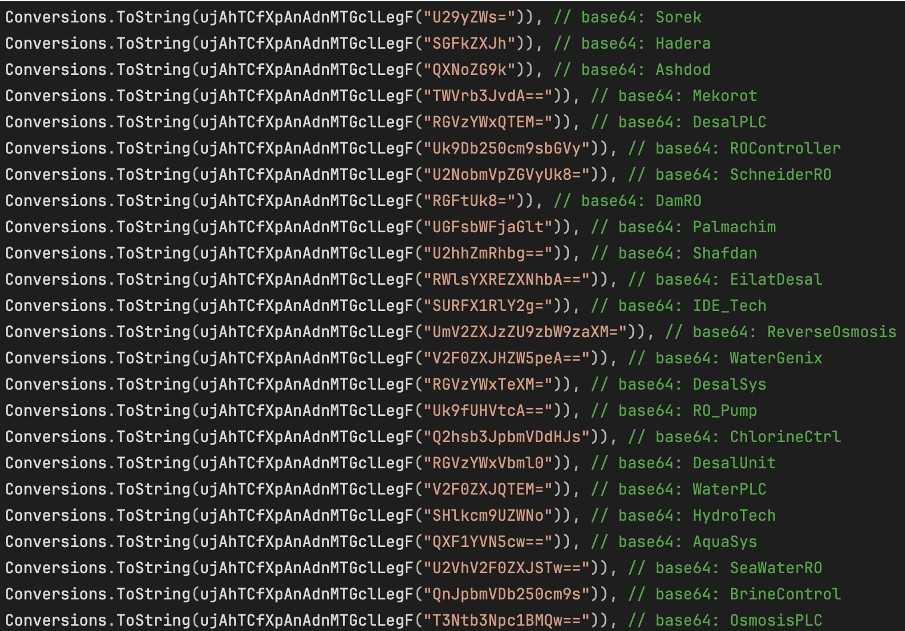
Beyond geographic filtering, ZionSiphon incorporates a second layer of environmental validation aimed at industrial water systems. The malware checks for:
- Process names associated with desalination and reverse osmosis systems
- Industrial control components like PLCs and chlorine dosing systems
- Specific directories and configuration files tied to water treatment software
This dual-filter approach—geographic plus environmental—demonstrates a targeted attack model rarely seen in commodity malware. It suggests the threat actor intended to deploy the payload only in highly relevant environments.
Privilege Escalation and Persistence
ZionSiphon employs a straightforward privilege escalation technique. It checks whether it is running with administrative rights and, if not, relaunches itself using PowerShell with elevated privileges.
Persistence is achieved via:
- Registry modification under
HKCU\Software\Microsoft\Windows\CurrentVersion\Run - A disguised executable named
svchost.exeplaced in a local application data directory - Hidden file attributes to reduce visibility
This approach is relatively simple but effective, blending into normal Windows behavior without relying on advanced evasion tactics.
Target Validation Failure
Despite its sophisticated targeting logic, ZionSiphon contains a critical flaw. The function responsible for validating whether a system belongs to the intended country fails due to a mismatch in encryption logic.
The malware compares encoded strings derived from IP ranges with the result of an XOR operation applied to the string “Israel.” However, the outputs never match. As a result, the malware consistently concludes that the host is not a valid target.
This flaw effectively disables the payload’s core functionality, suggesting:
- The sample may be a development build
- The logic was incorrectly implemented
- Or the malware was intentionally neutered
Self-Destruct Mechanism
When the target validation fails, ZionSiphon activates a self-destruct routine. This includes:
- Removing persistence registry keys
- Writing a log file indicating failure
- Creating a batch script that repeatedly attempts to delete the malware executable
This behavior reduces forensic artifacts and limits unintended exposure.
Industrial Sabotage Capabilities
If the malware were to pass its validation checks, its primary payload involves manipulating local configuration files related to water treatment systems.
It attempts to modify parameters such as:
- Chlorine dosing levels
- Pump activation states
- Valve positions
- Pressure settings
These changes could theoretically disrupt water treatment processes, potentially leading to unsafe conditions.
OT Network Discovery and Protocol Interaction
ZionSiphon includes a network scanning routine targeting common industrial protocols:
- Modbus (Port 502)
- DNP3 (Port 20000)
- S7comm (Port 102)
The malware scans the local subnet and attempts to identify devices responding on these ports. For each detected system, it performs lightweight validation to confirm protocol compatibility.
Modbus Implementation
The Modbus logic is the most developed. The malware:
- Sends a request to read holding registers
- Parses responses to identify relevant values
- Attempts to write new values (e.g., increasing chlorine dosage)
If dynamic discovery fails, it falls back to hardcoded register writes, indicating partial knowledge of target systems.
Incomplete Protocol Support
The DNP3 and S7comm implementations are clearly unfinished. While they include valid protocol headers, they lack complete structures required for meaningful communication. This suggests planned multi-protocol support that was not fully realized.
USB Propagation Mechanism
ZionSiphon also includes a removable media propagation feature:
- Copies itself to USB drives as a hidden file
- Creates deceptive shortcut files that execute the malware when clicked
- Hides original files to trick users
This technique is reminiscent of older ICS-targeting malware campaigns and indicates an attempt to bridge air-gapped environments.
Key Insights
ZionSiphon represents a hybrid threat combining traditional malware techniques with OT-specific targeting. Its defining characteristics include:
- Geopolitically motivated targeting
- Industrial process awareness
- Multi-protocol scanning capabilities
- Sabotage-oriented payload design
However, its operational limitations—particularly the broken targeting logic and incomplete protocol support—suggest it is not yet fully weaponized.
Our Opinion on the ZionSiphon Case
ZionSiphon is less alarming for what it currently does and more significant for what it represents. Even in its incomplete state, it reflects a clear shift in attacker behavior—from opportunistic cybercrime toward targeted disruption of critical infrastructure.
What stands out is the intentional layering of targeting conditions. This is not mass malware. It is designed to activate only under very specific geopolitical and industrial conditions. That level of precision indicates planning and domain research, even if execution falls short.
At the same time, the technical flaws cannot be ignored. The broken validation logic effectively neutralizes the malware, raising the possibility that this was either a prototype, a test deployment, or even a proof-of-concept that escaped into the wild prematurely.
More importantly, ZionSiphon highlights a growing trend: attackers experimenting with OT protocols like Modbus and attempting to manipulate physical processes. Even partial implementations demonstrate increasing familiarity with industrial systems.
In our view, this sample should be treated as an early warning rather than an immediate threat. It underscores the need for stronger monitoring across IT and OT boundaries, better segmentation, and proactive detection strategies. The next iteration of such malware may not have these flaws—and that is where the real risk lies.
