

Security researchers have uncovered a new phishing operation that abuses LiveChat, a widely used customer support tool that provides live messaging and AI-driven assistance.
Unlike traditional phishing attempts that rely on fake refund pages or login forms, this campaign interacts with victims through a real-time chat interface. Attackers pretend to represent trusted brands and use the conversation to collect sensitive data, including:
- Login credentials
- Credit card information
- Multi-factor authentication (MFA) codes
- Personally identifiable information (PII)
This method increases credibility by mimicking genuine customer support interactions.
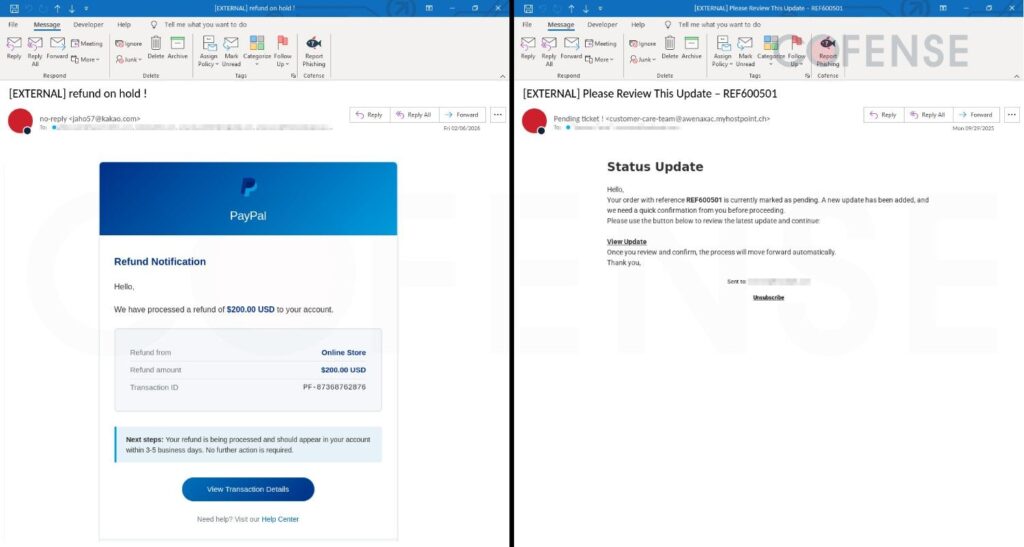
Initial Infection Vector (Email Lures)
The attack begins with phishing emails that use different psychological triggers:
Email Variant 1 – PayPal Refund Theme
- Claims the recipient will receive $200 USD
- Includes a button labeled “View Transaction Details”
- Uses branding similar to PayPal
This version targets curiosity and financial incentive.
Email Variant 2 – Amazon Notification Theme
- Provides vague order or account-related messaging
- Includes a “View Update” button
- No clear branding initially, increasing ambiguity
This version creates urgency and confusion, making users more likely to click.
Attack Flow Overview
Step 1: Redirection to LiveChat
Clicking the link redirects victims to a page hosted on the lc[.]chat domain, part of the LiveChat infrastructure.
- One page imitates PayPal
- The other imitates Amazon
Step 2: Chat-Based Engagement
The interaction differs slightly:
- PayPal version → Automated or bot-driven messages appear instantly
- Amazon version → User must enter an email before chat begins
Credential Harvesting Techniques
Amazon-Themed Attack (Human-Driven Interaction)
In this variant, the attacker operates manually through chat:
- Victim is greeted with messages like “Unlock your Pending Refund”
- The attacker asks for:
- Email confirmation
- Phone number
- Date of birth
- Address
- The conversation includes noticeable errors:
- Misspellings (e.g., “Ello”)
- Incorrect punctuation
These signs indicate a real human operator, not automation.
- The attacker then requests:
- Credit card number
- Expiry date
- CVC
To reduce suspicion, they add reassurance such as:
“Your information will be handled with confidentiality.”
This stage clearly reveals the intent: direct financial data theft via chat.
PayPal-Themed Attack (Multi-Step Phishing Chain)
This version uses a more structured approach:
- Victim is redirected to a fake login page
- A legitimate-looking MFA code is sent to the user
- Victim enters the code, which is captured by the attacker
Follow-up Data Collection
The victim is then prompted to submit:
- Billing information
- Date of birth (unusual for billing forms)
Final Stage
- Another form requests full card details
- A second MFA code is requested
- Victim is redirected back to chat and told the refund is complete
This sequence enables attackers to:
- Bypass MFA protections
- Take control of accounts
- Conduct financial fraud
Key Observations
- Real-time chat reduces user suspicion compared to static phishing pages
- Combination of automation + human interaction increases effectiveness
- Use of trusted brands like PayPal and Amazon improves credibility
- Attackers collect both authentication data and financial information
Indicators of Compromise (IOCs)
Email 1 (PayPal-Themed)
Stage 1 – Infection URLs
- hXXps://www[.]govnet[.]co[.]za/?redirect=…
Associated IPs:
- 104.21.90.116
- 172.67.200.101
Stage 2 – Payload URLs
- hXXps://direct[.]lc[.]chat/19449368
- hXXps://www[.]paypalrefund[.]workers[.]dev/…
- hXXps://api[.]telegram[.]org/…
Associated IPs:
- 23.48.203.38
- 104.21.20.86
- 149.154.166.110
- 23.48.203.39
- 172.67.192.3
Email 2 (Amazon-Themed)
Stage 1 – Infection URL
- hXXps://t[.]co/56TlmnQA0M
Associated IP:
- 162.159.140.229
Stage 2 – Payload URLs
- hXXps://direct[.]lc[.]chat/19252309
Associated IPs:
- 23.53.11.166
- 23.53.11.176
- 23.53.11.168
Conclusion
This campaign highlights how phishing tactics are evolving beyond traditional methods. By integrating live chat platforms, attackers create a more convincing and interactive experience that lowers user defenses.
The attack combines multiple techniques:
- Brand impersonation
- Social engineering
- Credential harvesting
- Financial fraud
Because these threats closely resemble legitimate support interactions, automated detection alone is not sufficient.
Organizations should invest in:
- User awareness training
- Real-time threat intelligence
- Dedicated phishing analysis teams
A proactive defense model is critical to detect and stop these advanced phishing attempts before they lead to account compromise or financial loss.
