

Recent intelligence indicates that threat actors associated with Russian intelligence services are actively conducting phishing campaigns targeting users of secure messaging platforms such as Signal and WhatsApp. These campaigns are not exploiting weaknesses in encryption technologies but instead focus on manipulating users into providing access to their accounts.
The attackers are primarily focused on individuals with high intelligence or strategic value, including government officials, military personnel, journalists, and political figures. By successfully compromising these accounts, adversaries gain the ability to monitor communications, impersonate victims, and extend their operations through trusted networks.
This activity highlights a broader trend in modern cyber operations where human behavior, rather than technical flaws, is the primary attack surface. The scale of the campaign is significant, with thousands of accounts reportedly affected globally.
Threat Overview
The phishing campaign is designed to gain unauthorized access to messaging accounts by deceiving users into revealing sensitive authentication information. Instead of attacking the encryption protocols of messaging applications, which remain robust, threat actors exploit user trust and routine behaviors.
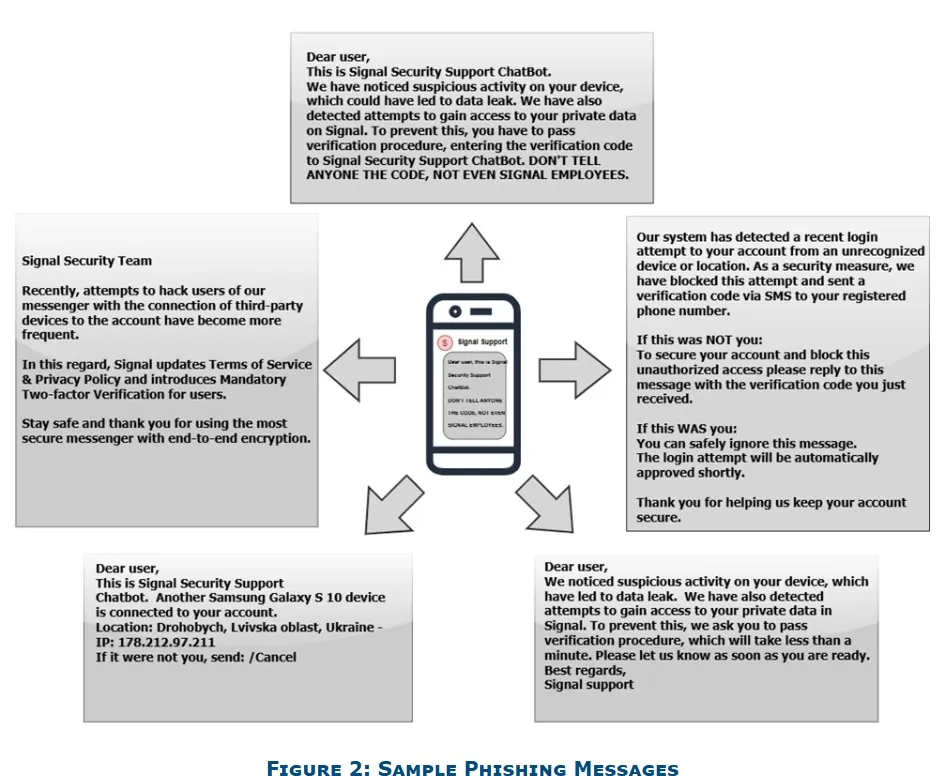
The attackers impersonate legitimate support services associated with messaging platforms. Victims receive carefully crafted messages that appear authentic and urgent, prompting them to take actions such as clicking malicious links, sharing one-time verification codes, or disclosing PINs.
Once the victim complies, attackers are able to link their own device to the target account or fully take control of the account. This allows persistent access to conversations and contact networks without immediately alerting the user.
The campaign demonstrates a clear understanding of platform features such as device linking and account recovery workflows. These legitimate features are being abused as entry points, making the attacks difficult to detect through traditional security mechanisms.
Target Profile
The campaign specifically targets individuals who are likely to handle sensitive or high-value information. These include:
- Current and former government officials
- Military personnel
- Political figures
- Journalists and media professionals
These individuals are attractive targets because their communications may contain intelligence, strategic decisions, or sensitive discussions. By gaining access to such accounts, attackers can collect valuable information without needing to breach secure systems directly.
Additionally, compromised accounts can be used as stepping stones to reach other high-value targets through trusted communication channels.
Attack Methodology
The attack chain relies heavily on social engineering techniques. The process typically unfolds in several stages.
First, the attacker initiates contact by impersonating a trusted entity, often presenting themselves as official support from the messaging platform. The message is designed to appear legitimate and may include branding, language patterns, and formatting consistent with real communications.
Next, the victim is encouraged to perform an action. This could involve clicking a link that leads to a fake login page or sharing a verification code sent to their device. In some cases, the attacker may claim that urgent action is required to secure or verify the account.
If the victim follows the instructions, the attacker gains access by either linking a new device to the account or completing a full account takeover. This process does not require breaking encryption; instead, it leverages the platform’s normal authentication mechanisms.
As the campaign evolves, there are indications that attackers may introduce malware into their operations. This would allow deeper access to the victim’s device and potentially enable broader surveillance or data exfiltration.
Technical Analysis
From a technical perspective, the campaign is notable for what it does not do. There is no evidence of vulnerabilities being exploited within Signal or WhatsApp themselves. End-to-end encryption remains intact and uncompromised.
Instead, the attackers focus on bypassing encryption entirely by gaining legitimate access to user accounts. Once inside, they can read messages in real time because the platform assumes the authenticated user is authorized.
The abuse of features such as “linked devices” is particularly effective. This functionality is designed for user convenience but can be manipulated if authentication codes are exposed. By linking their own device, attackers can maintain ongoing access even if the victim continues to use their account.
This approach represents a shift toward identity-based attacks, where control of the account is more valuable than breaking the underlying technology.
Impact Assessment
The consequences of these attacks can be severe, especially for high-value targets. Once an account is compromised, attackers gain access to:
- Private conversations
- Contact lists
- Group memberships
- Shared files and media
This information can be used for intelligence gathering, blackmail, or further phishing campaigns. Because messages appear to come from a trusted source, secondary victims are more likely to fall for similar tactics.
Impersonation is another major risk. Attackers can send messages that appear to originate from the victim, potentially influencing decisions or spreading misinformation.
At a broader level, these attacks pose a risk to national security, particularly when targeting government and military personnel. Sensitive communications could be exposed without any direct breach of official systems.
Indicators of Compromise (IOCs)
While specific indicators may vary, several common signs can help identify potential compromise:
- Unexpected messages claiming to be from app support
- Requests for verification codes or PINs
- Alerts about new linked devices
- Unusual login activity
- Messages sent from your account that you did not author
Users and organizations should monitor for these indicators and respond quickly if detected.
Mitigation Strategies
Reducing the risk of these attacks requires a combination of user awareness and security controls.
Users should avoid sharing verification codes or PINs under any circumstances. Legitimate services will never request this information through unsolicited messages.
It is important to verify the authenticity of any message that দাবি urgent action, especially if it involves account security. Users should access services only through official applications or websites rather than clicking on links in messages.
Enabling additional security features, such as two-step verification and device management alerts, can help detect and prevent unauthorized access. Regularly reviewing linked devices and removing unknown entries is also recommended.
Organizations should provide training on social engineering threats and establish clear reporting procedures for suspicious activity. Early detection can significantly reduce the impact of an attack.
Global Intelligence Context
This campaign is not isolated. Intelligence agencies in multiple countries, including the Netherlands, have reported similar activity linked to Russian threat actors.
These operations appear to be part of a broader strategy to monitor communications among government and military personnel. Messaging applications are attractive targets because they are widely used and often trusted for secure communication.
However, experts emphasize that these platforms should not be relied upon for highly classified or sensitive information. Even strong encryption cannot protect against compromised user accounts.
Conclusion
The phishing campaign targeting messaging applications represents a clear example of how cyber threats are evolving. Rather than attacking systems directly, adversaries are focusing on human behavior as the weakest link.
The success of these operations demonstrates that even the most secure technologies can be undermined if users are deceived into granting access. As a result, cybersecurity efforts must extend beyond technical defenses to include user education and awareness.
Our Opinion
This case highlights a fundamental reality in cybersecurity: the strength of a system is not determined only by its technology but also by the behavior of its users. Signal and WhatsApp are widely recognized for their strong encryption, and from a technical standpoint, they remain secure. However, this campaign shows that attackers do not need to break encryption when they can simply walk through the front door by exploiting human trust.
In our view, the most concerning aspect of this operation is its precision targeting. The attackers are not casting a wide net randomly; they are selecting individuals who hold positions of influence or access to sensitive information. This indicates a high level of planning and intelligence gathering before the phishing attempt even begins. It also suggests that these campaigns are part of a larger strategic objective rather than isolated cybercriminal activity.
Another important observation is the abuse of legitimate platform features. The use of linked devices and verification workflows is particularly clever because it allows attackers to operate within the normal boundaries of the application. This makes detection more difficult, both for users and for automated security systems. It also raises questions about how platform providers can balance usability with security in the future.
We also believe that the human factor will continue to be the primary attack vector in similar campaigns. Despite years of awareness efforts, social engineering remains highly effective. This is partly because attackers continuously refine their techniques, making messages more convincing and context-aware. As artificial intelligence tools become more accessible, the sophistication of phishing attempts is likely to increase further.
From a defensive standpoint, organizations must treat user awareness as a critical layer of security rather than an optional measure. Technical controls alone are not enough. Regular training, simulated phishing exercises, and clear reporting mechanisms should be standard practice, especially for high-risk individuals.
Finally, this campaign reinforces the idea that no communication platform should be considered completely safe for highly sensitive discussions. Even if the technology is secure, the user environment may not be. Decision-makers should carefully evaluate what type of information is shared عبر such channels and consider additional safeguards where necessary.
