

Security researchers have uncovered a large-scale malware campaign targeting gamers through fake “free cheat” tools distributed across GitHub repositories. These campaigns span multiple online games and rely heavily on social engineering to lure victims into downloading malicious software. The scale of the operation is substantial, with hundreds of repositories already identified, and the actual number likely reaching into the thousands.

Attackers are exploiting trusted platforms such as GitHub, Discord, and Reddit to appear legitimate while quietly distributing infostealer malware. A key payload identified in these campaigns is Vidar Stealer 2.0, a more advanced version of the long-running Vidar malware family. This malware is capable of stealing sensitive data including browser credentials, cryptocurrency wallets, and authentication tokens.
The rise of Vidar 2.0 appears closely linked to recent law enforcement actions that disrupted other major infostealers like Lumma and Rhadamanthys. As a result, cybercriminals have shifted toward Vidar as an alternative, demonstrating how quickly the threat landscape adapts.
Introduction
Recent investigations reveal a growing trend where cybercriminals specifically target gamers searching for cheat tools. These campaigns are not random; they are carefully designed to exploit a particular user behavior—downloading unauthorized software for competitive advantage.
The infrastructure supporting these attacks is highly organized and distributed across multiple platforms. Instead of relying on traditional malicious websites, attackers now use legitimate services like GitHub Pages to host landing pages. These pages redirect victims to external download sources, making detection and takedown efforts more complex.
This report explores how these campaigns operate, from initial infection vectors to the technical workings of Vidar 2.0.
Background: Evolution of Game Cheat Exploitation
Cheating in video games has evolved significantly over time. What began as harmless developer-added features has transformed into a competitive and often commercialized ecosystem. Modern cheat tools offer advanced capabilities such as automated aiming, wall visibility, and real-time player tracking.
With the rise of competitive online games, demand for these tools has increased dramatically. Paid cheat subscriptions can be expensive, which pushes many users—especially younger players—toward free alternatives. This creates an ideal opportunity for attackers.
The underground market for cheats operates through forums, Discord servers, and social platforms. It is within these communities that attackers distribute malicious tools disguised as legitimate cheats.
Threat Landscape Shift: Rise of Vidar 2.0
The emergence of Vidar 2.0 coincides with the disruption of other major infostealers. When law enforcement took action against Lumma and Rhadamanthys, it created a gap in the cybercriminal ecosystem. Vidar quickly filled that gap.
Originally discovered in 2018, Vidar has remained active for years. Its latest version introduces major improvements, including better performance, enhanced stealth, and more sophisticated data extraction techniques.
Vidar operates under a malware-as-a-service model, making it accessible to a wide range of attackers. Its affordability and reliability have contributed to its rapid adoption.
Attack Chain Overview
Initial Access
The attack typically begins on platforms like Reddit or Discord, where users are offered “free cheats.” These posts often appear genuine and are tailored to specific games.
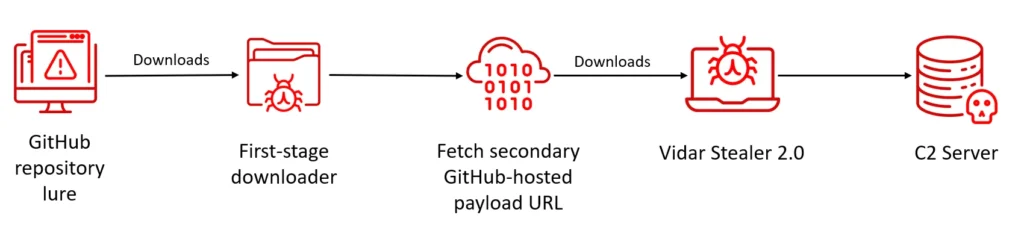
Users are then redirected to GitHub-hosted pages, which serve as entry points. These pages do not host malware directly but link to external sites controlled by attackers.
Execution Process
Victims are guided through installation steps that include:
- Disabling antivirus software
- Extracting password-protected archives
- Running executables with administrator privileges
Because cheat tools often require elevated permissions, these instructions do not raise suspicion among users.
Technical Analysis of Malware Delivery
The downloaded files act as loaders, often disguised as cheat tools. Many are compiled PowerShell scripts converted into executable format using tools like PS2EXE. This allows them to bypass simple detection mechanisms.
Once executed, the loader performs several actions:
- Adds exclusions in Windows Defender
- Contacts external services like Pastebin to retrieve additional payloads
- Downloads secondary malware components
- Hides files and directories within the system
The final payload is typically a packed version of Vidar 2.0, executed in the background with elevated privileges.
Persistence is achieved through scheduled tasks, ensuring the malware runs automatically when the system starts.
Advanced Infection Techniques
Another variation of the campaign uses large compressed files containing hidden payloads. These files often include unnecessary data to avoid detection and slow down analysis.
Scripts embedded within these files reconstruct the final malware using fragmented components. In some cases, tools like AutoIt are used to execute the payload, adding another layer of obfuscation.
Capabilities of Vidar 2.0
Vidar 2.0 is a highly capable infostealer with extensive data collection features.
Data Theft
The malware can extract:
- Browser credentials and cookies
- Autofill data
- Cryptocurrency wallets
- FTP and SSH credentials
- Messaging app data (Telegram, Discord)
- Local files and screenshots
It also targets cloud-related data, including Azure authentication tokens.
Browser Exploitation
Vidar uses multiple methods to access browser data, including decryption of stored keys and injection techniques. It can interact with both Chromium-based and Firefox browsers.
System-Level Features
The malware includes:
- Multithreading for faster data collection
- Polymorphic builds to evade detection
- Anti-debugging and anti-virtual machine checks
- Obfuscation techniques to hinder analysis
Command-and-Control (C2)
Instead of hardcoding server addresses, Vidar retrieves them dynamically using platforms like Telegram and Steam. These act as “dead drop resolvers,” making it harder to trace the actual infrastructure.
Why Gamers Are Targeted
Gamers represent an ideal target group for several reasons. They often download software from unofficial sources, expect security warnings, and may avoid reporting incidents to prevent account bans.
Additionally, gaming accounts can have real-world value. Rare items, in-game currency, and high-level accounts can be sold in secondary markets. This makes stolen credentials highly profitable.
Younger users are particularly vulnerable, as they may lack awareness of cybersecurity risks and are more likely to trust free offerings.
Persistence of the Infostealer Ecosystem
The rapid shift from one malware family to another highlights the resilience of cybercriminal operations. Even when major threats are disrupted, new or existing tools quickly take their place.
Vidar 2.0 demonstrates how malware continues to evolve, becoming faster, stealthier, and more adaptable. As long as there is demand for stolen data, these threats will persist.
Mitigation and Recommendations
Organizations and individuals should adopt a layered security approach to reduce risk. Endpoint protection systems with behavioral analysis can help detect suspicious activity. Regular updates and patch management are also critical.
Restricting execution from non-standard directories can prevent unauthorized programs from running. Most importantly, user awareness plays a key role. Educating users about the dangers of downloading software from untrusted sources can significantly reduce infection rates.
Our Analysis and Opinion
This case clearly reflects a deeper issue within both cybersecurity and user behavior rather than being just another malware campaign. What stands out is not only the technical sophistication of Vidar 2.0 but also how effectively attackers exploit human psychology and platform trust. The use of GitHub, a platform widely associated with legitimate development, changes the perception of risk for many users. When a download appears to come from a trusted environment, the natural instinct is to lower defenses, which is exactly what attackers are counting on.
Another important observation is how quickly the cybercriminal ecosystem adapts to disruption. The fall of Lumma and Rhadamanthys did not reduce the overall threat; it simply shifted activity toward another tool. This suggests that the ecosystem is not dependent on individual malware families but rather on the demand for stolen data. As long as there is a profitable market for credentials, tokens, and digital assets, new tools will continue to emerge.
From a defensive perspective, this also highlights a limitation in traditional security thinking. Blocking known malware is no longer sufficient because the malware itself keeps changing. Instead, the focus needs to shift toward behavior-based detection and monitoring abnormal activities such as unauthorized data access, unusual process execution, and suspicious network communication.
There is also a concerning social angle to this campaign. The fact that many victims are likely younger users raises ethical concerns. These users are not just losing accounts but potentially exposing sensitive personal and financial data. This makes the campaign more than just a technical threat—it becomes a broader issue involving digital safety and awareness.
Overall, this case reinforces the idea that cybersecurity is not only about technology but also about understanding user behavior, trust models, and evolving attacker strategies. Without addressing all three aspects together, similar campaigns will continue to succeed regardless of how advanced defensive tools become.
