

For years, Google’s API key architecture followed a clear and well-documented philosophy: API keys beginning with AIza... were not secrets. They were designed as public identifiers for client-side applications using services like Maps, Firebase, or YouTube. Developers were explicitly encouraged to embed them in mobile apps and frontend code without concern.
That long-standing assumption has now been fundamentally broken.
In early 2026, security research revealed a critical architectural flaw tied to Google’s Generative Language API (Gemini). Once enabled in a Google Cloud project, all existing API keys—past and present—automatically gain access to Gemini endpoints, without warning or developer consent.
The Core Problem: Silent Privilege Escalation
At the heart of this issue is a design decision: Google uses a single API key format across both public and sensitive services.
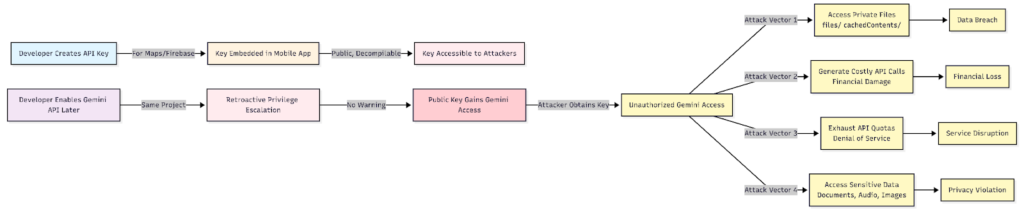
Here’s how the vulnerability unfolds:
- A developer creates an API key for a benign service like Maps.
- The key is embedded in a mobile app (as recommended).
- Later, Gemini API is enabled on the same project.
- The existing key silently gains AI-level access privileges.
No alerts. No permission prompts. No visibility.
This creates a dangerous scenario where a key that was once harmless becomes a fully functional credential for advanced AI services—accessible to anyone who extracts it from the app.
Large-Scale Exposure: What the Data Shows
CloudSEK’s BeVigil platform analyzed the top 10,000 Android apps and uncovered:
- 32 exposed API keys
- Across 22 popular applications
- Total install base exceeding 500 million users
These keys were verified to have active access to Gemini endpoints.
Notably, one app—ELSA Speak—demonstrated real data exposure, where attackers could retrieve:
- User-uploaded audio files
- Metadata (timestamps, hashes, file sizes)
- File access endpoints via Gemini APIs
This confirms that the vulnerability is not theoretical—it has already resulted in live data leakage.
Why Mobile Apps Are Especially Vulnerable
Mobile applications amplify this risk due to several factors:
- APK files are public and easily decompiled
- Hardcoded keys persist across versions
- Developers followed official Google guidance, not bad practices
- Large install bases mean mass exposure of a single key
In essence, every distributed app becomes a public repository of credentials.
Real-World Consequences: Financial and Operational Damage
This vulnerability has already led to severe consequences:
- A solo developer faced a $15,400 bill overnight
- A Japanese company incurred $128,000 in unauthorized usage
- A small team saw costs spike from $180/month to $82,000 in 48 hours
These incidents reveal deeper systemic issues:
- Billing delays prevent timely intervention
- No automatic anomaly detection or spending caps
- API revocation does not instantly stop charges
Risk Breakdown
For Users
- Exposure of personal data (audio, documents, images)
- Unauthorized access to AI-processed content
For Developers
- Financial losses from API abuse
- Service outages due to quota exhaustion
- Legal and compliance risks (GDPR, data protection laws)
Recommended Mitigations
To reduce exposure, developers must act immediately:
- Audit all Google Cloud projects for Gemini API enablement
- Rotate all API keys embedded in mobile apps
- Restrict keys strictly to required services
- Avoid hardcoding keys—use server-side proxies instead
- Continuously scan apps for exposed credentials
Our Opinion
This incident is not a case of developer negligence—it is a systemic design failure. For over a decade, developers were explicitly told that API keys were safe to expose. That guidance shaped industry practices, tooling, and architecture decisions across millions of applications.
By retroactively transforming these public identifiers into sensitive AI credentials, Google has effectively invalidated its own security model—without enforcing safeguards or even notifying users. This violates a core principle of security engineering: never change the threat profile of existing credentials silently.
What makes this especially concerning is the lack of protective controls. There are no enforced key scoping rules, no automatic anomaly detection, no spending caps, and no real-time billing cutoffs. These are not advanced features—they are baseline expectations for any platform offering high-cost, high-risk APIs.
Moreover, the burden has been shifted entirely onto developers, who must now audit, rotate, and redesign systems under pressure—despite having followed best practices at the time of implementation.
In our view, this is a wake-up call for the industry. As AI systems become deeply integrated into cloud platforms, security models must evolve proactively—not retroactively at the cost of users and developers.
