

In recent years, cyber espionage has evolved beyond traditional enterprise-focused attacks. A new wave of campaigns now targets the weakest links in the network chain—home and small-office devices. One such sophisticated operation has been attributed to Forest Blizzard, a threat actor linked to Russian military intelligence. Their latest campaign highlights how seemingly harmless consumer-grade networking equipment can be weaponized into powerful surveillance and attack infrastructure.
Understanding the Threat Landscape
Forest Blizzard has been actively exploiting vulnerable Small Office/Home Office (SOHO) devices since at least August 2025. These include routers and similar edge networking equipment that often lack proper security configurations. By compromising these devices, the attackers manipulate their settings—specifically DNS configurations—to redirect traffic through malicious infrastructure.
This approach allows the attackers to remain hidden behind legitimate, user-owned devices while conducting espionage or launching follow-on attacks. According to Microsoft Threat Intelligence, this campaign has already impacted over 200 organizations and approximately 5,000 consumer devices worldwide .
Attack Chain Breakdown
1. Edge Device Compromise
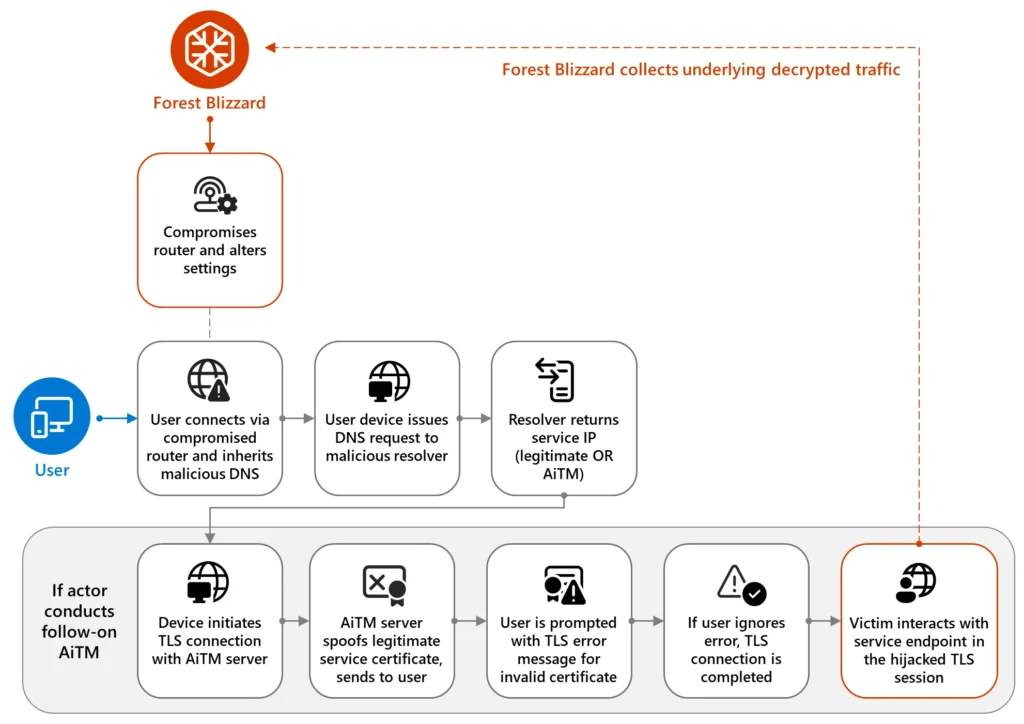
The attack begins with gaining unauthorized access to SOHO routers. These devices are often poorly secured, running outdated firmware or default credentials. Once compromised, attackers modify DHCP settings so that all connected devices use attacker-controlled DNS servers.
This step is crucial because it establishes persistent control over how network traffic is routed, without needing direct access to individual endpoints.
2. DNS Hijacking via Malicious Infrastructure
After compromising routers, Forest Blizzard leverages tools like dnsmasq—a legitimate utility used in many routers—to handle DNS queries. However, instead of forwarding requests securely, the tool is configured to route them through malicious servers.
This enables:
- Passive monitoring of DNS queries
- Mapping of user behavior and network activity
- Identification of high-value targets
DNS hijacking at this scale provides attackers with broad visibility while maintaining a low detection footprint.
3. Adversary-in-the-Middle (AiTM) Attacks
One of the most dangerous aspects of this campaign is the use of Adversary-in-the-Middle (AiTM) techniques. In select cases, attackers spoof DNS responses to redirect users to malicious servers impersonating legitimate services.
For example:
- Victims attempting to access Microsoft Outlook Web may be redirected to attacker-controlled infrastructure
- Fake TLS certificates are presented
- If users ignore warnings, attackers can intercept sensitive data such as emails and credentials
This method allows attackers to bypass traditional security layers and access encrypted communications in plaintext.
Targeted Sectors and Impact
Forest Blizzard’s operations are not random. Their targets include:
- Government organizations
- IT and telecommunications sectors
- Energy infrastructure
Additionally, specific AiTM attacks have been observed against government systems in Africa, demonstrating the campaign’s geopolitical significance .
While not every compromised device is actively exploited for interception, the scale of access provides the capability for widespread surveillance or disruption if needed.
Why SOHO Devices Are a Prime Target
SOHO devices represent an attractive attack surface due to:
- Lack of centralized management
- Minimal monitoring and logging
- Default or weak credentials
- Infrequent firmware updates
In hybrid and remote work environments, these devices often act as gateways into enterprise systems, making them ideal pivot points for attackers.
Mitigation and Defense Strategies
To counter such threats, organizations and individuals must adopt a proactive security posture.
Network-Level Protections
- Enforce Zero Trust DNS (ZTDNS) policies
- Use trusted DNS resolvers only
- Maintain detailed DNS logs for anomaly detection
- Block known malicious domains
Endpoint and Infrastructure Security
- Avoid using home routers in corporate environments
- Enable network and web protection tools
- Regularly update firmware on all networking devices
Identity and Access Controls
- Implement Multi-Factor Authentication (MFA) across all accounts
- Use Conditional Access policies
- Adopt passwordless authentication (passkeys)
- Centralize identity management systems
Advanced Monitoring
- Integrate identity logs into SIEM systems
- Use risk-based sign-in evaluation
- Monitor for unusual authentication patterns
These steps significantly reduce the risk of DNS hijacking and AiTM exploitation.
Our Perspective on the Forest Blizzard Campaign
The Forest Blizzard campaign underscores a critical shift in cyber warfare strategy—targeting the periphery instead of the core. Rather than attacking hardened enterprise systems directly, adversaries are exploiting overlooked infrastructure like home routers, which often lack even basic security hygiene.
This approach is both cost-effective and scalable. By compromising thousands of low-value devices, attackers gain indirect access to high-value targets. It also blurs the boundary between personal and corporate security, especially in remote work environments where employees connect to enterprise systems via home networks.
What makes this campaign particularly concerning is its stealth. DNS hijacking and passive traffic monitoring do not trigger conventional alarms, allowing attackers to remain undetected for extended periods. The selective use of AiTM attacks further indicates a strategic, intelligence-driven approach rather than indiscriminate exploitation.
From a defensive standpoint, this incident highlights the urgent need for organizations to rethink their security models. Trust can no longer be assumed based on network location. Every device—whether corporate or personal—must be treated as a potential risk.
Ultimately, cybersecurity is no longer confined to enterprise perimeters. It now extends into homes, personal devices, and unmanaged networks. Organizations that fail to adapt to this reality risk exposure not through their own systems, but through the weakest links connected to them.
