

he convergence of commodity data-stealing techniques and advanced persistent threat (APT) evasion strategies has given birth to a highly resilient breed of malware. Discovered by Microsoft Threat Intelligence and Microsoft Defender Experts, a Windows-based threat active since February 2026 exhibits an innovative operational design. Tracked under the signature Trojan:Win32/CryptoBandits.A, this malware fundamentally departs from traditional cryptocurrency clippers that rely on exposed, static IP addresses or basic installer bundles. Instead, it utilizes a hybrid architecture combining Windows Script Host capabilities, ActiveX automation, and an embedded Onion routing layer. By blending the rapid self-propagation characteristics of a classic network worm with the silent asset-stripping capabilities of a clipboard clipper, the CryptoBandits threat provides attackers with an enduring, anonymized foothold on infected endpoints, changing the way security analysts evaluate lightweight, script-driven stealers.
Initial Access Vector and Worm Propagation Mechanics
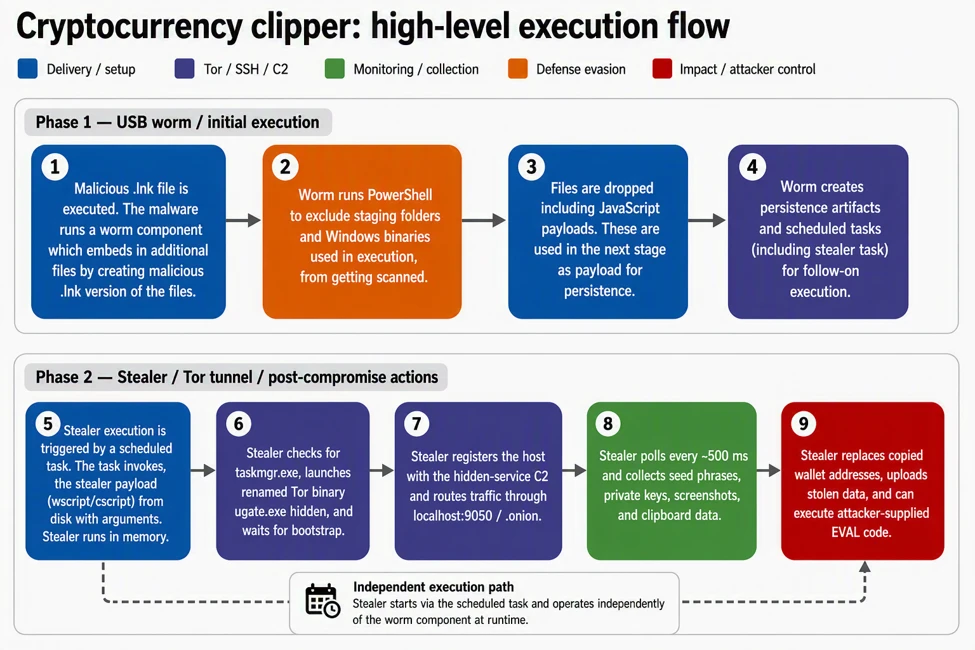
The primary vector for initial exposure relies on removable USB storage media deploying weaponized shortcut (.lnk) files. When plugged into a Windows endpoint, the worm component parses the file system for popular productivity files, specifically targeting extensions like .doc, .xlsx, and .pdf. Upon identification, the malware hides the original assets and generates matching malicious .lnk shortcuts using identical names and icons to maintain a benign facade. When clicked, these shortcuts trigger a multi-stage deployment sequence that launches the worm component alongside the primary data-harvesting clipper. To avoid duplicate overhead, the execution script first checks for existing staging directories. If clean, the core components are pulled over an encrypted tunnel. To fortify its survival against local defenses, the worm automatically establishes folder and binary exclusions within Microsoft Defender Antivirus, ensuring its working directories are systematically bypassed during routine security scans. Persistence is secured through two惊 indefinite scheduled tasks running JavaScript payloads wrapped inside custom XML configurations, ensuring propagation to newly inserted removable media and steady execution of the stealer.
Multi-Layered Evasion and Localized Tor Proxy Infrastructure
Defending corporate networks against CryptoBandits is highly complex due to its multi-layered defense evasion pipeline. The initial setup is orchestrated via a Python installation script protected by PyArmor obfuscation and compiled into a standalone binary via PyInstaller. The underlying payloads consist of two core JavaScript files dropped into dynamically generated five-character subfolders directly beneath the C:\Users\Public\Documents\ directory (such as \omoho\). These scripts utilize a dual-layer string-shuffling and decoder-function design to conceal commands from static scanning engines. Before launching, the malware queries the Win32_Process class via WMI to detect if Task Manager is active; if true, the script instantly terminates execution to evade live triage. If the gatekeeper check passes, the clipper drops and runs a renamed, portable Tor network client called ugate.exe within a hidden window. The script pauses for 60 seconds before establishing a local SOCKS5 loopback proxy listening on 127.0.0.1:9050. By forcing all outbound traffic through this proxy to resolve backend .onion hidden services, the malware entirely bypasses traditional enterprise perimeter DNS filters and localized IP blocking rules.
Command and Control (C2) Lifecycle and Remote Code Execution Hooks
The interaction between the victim machine and the hidden service infrastructure is deeply structured, mapping specific activities to specialized, server-side PHP endpoints. Utilizing a localized curl binary as its primary network driver, the malware encodes authentication strings using a unique victim Globally Unique Identifier (GUID) and a Geolocation IP (GEIP) token passed inside HTTP POST requests. The primary active domain uses designated endpoints across separate execution phases: /route.php handles initial beaconing and command retrieval, /recvf.php acts as an asynchronous pipeline for exfiltrated screenshots, and /stub.php remains open for secondary payload downloads. The actions communicated to the C2 utilize tags like SEED for stolen mnemonics, PKEY for private keys, and REPL to verify address replacements. Alarmingly, the malware contains an interactive remote administration hook embedded within a native routine called checkC2Command. If the backend returns an EVAL response, the script fetches a local file named cfile containing raw attacker-supplied code and executes it directly at runtime, acting as a functional remote access backdoor.
High-Frequency Clipboard Theft and Granular Address Substitution Logic
The true financial threat manifests within a high-frequency clipboard monitoring loop that queries the host API every 500 milliseconds. The malware parses the clipboard contents for specific patterns matching BIP39 12- or 24-word seed phrases, along with Ethereum and Bitcoin Wallet Import Format (WIF) private keys, validating extracted strings against an internal cryptographic word list. Upon discovery, the data is saved locally to a backup file under a GOOD path and continuously transmitted over Tor until server acknowledgement triggers its deletion. Concurrently, the malware triggers a background PowerShell screen-capture loop, capturing five sequential screenshots taken precisely 10 seconds apart to give operators complete visual visibility over account balances and wallet dashboards. For transactional diversion, the malware evaluates copied string values against alphanumeric filters and replaces the victim’s destination wallet addresses with attacker-controlled equivalents. This address replacement logic is fine-tuned per blockchain protocol to maximize deception:
- Bitcoin Legacy Addresses (starting with ‘1’, length 32-36): Replaced with an address matching the first two characters.
- Bitcoin P2SH Addresses (starting with ‘3’, length 32-36): Substituted with an address matching the initial two characters.
- Bitcoin Taproot Addresses (starting with ‘bc1p’, length 40-64): Replaced with an address matching only the final character.
- Bitcoin Bech32 Addresses (starting with ‘bc1q’, length 40-64): Substituted based on matching the trailing character.
- Tron Addresses (starting with ‘T’, length 34): Replaced with an address matching the first two characters.
- Monero Addresses (starting with ‘4’ or ‘8’, length 95): Replaced wholesale with a singular, hardcoded static address.
Enterprise Defensive Engineering and Behavioral Hunting Detections
Because the CryptoBandits malware employs aggressive Antivirus path exclusions (Behavior:Win64/PathExclusion.STA, .STB) and complex script obfuscation, enterprise security teams must look past traditional signature-based detection models. Microsoft Defender XDR identifies various elements of this campaign under specific behavior flags such as Behavior:Win64/ProcessExclusion.ST and antivirus definitions like Trojan:Win32/CryptoBandits.A/.B and Trojan:JS/CryptoBandits.A/.B. To proactively hunt for this threat, network engineers should deploy detection rules focused on unexpected local loopback bindings on port 9050, combined with process-creation logs showing Windows Script Host (wscript.exe or cscript.exe) initiating outbound child processes like curl.exe, cmd.exe, or powershell.exe. From a policy standpoint, organizations should leverage GPOs to block .lnk file execution from removable media and disable AutoRun/AutoPlay configurations completely. Restricting script interpreter permissions and enforcing Attack Surface Reduction (ASR) rules targeting obfuscated script execution and anomalous parent-child relationships will effectively dismantle the infection lifecycle before financial compromise occurs.
Our Technical Analysis and Industry Opinion on the CryptoBandits Campaign
The emergence of the CryptoBandits campaign represents a disturbing yet completely logical convergence in modern threat architecture: the marriage of classic worm-like physical propagation with highly localized network anonymization mechanics. Historically, worm behaviors were the domain of destructive malware or massive botnets, whereas crypto clippers were viewed as simplistic, loud, and easily disposable tools used by low-tier threat actors. By integrating a portable Tor client (ugate.exe) and utilizing local SOCKS5 proxying (localhost:9050), the operators have elevated a basic clipboard-stealing script into an elusive, long-term operational backdoor.
What stands out most to our analysis team is the developer’s sophisticated understanding of human and automated defensive workflows. The granular address replacement logic, tailored carefully to specific blockchain protocols (such as matching the prefix characters of Bitcoin and Tron addresses or the suffix characters of Taproot addresses), demonstrates a deliberate attempt to deceive users who perform cursory visual checks of their transaction inputs. Furthermore, the embedding of the EVAL remote code execution function ensures that this campaign is not just about immediate financial monetization; it serves as a permanent foothold for secondary network access. For modern enterprises, this case serves as a stark reminder that legacy perimeter defense strategies are wholly inadequate. Security teams must pivot entirely toward continuous behavioral monitoring and zero-trust endpoint architectures to contain script-based, proxy-aware threats before they bypass traditional signature-based detection.
