

The rise of AI-assisted development, often referred to as “vibecoding,” is reshaping how software is built. By allowing developers to describe requirements in natural language and receive working code instantly, it significantly accelerates development cycles. However, this convenience introduces a new class of risks. While the generated code may function correctly, it often lacks proper scrutiny, security validation, and ownership clarity.
This report explores how vibecoding impacts software security, highlights the emerging risks, and explains why traditional security practices struggle to keep up with this new paradigm.
Introduction
In recent years, software development has undergone a major transformation. AI tools can now generate production-ready code from simple prompts. What once required hours or days of effort can now be completed in minutes. This shift lowers the barrier to entry and allows teams to move faster than ever before.
But speed comes at a cost. When development accelerates beyond the capacity of review processes, security gaps begin to appear. Vibecoding is not inherently unsafe, but it changes how code is created, reviewed, and maintained, which directly affects security outcomes.
The Core Problem: Speed Over Understanding
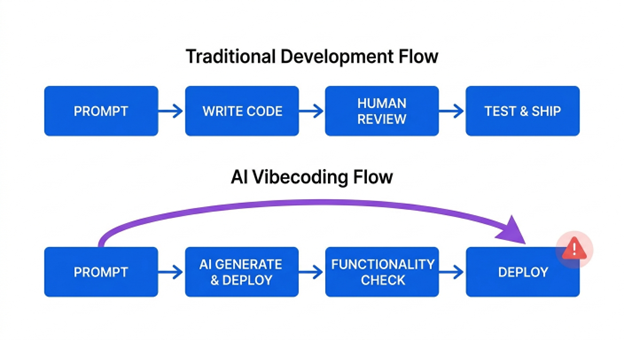
Traditional development workflows include several layers of validation. Developers write code, review it, test it, and often involve peers before deployment. These steps create friction, but they also ensure quality and security.
Vibecoding removes much of this friction. Developers often focus on whether the code works rather than whether it is secure or fully understood. In many cases, the individual deploying the code did not write it manually and may not fully grasp its behavior.
This shift leads to a dangerous pattern where functionality becomes the primary goal, while security is postponed or overlooked entirely.
Expanded Attack Surface Through AI-Generated Code
AI-generated code rarely consists of just the requested logic. It often includes additional elements that developers may not consciously evaluate. These include:
- Hidden dependencies introduced automatically
- Default configurations that may be overly permissive
- Weak handling of sensitive data such as tokens or credentials
- Simplified logic that ignores edge cases and abuse scenarios
Because these additions are subtle, they often go unnoticed during quick reviews. Over time, they accumulate and create what is known as “security debt.”
This debt does not come from a single failure but from many small decisions made under time pressure.
Ownership and Accountability Challenges
One of the less discussed issues with vibecoding is fragmented ownership. While a developer may commit the code, the actual responsibility becomes unclear.
Questions often arise later:
- Who originally generated the code?
- Why was a specific library included?
- Is the behavior intentional or accidental?
When these questions cannot be answered easily, fixing vulnerabilities becomes time-consuming and risky. The lack of clear ownership slows down incident response and increases operational complexity.
Additionally, teams sometimes rely on the same AI tools for both generating and reviewing code. This reduces true independence in validation, creating a false sense of security.
Security Controls Under Pressure
Vibecoding does not eliminate existing security controls. Instead, it overwhelms them. The sheer volume and speed of code generation make it difficult for traditional review processes to keep up.
As a result, organizations face a new challenge: managing continuous and rapid change. The real issue is not just insecure code but the inability to maintain control over what is being deployed.
By the time vulnerabilities are discovered, the code is already in production, and the original context may be lost. Fixing issues at that stage is far more disruptive.
Adapting Security for Vibecoding
To address these challenges, organizations must rethink their approach to security. Instead of relying on manual reviews and late-stage checks, they need to integrate security earlier in the development process.
Effective strategies include:
- Detecting issues early during code generation
- Automating security policies and guardrails
- Ensuring shared visibility between development and security teams
- Embedding security into existing workflows rather than adding friction
The goal is to make security a natural part of development rather than an afterthought.
The Role of Integrated Security Platforms
As development practices evolve, so must the tools that support them. Integrated security platforms are becoming essential because they align with modern workflows.
These platforms connect directly with CI/CD pipelines and development environments, allowing security checks to happen in real time. This ensures that risks are identified before deployment rather than after.
Timing is critical. Security that appears early is seen as helpful guidance, while late-stage alerts are often viewed as obstacles.
Conclusion
Vibecoding represents a powerful shift in software development. It enables faster innovation and lowers barriers, but it also introduces new risks that cannot be ignored.
The organizations that succeed will not be those that avoid AI, but those that understand its implications and adapt their security practices accordingly.
Speed alone is not the problem. The real challenge lies in managing that speed without losing control.
Our Opinion
From a cybersecurity perspective, vibecoding is not a threat by itself, but it significantly amplifies existing weaknesses in development ecosystems. The fundamental issue is not the AI-generated code, but the human behavior around it. When developers trust generated outputs without proper validation, they unintentionally bypass critical thinking and security awareness.
In our view, the biggest concern is the illusion of productivity. Teams feel more efficient because they deliver features faster, but they may be accumulating unseen risks. This creates a false sense of progress while silently increasing technical and security debt.
Another important concern is accountability. When ownership becomes unclear, security incidents become harder to investigate and resolve. This lack of traceability can have serious consequences in regulated environments.
However, vibecoding also presents an opportunity. If organizations redesign their security models to match this new development style, they can achieve both speed and safety. Embedding automated security checks, improving visibility, and enforcing strong governance can turn vibecoding into a secure and scalable practice.
Ultimately, the future will not be about choosing between speed and security, but about integrating them effectively.
